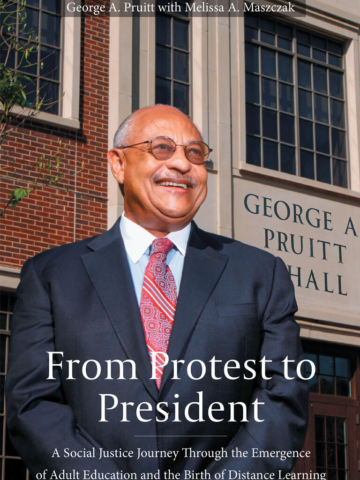
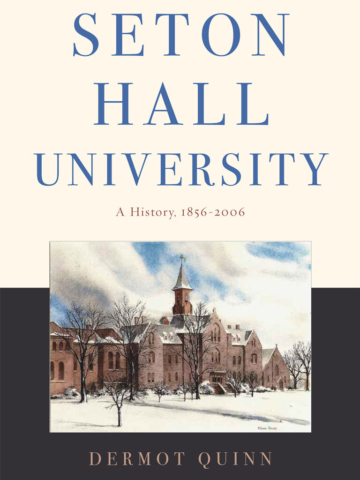
Rutgers University Press has recently released two books that tell the story of individuals involved with two New Jersey universities.
And despite some obvious differences, both reflect something that has been part of the American — and New Jersey — experience: prejudice.
“From Protest to President: A Social Justice Journey through the Emergence of Adult Education and the Birth of Distance Learning” is the personal story of George S. Pruitt, former president of Thomas Edison State University in downtown Trenton.
As he notes early in the book, “On October 7, 2017, I sat in a crowded but elegant ballroom at The Palace at Somerset Park, New Jersey, and listened as former governor Tom Kean provided remarks in my honor. The occasion was a gala to celebrate my retirement from the presidency of Thomas Edison State University after thirty-five years in office.
“As I gazed across the ballroom filled with colleagues, friends, and family and listened to the generous words echoing from the stage, I couldn’t help but marvel about what a long way this was from my grandparents’ home in Canton, Mississippi, where I was born, or the South Side of Chicago, where I grew up. I never thought about a career in higher education.”
Part of the reason, writes Pruitt, was that “as long as I could remember, I was set on becoming a medical doctor.”
Another was the environment that went beyond physical place. As an American of African ancestry notes, Pruitt writes, “In the ’40s, ’50s, and ’60s, Chicago was the second largest city in the United States and the most segregated, with the largest concentration of Black people in the country. The Great Migration brought millions of Black people north to escape the segregation, violence, and oppression of the South and to seek economic opportunity in the cities. New York had over three times the population of Chicago, but with around the same number of African Americans, who were scattered among the city’s five boroughs. In Chicago, they were segregated in the city’s sprawling South Side.”
He then puts his story in the context of his family and their experiences:
“My father, Joseph H. Pruitt, lived in Chicago and worked for the Illinois Central Railroad, where he met my mother, who was a passenger on his train. After a brief long-distance courtship, they were married in my grandparents’ living room in Canton in July 1940 and caught a train to Chicago that afternoon to begin their lives together.
“While my father worked on the railroad, he put himself through the Worsham College of Mortuary Science at night and became a licensed funeral director and mortician the year I was born. Dad ran on the railroad between Chicago and New Orleans and conducted funerals when he was in town.
“Though my mother, aunts, uncle, and cousins were all born in Canton, my aunt Daisy would lose her life there. Daisy Carmichael Abram was beautiful and bright with an effervescent personality. About two years after her son, Percy, was born, she was expecting her second child. One day, she was sitting at the kitchen table when, suddenly, she belched up a glob of bright red blood. She called Uncle Doc, and he immediately recognized that she was bleeding internally.
“He put her in his car and raced to the hospital in Yazoo City about thirty miles away. He drove straight past the White hospital in Canton because he knew they would not have treated her. When he finally got to the hospital, they didn’t have enough of her blood type. The closest blood bank for Black people was in Jackson, about fifty miles away. He left her at the hospital and raced to Jackson. By the time he returned, Aunt Daisy and her unborn child had both died.
“I don’t know what was on the death certificate, but being Black in Mississippi was the real cause of death for my aunt Daisy and cousin. They died three years before I was born, but my family and I have never gotten over the pain of their deaths and its attendant rage.”
“From Protest to President: A Social Justice Journey through the Emergence of Adult Education and the Birth of Distance Learning,” George A. Pruitt, 344 pages, $29.95, Rutgers University Press.
In “Seton Hall University: A History, 1856-2006,” Seton Hall history professor Dermot Quinn tells the story of how a major New Jersey education institute was created to address the oppression of another group: Roman Catholics.
The school is named in honor of Elizabeth A. Seton (Bayley), who in the late 18th century married into a well-established and aggressive merchant family and enjoyed a place in Manhattan society.
However, due to personal losses and choices, she converted to Catholicism, a faith that was despised in her former circles and associated with immigrants and the poor.
As Quinn notes, “Conversion brought (Seton) social isolation, loss of friendship, and an entirely new way of life. New York had few Catholics and none who frequented the drawing rooms where once she moved. The failing (family) business meant a move to a smaller house. She survived by teaching,” first in New York City and then in Baltimore, where she established a school for Catholic education.
Quinn, who also is the author of the Rutgers University Press publication “The Irish in New Jersey: Four Centuries of American Life,” writes that it was in 1856 when “James Roosevelt Bayley, Roman Catholic Bishop of Newark, founded a school in Madison, New Jersey, calling it Seton Hall College in honor of his aunt, Elizabeth Ann Bayley Seton.
“The name was a gesture of piety and a statement of intent. By honoring the greatest promoter of Catholic schools in early nineteenth century America, Bayley wished to continue her work of building American Catholicism through education, charity, and moral instruction. The new school was thus, in various senses, an act of faith. In the first place, it kept faith with a remarkable woman. In the second place, it promoted a particular faith, Roman Catholicism, and a particular people, the Catholics of New Jersey. Seton Hall was to cater to a new flock spiritually and socially, giving it a place in the world and, perhaps, in the world to come.
“As Catholicism took root in America, it needed such practical theologies of bricks and mortar. Bayley’s diocese, only three years old in 1856, was mission territory. His people were poor, unsophisticated, and unlettered, mainly immigrants and laborers with a handful of businessmen and professional people thrown into the mix. Immigrants held to their Catholicism as a living faith or as a diminishing memory of the world they had left behind. Not much higher up the social scale, business people were also condescended to by Protestants. It took imagination and courage to see in this unpromising terrain a future harvest. Bayley had both. Seton Hall was the seed and fruit of his vision in the thin soil of mid-Victorian New Jersey Catholicism, he built more than a school. He built a people.”
Seton Hall University: A History, 1856–2006, Dermot Quinn, 568 pages, $39.95, Rutgers University Press.