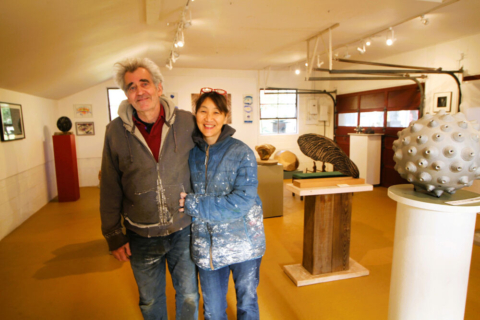
Sculpture can be more difficult to exhibit due to its size, weight, transportation, and the need to be shown from all angles.
Established Hopewell sculptors Ayami Aoyama and Rory Mahon have created a solution to transporting and showing their work in different venues and galleries.
The couple, married 21 years, converted a previous workshop to a 900-square-foot gallery space that showcases both their work.
The yet-unnamed gallery is on their five-acre property in Pennington. The gallery was the couple’s idea and came about quickly, going from cluttered garage-workshop to professional-looking gallery in less than one year.
“We were showing work to potential clients on folding tables. It just wasn’t a proper set up,” says Mahon.
The artists and their new gallery were a stop on the Tour Des Arts of Hopewell this past September. Thirty artists open their Hopewell and Pennington studios to the public in the two-day self-guided event to show and sell their work. While many artists are clustered in downtown Hopewell and are primarily a walking tour, the Aoyama and Mahon estimate they had about 30 visitors and seemed happy with that.
“It was a good turnout and gave us a chance to show the gallery space and entertain the visitors. We were happy and think everyone enjoyed the new gallery space,” Aoyama said.
The gallery on their property at 1423 Trenton-Harbourton Road, Pennington, is open to the public by appointment. Arrangements can be made by contacting Mahon at 609-477-4424. Mahon shares that he is working on a quarter-mile sculpture trail on the property that will be opened in the spring.
The couple and their two sons have plenty of room on the property. There is the main house, gallery space, an older studio, a new light-filled casting studio, and Aoyama’s painting studio. All are warmed by wood stoves and are used year-round. There are also a few other outbuildings, storage of materials, and an endless army of power hand tools, hoists, drill presses, lathes, and projects in progress.
“We have everything we need here,” Aoyama says.
Aoyama works in stone. Her work is nature based and can suggest shapes and patterns found all around us.
“I love the stone,” she says. “I tried other different materials, but I really love the stone. When I first understood the carving and polishing of the stone, it was like falling in love.”
When asked what her favorite stone to work with is, Aoyama replies, “Granite. It is the best. There are so many kinds of granite to work with.”
When both Aoyama and Mahon speak of their artwork, the other waits and listens respectfully. Even though they know each other’s processes, they take time to hear and listen to each other describe it. The mutual admiration is evident in both the process and the finished products.
Mahon works in metal, mostly bronze, using the sandcasting technique. Simply described, molten metal is poured into a hollow cavity made in specialized sand. When the metal is cooled the sand forms are removed, leaving the casting.
Sand casting does not offer immediate results. It is a lengthy process that requires many skills such as creating the form that will eventually be cast in sand, knowledge of metallurgy, and the experience to perform the process.
After the casting comes out of the mold there is the finishing of the piece, which involves interacting in some way with the metal to achieve the desired finish. This step can be very time-consuming and labor-intensive.
Mahon came to the area after growing up in Queens, New York. His mother was a homemaker. His father was head bartender at the Regency Hotel in Manhattan. Mahon graduated from Cooper Union in Manhattan.
The recently graduated Mahon came to the Princeton-Trenton area after he was given a little direction by one of his professors.
“I was sitting at McSorley’s Old Ale House, which was around the corner from the Cooper Union, talking with teacher Reuben Kadish, who was a well-known sculptor — he taught art history and sculpture at Cooper Union. Kadish said he heard of a sculpture center opening up in Princeton, New Jersey, and maybe I should check it out.”
This was when the Johnson Atelier was on Alexander Road, before moving to its current location on Sculptor’s Way in Hamilton.
“It was really the tip that changed my life. Those early years were the golden age of the Johnson Atelier. We were doing contract work for some very famous sculptors, such as George Segal, Red Grooms, Georgia O’Keefe, Kiki Smith, and Julian Schnabel,” says Mahon.
At its peak the Johnson Atelier employed more than 100 people. One of the benefits of working at the atelier was that the employees could work on their own projects after hours. It was not unusual to see almost the entire staff working into the night on their own work.
Aoyama traveled a longer path. The daughter of a stay-at-home mother and police detective father, she studied art in her native Japan and earned her degree in painting at Aichi Prefectural University of Fine Art and Music in Nagoya. Coming to the U.S. in 1996, she studied at the Arts Students League in New York, among other schools. Aoyama became more interested in sculpture, and in particular, stone carving. Again, an instructor pointed a student toward Johnson Atelier. That was the late, nationally known, Roosevelt, New Jersey-based sculptor Jonathan Shahn.
She joined the Johnson Atelier apprentice program in the stone division. Though the casting department and the stone division were very separate, this is where she crossed paths with and eventually partnered with Mahon.
Aoyama has exhibited widely in the New York, New Jersey, and Pennsylvania area with gallery and museum shows. She currently works for Antiquity Stone as a finishing supervisor, with her team working on stone sculptures for world famous artist Jeff Koons. You can see Aoyama on a 2023 episode of “60 Minutes” talking about a recent Koons project that had 33,000 people hours of hand polishing and how challenging the finishing of stone sculptures can be. “It is stressful as at any time a slip up can damage or ruin the artwork,” she says.
Talking about his other work, Mahon says he has stepped back from a recent job as an art handler at Princeton Art Museum. “I was working ‘part time’ — up to 32 hours a week. I am trying to do more of my own work and less work for others. It was great at the Princeton Museum, I mean they have such an impressive collection, that they only have room to show a fraction of, due to not enough wall space.”
Mahon was also on the team that in 1980 fabricated the mammoth, 70-foot-long sculpture “The Awakening” by Seward Johnson. The sculpture shows a giant emerging or freeing himself from the earth. With an open mouth and clenching fingers, the iconic piece was originally installed in Hains Point in East Potomac Park outside of Washington, D.C.
A version of “The Awakening” is temporarily located in Johnson’s adopted hometown of Hopewell and will be there for the next year.
Currently, Mahon primarily does casting for one client, internationally known New York-based artist Julian Schnabel. “Working for Schnabel fills my schedule. He is a good client and a wonderful artist,” says Mahon.
Aoyama and Mahon will also be showing work in a group exhibition at the Pennington School’s Silva Gallery in January. The show, “A Community of Artists,” features work by several other regional artists once part of the Johnson Atelier: le Corbeau, Gyuri Hollosy, Harry Gordon, Wendy Gordon, Eric Schultz, Dana Stewart, and Ivia Sky Yavelow. The show runs through Friday, February 2, with a reception on Thursday, January 11, from 6 to 7:30 p.m.
Aoyama is also revisiting her love of painting. She has a separate studio where she is pursuing large-scale paintings of cityscapes with traditional Japanese leanings. The vertical cities are reminiscent of Japanese prints that show the “Floating World” of the period when Japan was largely cordoned off from the rest of the modern world. This style was very influential on European artists in the 1800s, when they were finally seen by the outside world.
These larger paintings will accompany the paintings she is already exhibiting on the walls of the gallery here.
Along with the free-standing sculptures by both artists surrounding their new gallery, the property is a small sculpture park that showcases their own work as well as the work of others that are part of the couple’s collection. Three bells cast by Mahon hang in various locations on the property supported by posts and lintels. Each bell has a different theme. One has all natural elements from the property such as certain species of tree leaves and fruits found nearby, fashioned in bronze and sounding in perfect tone.
The need as artists to find exhibition space to showcase their work has been solved by these two experienced artists. They created their own space. They are showing their work by appointment and plan to start having small gatherings in the spring. When working in stone and bronze the work takes patience but the results are enduring.
Pointing at some sculpture surrounding them, Mahon says, “Look at these, the pieces will be here for a thousand years. More!”
Aoyama and Mahon’s gallery is located at 1423 Trenton-Harbourton Road, Pennington, and open to the public by appointment by calling 609-477-4424.
A Community of Artists, Silva Gallery, Pennington School, 112 West Delaware Avenue, Pennington. Opening reception Thursday, January 11, 6 to 7:30 p.m. On view through February 2. Public exhibition hours are Thursdays, January 18, January 25, and February 1, 5:30 to 7 p.m. Scheduled appointments are available Mondays through Wednesdays from 10:30 a.m. to 6 p.m. 609-737-4133 or www.pennington.org/arts/silva-gallery-of-art.
For more information on the artists Aoyama and Mahon, visit aaoyama.com and rorymahon.com.