Pick a crisis, any crisis will do. There are many to choose from, currently.
So much bad news is brewing — and our exposure to it seems ever more constant — that it seems difficult to escape and even breathe sometimes, let alone feel a sense of peace.
Here is where deliberate quietude and reflection can work wonders. Sound meditation can be an especially therapeutic route if you allow yourself to absorb its curative characteristics.
There are more and more sound healing modalities offered commercially, such as sound baths with crystal or brass bowls, tuning fork sessions, as well as any number of apps and downloads that offer meditative and natural sounds.
However, there is something about hearing the human voice in song and chant that intuitively provides the most direct and compassionate sense of connection, a healing that goes into our very collective unconscious.
What better place to bring the healing power of song and chant than a sacred space, such as the Princeton University Chapel?
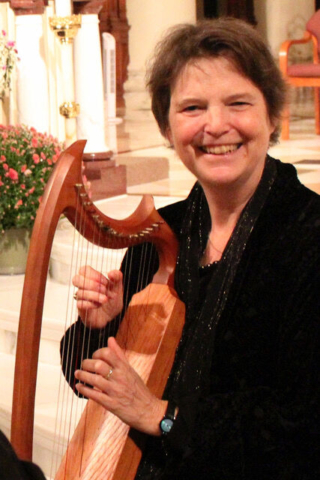
Each month, the office of Religious Life at Princeton University offers Sound Journey with Ruth Cunningham, a soothing hour of sound and song, held within the splendid surroundings of the university’s chapel. Cunningham, a founding member of the world-renowned vocal ensemble Anonymous 4 and a sound healing practitioner, offers composed and improvised music for meditation, contemplation, and prayer.
Cunningham, who lives in Inwood (Upper Manhattan), reached out to Rev. Alison Boden, dean of the Office of Religious Life and the Chapel, and suggested she might bring her healing skills to Princeton. The two had met after an Anonymous 4 concert and had kept in touch for years.
“Ruth Cunningham has been a friend of mine for 30 years and a friend of the Princeton Chapel for the last six,” Boden says. “We are so glad that we can bring her extraordinary music and presence to our community. Her voice fills our magnificent space so perfectly. The stone walls’ reverberations are beautifully suited to the timbres of Ruth’s extraordinary voice. The richness and simplicity of her tone creates the ideal conditions for participants truly to go on their own ‘sound journey.’”
“I look forward to each one and the chance to meditate in a setting of such auditory beauty,” she says. “They are quieting, settling, deepening experiences for me, and others who attend tell me that the same is true for them.”
Unlike “sound bath” sessions where a practitioner creates the sounds and the patient is just listening, participants in the monthly Sound Journeys can find their own special meditative place — and can actually participate.
“We’ve learned to tune out sound, but this is kind of the opposite: It’s active listening to music, even listening to only one note,” Cunningham says. “Just listening to that one note helps people settle in, get a sense of who they are, and where they are.”
“The Sound Journey does quiet people down, may even put you to sleep — which is OK, take from it what you need,” she says. “I don’t know what my music does for you or to you, but if it affects you, that’s great. It’s a time to receive.”
She reflects that music can create a space or a kind of container, “…and this container can relax you, bring you to tears, can make you smile or whatever, if you allow yourself to settle into it.”
For the November Sound Journey, Cunningham was a one-woman band, singing, humming and chanting, playing a miniature harp and wooden flute, sounding a lovely chime, and accompanying herself with a shruti box — an Indian drone box related to the harmonium.
People quietly filed into the chapel, mostly seating themselves in the chancel — the area of the church that’s behind the pulpit — amid the sculpted wood. A few chose to sit in the chapel’s main space, but it really didn’t matter where you sat; the sound was magnificent everywhere.
Cunningham invited us to join her in humming a single note, to center ourselves and be aware of our breathing. From there she took the participants on a multi-cultural sonic journey, singing and chanting in English, Latin, and Sanskrit.
Her melodies are either written chants from decades of learning and performing this music, or sometimes she just improvises.
“Give me a drone (note) and I can make up a chant,” she says. “Or give me a text and I can create a prayer in the moment and also improvise on syllables.”
She goes into each Sound Journey with an idea for a theme, sometimes related to the liturgical calendar, to a certain saint, or sometimes just related to what’s happening in the world at the moment. The November 8 Sound Journey’s theme was peace, taking a step back from the news of the ongoing wars around the world.
That night Cunningham sang an especially beautiful peace prayer in Sanskrit and also included one in English created by her sister, Elizabeth, “peace in each breath, peace in my heartbeat.”
As the atmosphere settled deeper into contemplation, Cunningham walked through the chancel chanting and shaking a wind chime, which gave off an enchanting sound. She then sat at the piano and accompanied herself, as her chant swelled to a kind of wail, almost keening, encapsulating a kind of collective grief.
Cunningham first began offering healing song and music at Saint Paul’s Chapel in New York City, from 2001-2002, after the 9/11 attacks. She was among the musicians to offer healing services there for the families of the missing and deceased, police, fire, and emergency workers, as well as search and rescue personnel — those working on “the pile.”
“I played harp and piano and sang, and it was an amazing space to be in,” she says. “Families were mourning, or people were resting, workers were eating or relaxing after a long shift. Again, it was music as a space or container. The music just really did something, it really helped at such a powerful time. I’m glad I got to participate in that.”
Growing up Milbrook, New York, in a family that loved sacred music (her father was an Anglican minister, her mother sang in the choir), Cunningham has sung since age four and played instruments since childhood, as well.
“I played a lot of music as a teenager and was very interested in Baroque flute and recorder,” she says. “From age 14, I knew I wanted to play professionally.”
Cunningham received a bachelor of music in performance of early music from the New England Conservatory of Music and taught recorder and Renaissance flute at the Amherst Early Music Workshops for 16 years. She is certified as a cross cultural music healing practitioner by the Open Ear Center, where she studied with Pat Moffitt Cook.
With Anonymous 4, Cunningham performed in concerts and festivals throughout the United States, Europe, and the Far East and made 13 recordings, including David Lang’s “Love Fail” and Richard Einhorn’s “Voices of Light.” Cunningham’s own releases are “Light and Shadow: Chants, Prayers and Improvisations,” and “Harpmodes: Journey for Voice and Harp.”
She has released two CDs of multi-faith chants with colleague Ana Hernandez: “Blessed by Light” and “HARC: Inside Chants.” Among her other recordings are “Sacred Light” with harpist Diana Stork (At Peace Music), and “Ancient Beginnings,” which is part of the Open Ear Center’s music for healing.
She is also featured on “Invoking the Muse,” a work with frame drummer Layne Redmond on the Sounds True label.
In addition, Cunningham has been the musician for a number of summer courses for Ubiquity University in Chartres, France. She has also performed and recorded with the Renaissance vocal ensemble Pomerium and is a regular member of the professional choir of the Church of Our Savior in New York City.
All the while, Cunningham has kept a busy schedule as a freelancer, mostly as a church musician.
“There’s always a church ‘job’ somewhere every weekend,” she says. “But I still have time to do the sound healing, I have the training, and it all worked out.”
“I love the work I’m doing now as a musician and a sound healing practitioner because it uses all the skills I have worked on throughout my life — singing, flute playing, keyboard, harp as well as spiritual practices that I have engaged in for many years,” Cunningham says. “When I work with people, I encourage them to use music more consciously and especially to use their own voices as a tool for transformation, healing and connection to spirit.”
“Music, sound, and vibration are amazing tools,” she says. “I think in times to come, people will realize more and more what a powerful gift they are for both healing ourselves and our planet.”
Sound Journey with Ruth Cunningham, Princeton University Chapel. Wednesday, January 17, 5:30 to 6:30 p.m. Then on the first Wednesday of the month: February 7, March 6, April 3, May 1. Free and open to the public. chapel.princeton.edu.
Ruth Cunningham on the web: www.ruthcunningham.com.