
In theatrical inventiveness, ingenuity, gymnastics, energy and fun, the Princeton Summer Theater production of Patrick Barlow’s “The 39 Steps” rates high marks.
Characters called Clown 1 and Clown 2 (Joe McLean and Jordan Rashdan) live up to the billing, reveling in broad humor, flamboyant parody and comic aplomb while Shaelin McKenna basks in an assortment of femmes fatales, and Jacob Schorsch adds a series of droll reactions and takes to his role as the hero relied on for a tinge of seriousness among the vaudeville.
Even Florencia Curchitser’s lighting accelerates the amusement director Erik Bloomquist choreographs so carefully. A silhouette of biplanes chasing focal character Richard Hannay (Schorsch) while his dialogue notes he’s running north by northwest is one of several gems.
But — and this is a big one — while orchestrated mayhem became the raison d’etre for staging “The 39 Steps” after Barlow rewrote a spoof by Simon Corble and Nobby Dimon of Alfred Hitchcock’s 1935 pre-World War II thriller and made it a decade-long hit in London and then the world, there’s an obverse side to Barlow’s script.
Mystery. The aforementioned thriller Hitchcock adapted from John Buchan’s 1915 novel referred to German spying within Britain during World War I, but Hitchcock used it presciently to underscore Nazi menace in 1935. It is an intense story of espionage, constant danger, and nail-biting captures and escapes.
That has to be on the stage alongside the spoof, distinctly in spite of it. Creative goofing is entertaining. It has been since Og did a fake Dick Van Dyke-ish tumble over a rock and set his fellow cave dwellers roaring with laughter. “The 39 Steps” provides more. It carries a genuinely interesting mystery within its story, a mystery that has to emerge and claim equal time to any hijinks, clever or hilarious as they may be.
Since first seeing Maria Aitken’s original production of Barlow’s “The 39 Steps” at London’s Criterion Theatre in 2006 (and again in 2009), I’ve seen probably three dozen stagings at venues ranging from major regional houses to larky basement operations. I’d say directors batted one for eight (.125 average) in meshing comedy with intrigue. I also admit it took me a few minutes to notice Aitken was staging a comedy, though Barlow’s participation should have been a giveaway, in 2006.
Erik Bloomquist meets “The 39 Steps’” fish-or-fowl challenge halfway. Well, maybe 60/40, with the edge going toward clowning. His first act leans decidedly toward broad comedy, with McLean and Rashdan given seeming carte blanche to go for laughs, which they do with limber relish, although the most impressive bit of physical legerdemain was Schorsch wriggling from beneath the entwined corpse of McKenna’s Annabella Schmidt to get Hannay’s cross-Britain adventure started.
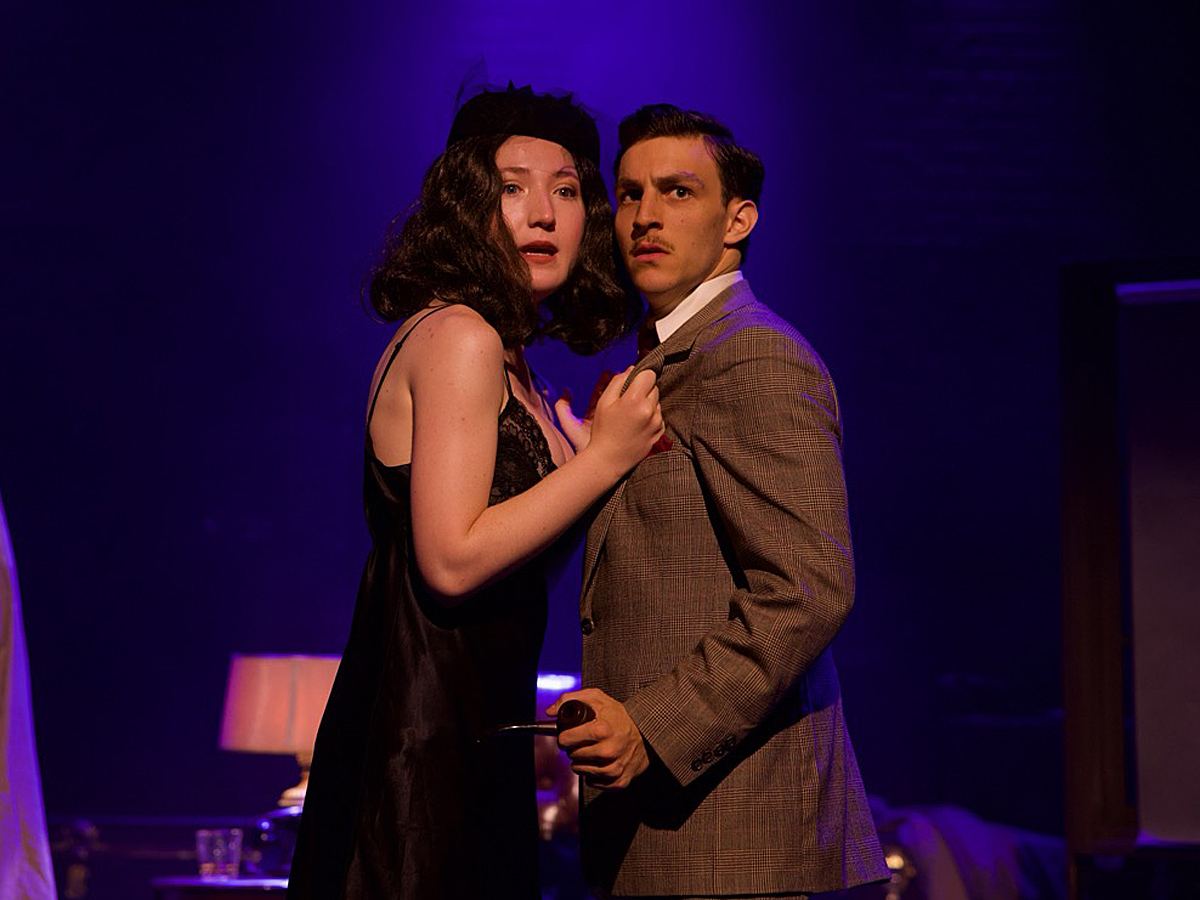
In that wriggling sequence, Schorsch defies bodily limitations. McLean and Rashdan make a dedicated habit of doing that, twisting themselves into and out of a string of complex poses but being funnier when they exaggerate or parody a character, usually a woman, who could be played straight but who flounces, makes moues, winks, falls, becomes clumsy or flirts with ardent but hopeless abandon.
Meanwhile, Hannay is fighting for his personal freedom, having been accused by circumstantial evidence of killing Schmidt and, more importantly, of having been entrusted with information about a plot Nazi sympathizers are hatching. He must stay at liberty while using skills he developed in Britain’s diplomatic corps to find out if Schmidt was on the level about a German cell operating on British soil.
Spotlighting Hannay’s plight is where Bloomquist’s “The 39 Steps” needs more effort. The joking, including myriad Hitchcock references, some supplied by Barlow, some improvised by Bloomquist and company, becomes theatrically infectious and completely overshadows Hannay’s authentic mission to absolve himself and prevent Nazi incursion.
A marriage between farce and gravitas is possible. When Schmidt, for a number of reasons, is brought back to Hannay’s Portland Place flat after an incident Schmidt initiates causes panic in a London music hall, it is clear they are being tailed by a couple of men visible from Hannay’s window.
This is a time to relax humor and let the sinister prevail. The vigilant men do not seem threatening. Hannay can dismiss them and assume control of his and Schmidt’s situation, one that will prove more dire than he estimated.
Suspense in small doses would go a long way in tempering the comic aspects of “The 39 Steps” and bring the audience back to momentary reality before bathing them in McLean and Rashdan’s deft tomfoolery.
It would provide clarity that eludes Bloomquist’s first act. Familiar with the story, I knew where to look and spot clues. It’s a good thing because while fun abounded, confusion did as well. The PST stage was so active, perhaps delightfully active, “The 39 Steps’” main thread became too thin and obscured to be readily seen. Hannay was one more cog in a funny but camouflaging comic barrage.
This hiding of a story’s heft behind its comedy has become epidemic. The 2006 success of “The 39 Steps” triggered a series of mysteries, especially those involving Sherlock Holmes, couched in clowning. Some of “The 39 Steps’” offspring barely attempt anything serious or involving.
“The 39 Steps” does. Or can. Bloomquist and company prove they know that by a second act that gives Barlow’s script more even play, perhaps even tipping the scale toward Hannay’s mission.
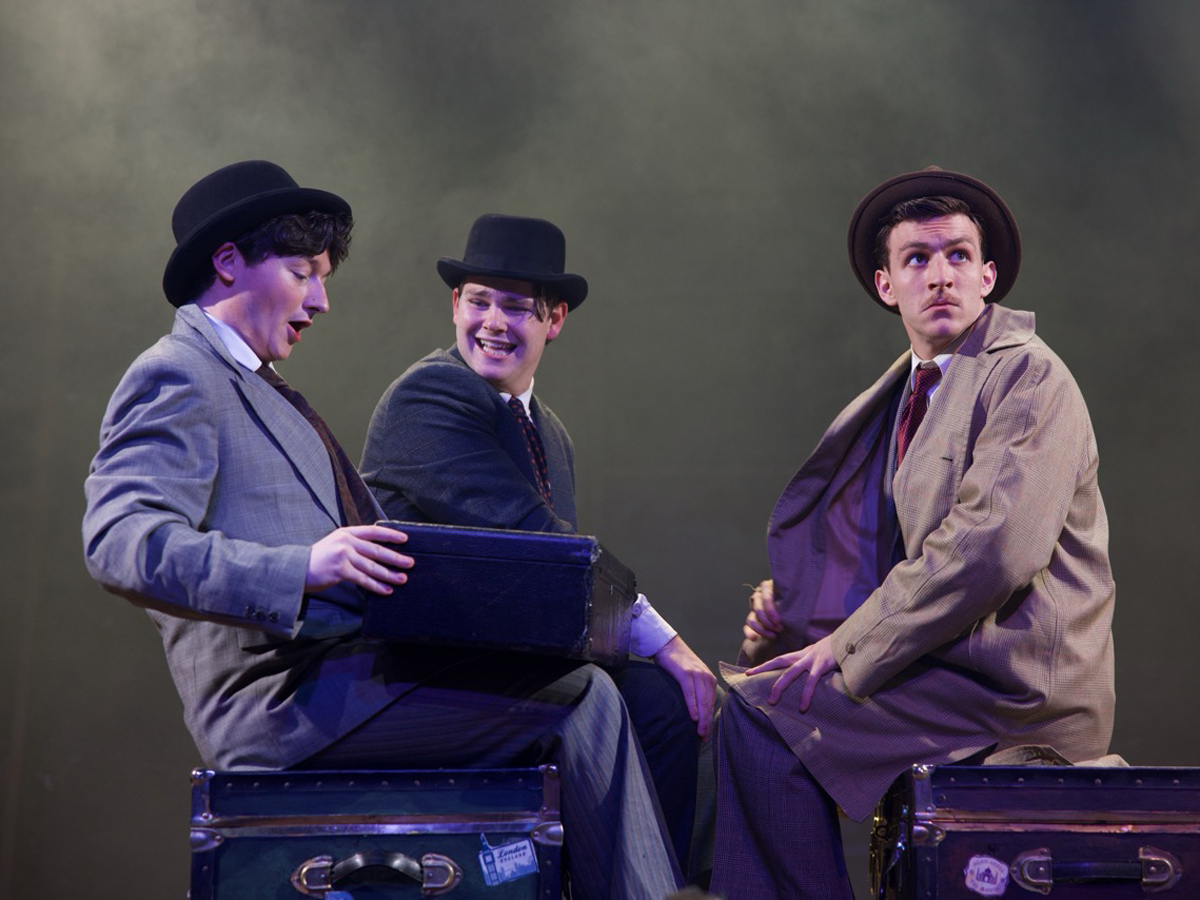
Suddenly, a sense of urgency emerges. As Hannay learns more, and Bloomquist puts more focus on plot, the consequences of Hannay failing in his attempt to clear his name and expose a dangerous spy ring take dramatic hold. Texture replaces sporadic nods to a situation that threatens a man’s liberty and a nation’s security.
Luckily, this emphasis on Hannay solving a conundrum and realizing how to share his knowledge with the authorities who want to arrest and hang him comes in time to make Bloomquist’s “The 39 Steps” involving and even exciting.
The worry is whether the audience, which had every reason to get lost or lose interest during three-fifths of the production, can change gears and pay closer attention once Bloomquist’s production does.
My verdict is it can’t. Which is a shame because the recovery is remarkable.
Jacob Schorsch is a Richard Hannay worth watching even while his character seems to be the production’s second thought.
Schorsch has the burden of keeping “The 39 Steps” on a serious plane while being part of its slapstick. He does so with wit he lends to his character.
Schorsch’s Hannay is always thinking, always aware, always mindful of what is at stake for him and England. While that means having to sort out a ton of information comedy is obscuring, it also means having to fit into and accept situations that involve mental dexterity and the ability to play along to survive.
It also means Hannay makes mistakes along the way, by unknowingly trusting a scoundrel or misinterpreting what appears to be obvious. Schorsch handles these incidents with the intelligence that is Hannay’s core. He visibly acknowledges his error and recovers to move ahead with further investigation and next steps.
Joe McLean and Jordan Rashdan are ready for any music hall. Individually and together, they are a cornucopia of elemental and shrewd comic devices. I’d have been thrilled if they followed curtain calls with a rendition of Cole Porter’s “Brush Up Your Shakespeare.”
Rashdan obviously loves clowning. His eyes sparkle when one of his thousand characters is most mischievous or comically salacious. He has several breakout moments, the top three being a political committee chairman who speaks inaudibly while introducing a keynote guest, a female Scottish innkeeper whose accent is so strong she is unintelligible to anyone unfamiliar with deep brogue, and Mr. Memory, a music hall performer whose specialty is spewing facts on request. As Mr. Memory, Rashdan brilliantly pulls off something beyond one’s understanding of all an actor can do. In double time, he rattles off the main information that proves Hannay’s innocence and the Nazi threat to Britain.
I could cite a dozen more examples of Rashdan’s gifts. He’s a comic whirlwind.
Joe McLean also finds freedom in giving humorous sides to nefarious characters. His spoofing helps to throw Hannay and “The 39 Steps” off crucial scents, McLean entertaining even as he is throwing Hannay or England to the Nazi wolves.
Like Rashdan, to whom he can be Laurel or Hardy but always a symbiotic partner, he enjoys his moments in drag. He also is of a size that lends threat to scenes that require it.
Shaelin McKenna’s roles are thankless next to the range her castmates enjoy, but she manages the enigmatic character of Annabella Schmidt and the hauteur of a confidante Hannay meets on a train with skill that demonstrates her versatility.
Jeff Van Velsor designs another perfect set for PST by centering action in a playing space that resembles a small theater while grand walls entirely fill stage left and right. Quick action by “The 39 Steps” cast transforms the compact space into everything from Hannay’s cramped bedsitter to a Scottish inn and posh vestibule.
Costumers Alex Conroy and Didi Vekri have a field day providing McLean and Rashdan layers they can remove or enhance to meet a role while giving Hannay appropriate tweeds and McKenna gowns that are exactly right for whatever woman she’s playing.
Florencia Curchitser is a co-star of the production, creating effects that are frequently comic or intense. Kirk Longhofer is as adept with a panoply of sounds that establish location and cause tension.
“The 39 Steps” runs through Saturday, July 18, at Princeton Summer Theater in the Hamilton Murray Theater on Princeton’s campus, the best entry from Nassau Street being just across from Labyrinth Books. Showtimes are 7:30 p.m. Thursday through Saturday and 2 p.m. Saturday and Sunday. Tickets are $35 for evening performances and $30 for matinees. They can be obtained by visiting princetonsummertheater.org.
