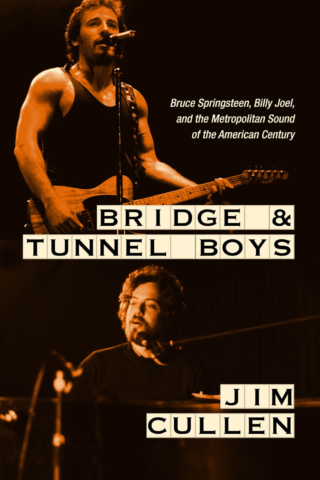
As the opening of Jim Cullen’s new Rutgers University Press book, “Bridge & Tunnel Boys: Bruce Springsteen, Billy Joel, and the Metropolitan Sound of the American Century,” makes clear, it is a book that asks “What makes a piece of popular culture count as popular? How is success measured? And why — and of what — were Billy Joel and Bruce Springsteen icons?”
Let’s start with an answer regarding the title’s bridge and tunnel.
As the Queens, New York, native author of “1980: America’s Pivotal Year” and “Born in the U.S.A.: Bruce Springsteen and the American Tradition” notes, “The phrase refers to the fact that those who live on the periphery of Manhattan — which, as everyone knows, is really the heart of New York City — must cross bodies of water by ferry, rail, or car to reach the island, though its connotations extend more widely.”
Yet, as he continues, there’s more. “It’s not a nice term. But it’s a highly elastic one in which the disdain stretches in more than one direction. These days, one often hears it in the context of Broadway culture — theater insiders who lament the bland tastes of suburbanites who flock to dismayingly middlebrow musicals instead of more challenging fare, predilections all the more galling because the city’s theatrical culture depends on the economic infusions those suburbanites provide.
“But condescension takes on other forms as well. The bridge and tunnel crowd is not simply lacking in taste or wealth; it also evinces a host of other vices for which contempt, veiled or not, is understood to be justified. Environmental despoliation. Selfish fiscal libertarianism. And, of course, racism.”
They also buy tickets and recordings, so, as Cullen adds, “the picture is a little more complicated.”
Which brings us to a few of the other questions. Just what is it that gauges the success of a piece of popular culture?
“The answer can be surprisingly complicated, especially in the case of popular music — a term that can also be difficult to define,” says Cullen. “For the purposes of this book, ‘popular music’ or pop,’ refers to what might be imagined as a virtual town square in which many musical genres jostle for musical currency in mainstream media culture. At any given time, a particular genre may dominate — jazz in the 1930s, for example, or hip hop in the 1990s — even as others (country music, for example, or Broadway tunes) proceed in parallel fashion, with individual performers crossing over from relative margins to mainstream success.”
Making matters even more complicated and connecting the point to Springsteen and Joel, Cullen points to a “genre that can be considered pop in its own right — songs conceived from the outset for mainstream success as understood in a particular moment, which can endow such music with a sense of novelty, but sometimes lead it to seem deracinated (though of course no music can entirely escape a timestamp of its origins).
“In the period covered in this book, the dominant genre in popular music was rock & roll, the one to which Billy Joel and Bruce Springsteen pledged their musical allegiance, and from which they garnered their most durable audience. But they actively sought, and for a season succeeded, in crossing over to pop success, success that involved an implicit endorsement of their choices and values as musicians — and, to a lesser extent, as people.”
The author then follows his rhetorical question, “How is such success measured?”
It’s a good rhetorical question. Although he reports that Billboard magazine’s “top” rankings were not purely objective, they were an instrument that was informed by sale of records (no longer, says Cullen), radio airplay, and duration of time on the charts, recent ratings and determination of success has been more complicated and dependent on other methodologies, including streaming service reports and computer algorithms.
Nevertheless, he concludes, in the final decades of the 20th century, Billy Joel and Bruce Springsteen were major stars and big hitmakers.
They also connect to the bridgers and tunnelers reference in the title. As Cullen notes, “the careers of two figures with strikingly parallel experiences who embodied this metropolitan experience of city and hinterland as a sometimes uneasily integrated geographic and demographic unit in the second half of the twentieth century. They too were of a middling sort: people of modest backgrounds from the urban fringe who came of age at a time of unusual mobility and who experienced more mobility than most. That they could do so reflects a series of tendencies, from urbanization to relative national affluence, that go back centuries. But their lives were also the product of a highly unusual moment, one whose likes had never really happened before and are unlikely to happen again, a moment of unusual hope and promise for a great many Americans. We should understand that at the outset.”
Offering that Joel and Springsteen “are many things to many people: celebrities, live performers, songwriters, real or imagined lifelong companions,” Cullen first notes how they appeal to different types. “Springsteen comes off as a more extroverted, appealing figure than Joel, whose melancholy suffuses his life and work.”
He then makes the following summation: “Both men have battled depression, which Joel has tended to treat with alcohol, while Springsteen has treated with antidepressants. And both men have struggled to achieve mature adult attachments, with tempers that can erupt when their prerogatives are not honored. Still, after prolonged study of their life and work, it’s hard to avoid a conclusion that Springsteen has grown more, and managed his demons better, than Joel has. (And) Joel is overall the better musician and Springsteen is overall the better lyricist.”
He then offers this interesting observation. “Here are two men born within a few months of each other on opposite sides of, and about the same distance from, Manhattan. Both were signed to the same record label; both released their first albums on that label the same year. Despite high hopes, both underperformed expectations in the years following their debuts, and both were in danger of losing their careers by the mid-1970s. Both managed to spring back with breakthrough albums in the latter half of that decade. Both peaked in their dominance of the pop charts in the mid-1980s, when both married models (whom both later divorced). Both faded as pop stars in the early 1990s, though they retained their followings and augmented them into the twenty-first century. Both are remembered as icons of their era.”
But, as Cullen asks, icons of what?
The answer, he says, is “that both were embodiments of a certain kind of metropolitan culture that emerged and flourished in the late 20th century, a culture that experienced a final flowering in the latter days of the American empire. Billy Joel and Bruce Springsteen were representative figures of the metropolitan rim at the moment when suburbanites became the majority of the U.S. population: they embodied the moment when the margins paradoxically became the center.”
As Cullen says, leading the reader into the body of the book, “Trying to make sense of this to consider how any given moment or person is a product of change and/or continuity, and which matters more — is at the heart of what it means to engage with the past. That engagement is finally personal, a process of making meaning at the heart of history. The historian points the way. The reader makes sense of the journey. But only after the kind of sustained encounter this little study intends to provide.”
Bridge & Tunnel Boys: Bruce Springsteen, Billy Joel, and the Metropolitan Sound of the American Century,” Jim Cullen, 290 pages, $31.95, Rutgers University Press.