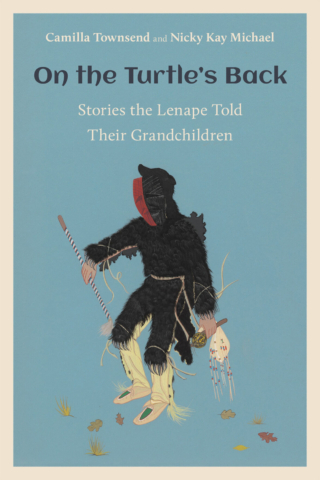
“On the Turtle’s Back: Stories the Lenape Told Their Grandchildren,” a collection of Lenape folklore, is a recent release from Rutgers University Press that provides the current residents of Lenapehoking — the land of the Lenape — the opportunity to learn more about the region’s indigenous population.
The Lenape were the Native American population that lived in the region roughly from Manhattan to Delaware until being displaced by European colonial settlers.
Written for a simple and clear read by Camilla Townsend, professor of history at the Rutgers School of Arts and Sciences, and Nicky Kay Michael, interim president of Bacone College in Muskogee, Oklahoma, the book explores the interior world of the Lenape by exploring the stories they shared.
By doing so, it provides a good resource for those looking for an introduction to the subject.
For example, as the writers note to focus the reader’s attention, “In calling themselves the ‘Lenape,’ the people were referring to themselves in their own language as the ‘common people,’ the ordinary mortals of the land. Others tended to refer to them by terms that meant ‘people of the East,’ for they lived mostly in today’s New Jersey, the land between the Delaware River and the sea, but also stretching upward into the area around present-day New York City, westward into Pennsylvania, and southward into Delaware.”
Townsend and Michael then explain how the Lenape had employed a nomadic lifestyle for centuries, hunting birds and mammals, catching fish and shellfish, and foraging.
Then, a few hundred years before European contact, they began to farm the “Three sisters” (corn, beans, and squash), dividing their seasons between time in their agriculture villages and time pursuing game.
The writers then say, “After the Europeans arrived — first the Dutch at Manhattan and then others (the Swedes, Finns, and English) throughout the region — the Lenape traded and sometimes fought with them, depending on how they were treated. European diseases devastated their population, and they gradually began to retreat westward. Soon they were spoken of as the ‘Delaware’ in honor of the river on whose banks they now clustered. They retained that name even as they were pushed farther and farther west; the name is still theirs today, though they are also known as the Lenape.”
Interesting, the writers note, that despite their gradually dwindling numbers, “the Delaware played a large role in America’s unfolding national consciousness. They still have a secure place in the dominant culture’s historical imagination. There, they sell Manhattan to the Dutch for a pittance. They befriend William Penn but still suffer the Walking Purchase. They promise George Washington their support and enter stories of the Revolution. They appear as the last of their kind in dramatic poems and novels of the emerging young country.”
Yet, the authors argue, the Lenape were much more than props in the European-American based national narrative. “They had their own expressive lives. Their young people shouted in mirth; their children made youthful mistakes; their parents showed them the way; their old folks exhorted. They prayed, debated, and told stories.”
However, despite all that has just been noted, Townsend and Michael observe that there is little known about the Lenape’s thoughts, joys, fears, and linguistic expressions.
As the writers note, “Archaeology can reveal a great deal about a people and the choices they make: We can map out their villages and admire their discarded gadgets. But the field can tell us relatively little about people’s interior lives. Historical records left by Europeans can also be illuminating: We can study diplomatic exchanges in which the speech of Indigenous participants is recorded as well as the treaties signed and the battles fought. But from such sources we learn a great deal more about the thoughts of the Europeans than those of the Indians; we can sometimes deduce what the Indigenous people of the era were thinking, but certainly not on the deepest level.”
And while some Native Americans managed to write their own books while memory of the old ways was still fresh and sharp, “the Lenape were pushed out of their homeland long before writing a book to record their perspectives was a realistic possibility. So, in some ways, or on some levels, we are left wondering who they once were. Fortunately, as this book makes clear, some highly relevant Lenape sources do survive.”
One key reference is the title of the book. It refers to the unifying creation myth when “the earth was created once (by Gicelemu’kaong), and then covered with water afterward. There was trouble in getting dirt to start a new earth. Various animals were sent down to get dirt, but all came up drowned. The Muskrat finally got the dirt in his paw; but he was dead when he came up. Whoever was fixing the new earth — perhaps God — took this dirt, and after inquiring which creature was able to hold it, put the dirt on the turtle’s back.
“On the Turtle’s Back” is the most recent in a small selection of RUP’s Lenape-themed books, including the familiar “Dickon Among the Lenape Indians” (1963) and “The Delaware Indians: A History” (1990).
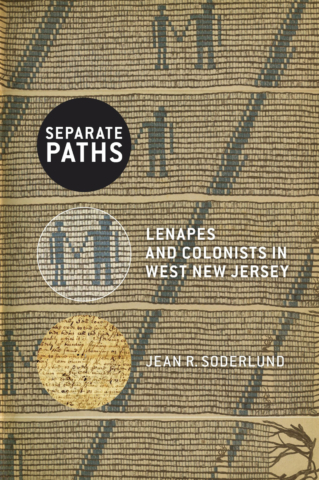
It also joins the recently released “Separate Paths: Lenapes and Colonists in West New Jersey” by Lehigh University professor of history emeritus Jean R. Soderlund. It is a book that deserves attention for its fresh look at New Jersey history — especially in regards to the interactions of the colonists and the Lenape.
As she notes, employing an “s” to indicate the plural and Lenapehoking for southern New Jersey, “Relations between Lenapes and colonists in southern Lenapehoking have received much less scholarly attention than European settlement in other parts of North America, such as Virginia, New England, and New Netherland, where military force and epidemics destroyed Indigenous nations.
“Investigations of the social and political history of Lenapes and colonists have generally followed separate paths in southern Lenapehoking, which comprised the land area of old Burlington, Gloucester, Salem, and Cape May Counties. Using evidence from documents and sites, archaeologists, anthropologists, and ethno- historians have conducted substantial research on the Lenapes, focusing specifically on communities in southern Lenapehoking or considering the region as part of broader comparative work.
“This book offers an attempt to understand the cross-cultural dynamics of how Lenapes, Swedes, Finns, Quakers, and enslaved Africans coexisted and built a functional society in late 17th century Lenapehoking.”
While Sonderlund says historians have already shown that West Jersey and portions of closely related Pennsylvania “differed from the early Chesapeake and New England colonies because of greater ethnic diversity among European settlers, but we are unclear on why that mattered in the colonial era.”
She then begins to provide new information, noting that “many have assumed that the early Quakers acted benevolently toward both Lenapes and Africans based on the Friends’ beliefs in nonviolence and the equality of all people under God. This study explores how, despite Quaker pacifism and long-standing Lenape-old world settler alliances, European colonization in southern Lenapehoking resulted in the dispossession of Indigenous people and enslavement of Africans similar to conquests elsewhere by militaristic regimes.”
And, “unlike many parts of the Atlantic seaboard in North America, southern Lenapehoking remained sovereign in 1675 when the Salem Quakers arrived.” And as the Friends entered their homelands, “The Lenapes remained a formidable nation of approximately three thousand people in 1670 and used that power to protect their sovereignty, conducting small-scale mourning war against individuals who encroached on territory without proper treaty protocols.”
Soderlund also says the Lenapes maintained a close alliance with Swedes, Finns, and other old settlers, and from 1665 welcomed those who moved from the west bank of the Delaware seeking larger farms and freedom from the England’s strict land policies. “The old settlers had become close allies and business partners with (Lenape) traders, and some European men and Lenape women married. The Natives and colonists felt comfortable as neighbors, exchanging knowledge of agriculture, livestock, hunting, fishing, and food preservation.”
However, in the 1670s, influential Friends members “decided to try their hand at colonization. They planned to take over southern Lenapehoking both as a business venture and to establish a society free from religious persecution. The Quakers fully intended to use peaceful methods in their occupation, primarily by negotiating exchange of the territory for such goods as cloth, tools, wampum, and alcohol. They apparently expected the Lenapes to cede all their land and depart, contrary to the Lenapes’ resolve to permit small numbers of colonists to establish homes.”
As the saying goes, the rest is history — our history.
On the Turtle’s Back: Stories the Lenape Told Their Grandchildren, by Camilla Townsend and Nicky Kay Michael. $25.95. Rutgers University Press, 250 pages.
Separate Paths: Lenapes and Colonists in West New Jersey by Jean R. Soderlund. $30.95. Rutgers University Press, 200 pages.