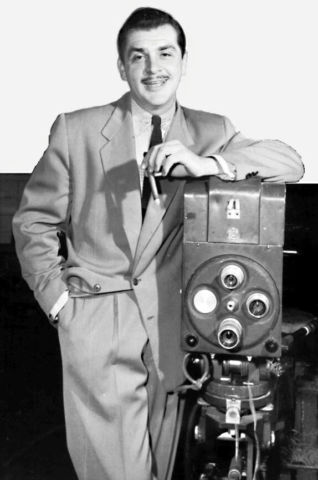
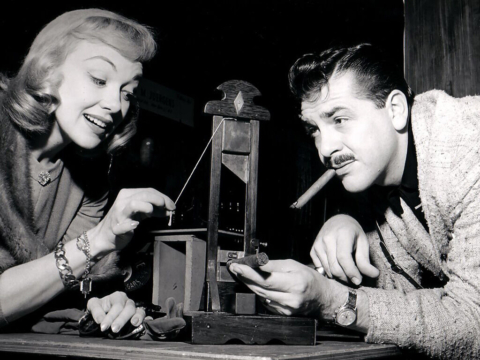
“Ernie in Kovacsland” is one of the newest and more developed volumes focusing on the work of acknowledged master of innovative television comedy and imagery, Trenton’s Ernie Kovacs.
The book has been seriously and wittily put together by Josh Mills. His mother was Edie Adams, Kovacs’ television performing partner and wife from 1954 to his death in a car accident death in 1962. She remarried in 1964, and Josh Mills was born in 1968.
In this era with AI, a proliferation of images, and videos, it is difficult to convey just how innovative Kovacs’ experimentations with television were in those days when there were only a few channels and broadcasting stopped at midnight.
Since I grew up during those early days of television and in the Philadelphia area, where Kovacs got his TV start, let me share a few perceptions.
When television began, its shows and presentations followed approaches that viewers had already experienced by attending theater, film, and public meetings.
And while there were some innovations, like the three-camera taping method, the visual storytelling remained mainly linear and coherent.
But not with Kovacs.
While there was great attention to establishing some noted character types, including the archetypal modern schlub Eugene, Kovacs’ shows were more bent on bending the rules of familiarity — creating burst-out-loud moments of absurdity.
For example, take the commercial where Kovacs, as a car salesman, gives an auto a slap of confidence and the car plummets through an actual floor. Or the segue between scenes that featured an oversized ballerina slowly moving to an eerie voice singing “Mack the Knife” in German. And how about the Nairobi Trio? That recurring bit featured three masked and long-coated music-making gorillas creating mischief while performing the sing-songy song “Solfeggio.”
(Incidentally, while Kovacs was always part of the trio, other unrecognizable trio members included wife Adams, Trenton pianist Edie Hatrack, and an occasional guest, including famed American singer and actor Frank Sinatra and comedic film and stage actor Jack Lemon.)
While I was too young to figure out what exactly was going on or even the schedule on my own, my mother, who saw Kovacs’ career start on Philadelphia radio, was an early follower and a Kovacs enabler.
And Kovacs — along with “the Mickey Mouse Club” — was on my must-see list.
Program after program I would see Kovacs buzz saw through popular and high culture — everything from singing Mounties and tipsy fay poet Percy Dovetonsils — and mesmerized by the surprising visuals — like in the bit where Kovacs, as Eugene, functions in a setting that all seems normal — until he attempts to pour milk into a cup and the liquid flows at out an angle and misses the cup.
In the 1950s, Kovacs had moved from the East Coast to California to continue to create television and appear in films (which did not yet use his visual genius). Then there was the car accident.
While he no longer created, his work continue to attract attention, and books and recordings began to appear. Then when video recordings became a daily part of life, his work was seen by more and more — just do a search on YouTube to find out.
Nevertheless, as Mills explains in his book, a major part of his legacy was saved by Adams, who “guarded his professional career and their personal life together so closely that almost everything you will see in these pages is due to her — from the scans made from the 60 (!) boxes of material she donated to the UCLA Special Collections Library to the ephemera in an uncounted number of boxes in her house. The other 10 percent is stuff I found on eBay to help fill in the blanks.”
For the record, Kovacs was born in Trenton in 1919 to immigrant parents. His father was a police officer who entered the “beverage business” and led an up and down career running saloons and taverns.
As Edie Adams writes in an essay in the book, Kovacs’ personal “retreat was to go into his room and read all the Tom Swift books, on which he later did takeoffs. It was the beginning of his self-education. From then on, wherever he lived, Ernie always had a desk, and his main occupation was reading and writing, even as a kid. For someone with only a high school education, he was one of the most well-read people I’d ever met. He’d read the classics just because he wanted to, not because he had to take a course.”
She adds that in high school Ernie acted in plays, in part to escape from his family situation. And while he was a failing student, his stage talent and baritone voice landed him a scholarship with a summer stock program on Long Island.
While an American Academy of Dramatic Arts scholarship followed, he was unable to finish it due to poor health, and after being in a welfare hospital in New York City ended up back in Trenton.
There he worked with the local Contemporary Players and landed a job as an announcer for WTTM radio in Trenton. It was there that he began to employ off-beat comic bits and became the host of the “Talk of the Town” interview show.
Meanwhile, off-mic, he wrote a weekly news column for the Trentonian newspaper, announced at sports events, acted, got married, and learned to play poker — a lifelong passion that helped end his first marriage.
As George Glazer recounts in a circa 1957 interview with Kovacs in After Hours magazine, Philadelphia television station officials recognized Kovacs’ talent and had him “make his start in TV on a cooking show that ran from 7 a.m. to 9 a.m.
“Usually, the show consisted of a visiting cook, who was interviewed, and then made his or her favorite dish before the cameras. One day, the cook didn’t show.
“‘It was bad enough having an early morning show anyway,’ (Kovacs) recalls, ‘but to have to do a cooking show without a cook was worse yet.
“‘I remember thinking that maybe I could pull it off by myself, since all the cooks who would possibly be up at 7 a.m. would be cooking for a living, and couldn’t get off from work to do the show. So I did the next best thing — I sent some of the crew out to get some vegetables and things, grabbed an old cook book that was in somebody’s office, and tried to pick out the easiest thing.
“It was horrible — we didn’t have all the ingredients, I couldn’t cook in the first place, I had no idea what the utensils we had were for, and I kept getting the notes for the recipe I had made mixed up with the notes for the commercials. I finally gave up on the thing, and started making jokes, faces, imitations and anything else I could think of, and by the time 9 a.m. rolled around, I was a nervous wreck.’
“Nervous or not, Kovacs’ program underwent a change, and he emerged as a full-time funnyman for early-rising Philadelphians.
“The network heard about it, and pretty soon Ernie and Edie were on their way to New York. In 1951, he did the first Ernie Kovacs show for NBC, and between then and now has also had shows on ABC and CBS, and for a time worked all three at once.”
To get a sense of what Kovacs was doing with comedy, columnist Richard Gehman wrote the following in his late 1950s Real magazine article, “The Wacky World of Ernie Kovacs.”
“Ernie is a warm, unfunny guy — by that I mean he’s a regular human being when he isn’t performing. He doesn’t sit around trying to crack jokes like many comedians do. I would say his type of comedy is just a slight exaggeration of his life philosophy. He always finds something funny in commonplace situations. When he’s onstage he’s making a social commentary or an observation on human nature.”
Now combine it with the following assessment published in Salon Magazine: “Kovacs’ art was more original, personal, and bizarre than anything else being done in the early days of television. At a time when the medium was still figuring out what it was — and modeling itself alternately on radio, cinema, legit theater, and vaudeville — the Trenton native decided to wing it and see what happened. He treated the TV studio as a playground and the camera as his playmate. At the heart of everything he did was a simple realization: the television camera is not a recording device, but an expressive tool — a machine that transforms the real into the virtual, and makes even the weirdest flights of fancy seem natural.”
Then there’s Mills’ recollection of his mother and her desire to let a new audience know “how much of a genius Ernie Kovacs was. He couldn’t tell a joke to save his life, my mom told me. But he knew what made him laugh, and he translated that to the small screen in the 1950s before anyone had played with the medium of television like he did.”
“Ernie in Kovacsland: Writings, Drawings, and Photographs from Television’s Original Genius,” 284 pages, $34.99, Fantagraphics.