In a series programs with “earth” as a theme, New Jersey Symphony Orchestra music director Jacques Lacombe concludes a four-year musical survey of the elements long thought to embody the natural world: earth, air, fire, and water — concepts that have inspired composers for centuries. A Lacombe signature creation, the multi-year set of Winter Festival programs has focused on a different element each season since Lacombe’s arrival at the NJSO.
Two winter concerts with different musical programs are scheduled for two locations in central New Jersey: Richardson Auditorium at Princeton University and the State Theater in New Brunswick.
The Richardson program — set for Friday, January 17 — includes Gustav Mahler’s “Das Lied von der Erde,” (The Song of the Earth) and the North American premiere of Tan Dun’s Earth Concerto, a work inspired by the Mahler work.
“Earth” soloists are percussionist David Cossin, who also teaches percussion at New York City’s Queens College; NJSO percussionists James Neglia and James Musto; and Chinese wind instrumentalist Zhang Meng. Soloists for Mahler’s composition are mezzo-soprano Elizabeth Bishop and tenor Russell Thomas.
The presentation at the State Theater on Saturday, January 25, includes Richard Wagner’s “Venusberg Music” from “Tannhauser,” Vincent D’Indy’s “Symphony on a French Mountain Air,” and Richard Strauss’ “Alpine Symphony.” Pianist Pascal Roge solos in the D’Indy piece.
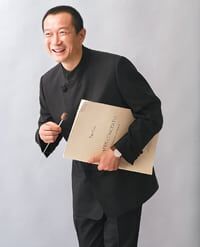
In a way the four-year cycle has come full circle since the first program in 2011. New York-based percussionist Cossin soloed in the programming for Water at that time, and solos in the 2014 conclusion of the multi-year survey, Earth. Composer Tan Dun, who is based both in China and in New York, wrote both the Water and the Earth concertos.
For his instrumentation Tan goes beyond existing instruments to create both aural and visual effects. When there is no known instrument to make the sound he wants, the composer devises something new. For instance, Tan’s Water Concerto calls for dipping a vibrating cymbal into an illuminated bowl of water.
For Earth Concerto Tan collected clay in Hong Kong, Taiwan, and the Chinese mainland, and invited and built both traditional eastern and non-traditional instruments. Since his theme was Earth he also arranged for the construction of standard western instruments, such as drums and marimba-like instruments, from ceramics. Extending the instrumental palette in his pieces, he requires brass players to remove their mouthpieces, or string players to hit the fingerboard and strings with the palm of their hands. In one movement of Earth Concerto he asks instrumentalists to inhale and exhale audibly and to mouth loudly certain syllables.
Tan conducted the premiere of Earth Concerto in August, 2009, at Austria’s Graffenegg Music Festival, which commissioned the work. Cossin was the percussion soloist and Zhang played ceramic wind instruments. Kristjan Jarvi, son of Neeme Jarvi, Lacombe’s predecessor at the NJSO, conducted European performances of the piece.
Initially, performances of the piece were more difficult than repetitions of most new pieces because of the scarcity of duplicates of Tan’s invented instruments or those constructed of ceramics.
Interviewed by telephone, shortly after returning to Montreal after a month in Paris, conductor Lacombe explains that Tan revised the Earth Concerto in 2011 to make it more accessible for conventional instruments instead of relying on the rare stone or ceramic instruments. The revised version is shorter than the original.
To help Lacombe prepare the piece Tan sent a video from China with explanations about the instruments. Cossin joined the search for instruments to convey the composer’s wishes. Victoria McCabe, NJSO’s communications and external affairs manager, says that he chose the three sets of five flower pots used in Earth Concerto not merely because they had pitches. In addition the pots in each set have interesting sonic relationships to each other.
A leadership team consisting of conductor Lacombe, composer Tan, solo percussionist Cossin, and NJSO percussionists Neglia and Musto will pre-plan the details before rehearsals begin. And Tan will attend rehearsals to help keep the NJSO on track for the performance.
Besides unconventional instruments, Tan’s Earth Concerto score prescribes unconventional locations for violins. They are to be deployed in the auditorium where the performance takes place. “There’s a graphic in the score,” Lacombe says. “A curvy line shows the unusual locations. We will have to adjust and play with it. It’s a special challenge because of the three different locations where we’ll play the piece. It’s especially challenging in Princeton where there will be no rehearsal before the performance.”
Pairing Tan’s Earth Concerto with Mahler’s “Das Lied von der Erde” makes for an achievement of tight programming for the “Earth” theme of the January festival. The appropriateness of the combination gradually registered with Lacombe. “I was researching for the 2014 festival,” he says. “We had already decided on ‘Das Lied’ because of our special focus this year on compositions by conductors. When the score arrived, I read that ‘Das Lied’ had inspired Tan Dun’s Earth Concerto. I was happy to find that Tan Dun’s Earth Concerto was written for stone and clay instruments. It is also a good fit because the four-year cycle began with Tan’s Water Concerto in 2011. Furthermore, composer Tan Dun is a conductor,” Lacombe says.
“Das Lied,” which Mahler based on a German translation of Chinese poems from the Tang dynasty, which flourished for 300 years beginning in the seventh century, is a personal favorite of Tan Dun. The three movements of Tan’s Earth Concerto parallel three of the six movements of “Das Lied.”
Before making a final decision to program the Tan piece, Lacombe listened to a recording sent by the publisher. “I never program a piece without seeing the score or hearing a recording,” Lacombe says, “except when a commission is involved.”
Once you’ve worked out how to conduct a Tan Dun piece, the rest falls into place, Lacombe says. “The Water Concerto was very easy once you figured it out. The piece is well written; Tan is a conductor. It was just a question of creating the right mood and the right style. It was fun to do.”
In contrast, Lacombe, along with others, finds the last movement of Mahler’s “Das Lied” notoriously difficult to conduct. “It’s so slow,” he says, “and has unmatched subdivisions, which vary rhythmically within the beat.”
Like a parent showing no favoritism among his children, Lacombe displays his enthusiasm for the second Winter Festival program. “The D’Indy, which is based on a folk tune from the French Alps, is rarely done, and piano soloist Pascal Roge is wonderful,” he says. “Strauss’ ‘Alpine Symphony’ has a huge orchestra and a big back-stage brass section. The ‘Alpine’ is always exciting and a big project.”
New Jersey Symphony Orchestra, Richardson Auditorium, Princeton University. Winter Festival Program One: the North American premiere of Tan Dun’s Earth Concerto and Gustav Mahler’s “Das Lied von der Erde.” Friday, January 17, 8 p.m. Additional performances of this program will be performed at the New Jersey Performing Arts Center (NJPAC), 1 Center Street, Newark, Saturday, January 18, 8 p.m., and Mayo Performing Arts Center, 100 South Street, Morristown, Sunday, January 19, 3 p.m.
New Jersey Symphony Orchestra, State Theater, 15 Livingston Avenue, New Brunswick. Winter Festival Program Two: Richard Wagner, “Venusberg Music” from “Tannhauser; Vincent D’Indy’s “Symphony on a French Mountain Air”; and Richard Strauss’ “Alpine Symphony.” Saturday, January 25, 8 p.m. The program will also be performed at the New Jersey Performing Arts Center (NJPAC), 1 Center Street, Newark, Friday, January 24, 8 p.m. and Sunday, January 26, 3 p.m.
Tickets for all venues are priced from $20 to $90. www.njsymphony.org or 1-800-255-3476.