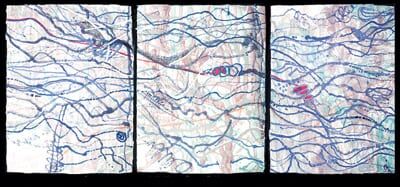
For those who have missed the memo posted on the state’s historical landscape: New Jersey has been home to some major art movements and artists. As a matter of fact many of the artists who have become stars of major metropolitan art centers, such as New York City, have lived — and continue to do so — in the small towns and main streets of our state.
The reality is that art is created by people who do what people always have done: live and create where they are.
And New Jersey — with its proximity to a variety of influences — created an environment where it was not unusual to spot someone such as George Segal, called the most important American sculptor in the second half of the 20th century, driving his worn-out sedan along Route 1.
A new and ambitious project called “Concentric Circles of Influence: Celebrating Central New Jersey at the Forefront of Creative Activity” — opening this month at several regional exhibition venues — strives to put a spotlight on our region’s link to important art making and serves as a natural continuation of the Princeton University Art Museum’s just concluded exhibition “New Jersey as a Non-site.” That exhibit examined an important regional arts movement that occurred in the 1960s yet continues to influence the art world today.
“Much of America’s creative activity took root in small but important enclaves all across the country. Beginning in the mid-20th century, central New Jersey became one such hotbed, and played an important role in American cultural life of the last century. The accomplishments of the artists who lived and worked here are documented in the paintings, drawings and sculpture they produced,” note curators Kate Somers and Ilene Dube.
If both names seem familiar, they are. Somers has been visible for the numerous exhibitions she has curated at the Bernstein Gallery at the Woodrow Wilson School at Princeton University. Dube is an artist, regular arts contributor to U.S. 1, the former editor of the Princeton Packet’s TimeOff magazine, and writer of her own blog the Artful Blogger.
Their effort, as they write, “is a series of art exhibits, film, gallery talks, and panel discussions that focus on notable art communities that developed in central New Jersey beginning in the late 1930s. The exhibitions are being offered in venues across the region and explore the role New Jersey has had as a creative cauldron since the mid-20th century.”
The highlighted artist communities or groups include the artists of Roosevelt, Queenston Press Artists, Princeton Art Association (which morphed into Artworks in Trenton), the Trenton Artists Workshop Association (of which I was a founding member), and the Princeton Artists Alliance.
Each will be examined through the historic and contemporary works by artists representing each group and exhibited in a variety of regional galleries, many of which were the sites for some of the group’s original efforts.
The organizers say that they originally set out to celebrate a group of women artists who came together in Princeton in the 1960s to learn printmaking from regional artist and educator Judith K. Brodsky. “From this small group, along with other artists who established the Princeton Art Association during the same period, many other art groups eventually formed. Just as interests during this period began to overlap as artists joined multiple groups and influenced one another’s work, the original project grew to encompass more of these ‘Concentric Circles.’”
Dube notes, “We discovered that not only had the women artists’ group come together at this time, but other important artists in the area were taking classes with each other, interacting and influencing each other. Although the artists of Roosevelt had formed in the 1930s, many were still active in the 1960s and 1970s, and knew the artists of the Queenston Press. In addition, there were connections to artists who had taught at Mercer County Community College, as well as the artists who formed the Trenton Artists Workshop Association.” The name Queenston, by the way, is the female response to being in towns boasting masculine attributes: Princeton and Kingston.
The “Concentric Circle” series gets started with several simultaneous openings in Princeton. Other events follow in West Windsor and Trenton.
The Queenston Press, The Woman Portfolio
First is the “Concentric Circles of Influence: the Queenston Press, The Woman Portfolio” at Princeton Public Library, recently opened and continuing through Tuesday, April 15. A reception is set for Saturday, January 18, from 3 to 6 p.m.
The “Portfolio” exhibition, say curators, was inspired by the United Nation designations of 1975 as International Women’s Year, an ensuing Decade of Women, and Time Magazine’s January, 1976, cover highlighting achievements by women. “In 1976, a group of Princeton artists produced The Woman Portfolio, published by Judith K. Brodsky and the late Zelda Laschever. Brodsky and Laschever state in the foreword to the catalog that accompanied the portfolio, ‘The prints themselves are not propaganda for a movement. They represent deep responses to the word ‘woman.’’ Although The Woman Portfolio was produced more than a quarter century ago, the prints are still as timely and vital as they were, and as varied as the group of women who made them,” say the curators.
Princeton Public Library, 65 Witherspoon Street, Princeton. Monday through Friday, 9 a.m. to 9 p.m., Saturday 9 a.m. to 6 p.m., and Sunday 1 to 6 p.m. www.princetonlibrary.org or 609-924-9529.
The Queenston Press Bicentennial Portfolio
Next is “Concentric Circles of Influence: The Queenston Press Bicentennial Portfolio” at the Historical Society of Princeton’s two locations: Bainbridge House and Updike Farm. Both exhibitions run from January 18 through July 13, with a reception on Saturday, January 18, from 3 to 6 p.m.
The Bainbridge House exhibition is organized around portfolios created as part of Princeton’s 1976 celebration of the American Bicentennial and charts Princeton’s “place in the nation’s history through prints of such sites as the Delaware-Raritan Canal, Princeton University’s Nassau Hall, Morven, and Princeton Cemetery.” The Bainbridge House, the Historical Society’s headquarters, is located at 158 Nassau Street, Princeton, open Wednesday through Sunday from noon to 4 p.m., admission $4.
The Updike Farm exhibition is “The Queenston Press Ten Crucial Days Portfolio,” a group of images that interpret “the dramatic events that unfolded between the time George Washington’s crossed the Delaware on Christmas Day, 1776, and the surrender of British troops in Princeton 10 days later.” The historical and artistic significance is amplified by the farm’s presence on the actual route followed by Continental troops on their way to engage British soldiers at the neighboring farm. Updike Farm is located at 354 Quaker Road and is open the first Saturday of every month from noon to 4 p.m. or by appointment (by E-mailing eve@princetonhistory.org).
Both of the exhibitions will contextualize these important and significant prints and their makers through video, interactive elements, and images of the artists at work, say the curators.
Princeton Historical Society, 158 Nassau Street, Princeton, and 354 Quaker Road, Princeton. www.princetonhistory.org
The Queenston Press Contemporary Works
‘The Arts Council of Princeton is itself at the center of influence as it has encouraged the work of artists in ever widening circles of art-making in the Princeton area for almost 50 years,” write Dube and Somers. “As such it is pleased to present the recent work of the remarkable women of Queenston Press who were at center of the early communities of local artists. Judy Brodsky, Yvonne Burk, Trudy Glucksberg, Lonnie Sue Johnson, Margaret Johnson, Joan Needham, Helen Schwartz, Marie Sturken, and Linda White will show work that includes printmaking, handmade paper, drawing, painting, multi-media basketry, and collage.”
The ACP will also present an artist panel discussion with moderator Anne Swartz on Thursday, February 6, at 7:30 p.m. A screening of a film by Ilene Dube, “The Birth of an Art Community,” will also be held on Thursday, March 6, at 7 p.m. Both events will take place in the Paul Robeson Center’s Solley Theater.
Dube’s film, by the way, not only contains interviews with a number of the Queenston artists, it uses music by composer Rita Asch, a member of Movis. That newer artists group, which includes John Goodyear of the Rutgers group, connects to the others through Maggi Johnson, a member of the original Queenston Press group and Princeton Artists Alliance; Marsha Levin-Rojer, also of the Princeton Artists Alliance; and Susan Hockaday, an original Princeton Art Association board member as well as Princeton Artists Alliance member. Berendina Buist and Eve Ingalls are also members. Besides the special showing, the video will also be shown during exhibition hours.
Taplin Gallery, Arts Council of Princeton’s Paul Robeson Center for the Arts, 102 Witherspoon Street, Princeton. Saturday, January 18, through Saturday, March 8. Reception January 18, 3 to 6 p.m. Monday through Friday, 9 a.m. to 5 p.m., Saturday, 9 a.m. to 4 p.m. 609-924-8777 or www.artscouncilofprinceton.org.
Left of Central: TAWA, Artworks, and Art in the Capital Region
‘The exhibit explores the founding and evolution of the Trenton Artists Workshop Association (TAWA), including its early relationship with Mercer County Community College (MCCC); as well as the pioneering early days of the Princeton Art Association’s (now Artworks) move to the city. Featured artists are among those who were instrumental in the early days, and in sustaining these groups over more than three decades,” the curators say. Featured artists include Latta Patterson (who co-founded the organization), Elizabeth (Roszel) Aubrey, Judy Brodsky, Marge Chavooshian, Frank Greco, Susan Hockaday, Tom Kelly, Mel Leipzig, Tom Malloy, Terri McNichol, (past president) Dave Orban, Dallas Piotrowski, Aundreta Wright, (past president) Nancy Zamboni, and others involved with the organization’s long history.
The exhibition — coordinated in part by Mercer County Cultural and Heritage Commission staff member and former TAWA president Tricia Fagan — also reflects the vision of MCCC Trenton campus’ Dr. Mary Howard who brought the artists together downtown and reawakened the spirit of the Trenton Fine and Industrial Arts School which had become Trenton Junior College and then the community college.
The Gallery at Mercer County Community College, Communications Building, second floor, 1200 Old Trenton Road, West Windsor. Tuesday, January 21, through Thursday, February 20. Reception Saturday, January 25, noon to 2 p.m. 609-570-3589 or www.mccc.edu/gallery.
Artists of Roosevelt
‘Artists of Roosevelt,” at New Jersey State Museum, February 15 through May 25, highlights the community of visual artists “that developed and still thrives in Roosevelt (formerly Jersey Homesteads), New Jersey. The exhibition will explore the development of Roosevelt as an art community and allow visitors to discover the impact these important artists had, and continue to have, on American art. Historic works drawn from the NJ State Museum’s collections include artists Jacob Landau, Sol Libsohn, Stefan Martin, Gregorio Prestopino, and Ben Shahn. Contemporary artists to be included are Bill Leech, Ani Rosskam, and Jonathan Shahn, among others.”
New Jersey State Museum, 205 West State Street, Trenton. Tuesday through Saturday, 9 a.m. to 5 p.m.; Sundays, noon to 5 p.m. 609-292-6300 or www.state.nj.us/state/museum.
Scanning decades, arts movements, communities, and perceptions, “Concentric Circles” starts the telling of regional arts movement. Yet more important it is a positive reminder that the central New Jersey region is an important part of the creative world.
It also suggests that it may become more important in the future as the cost of living in metropolitan areas become less and less supportive of young and innovative artists.
As celebrated New Jersey-native and poet/musician Patti Smith recently said, “”New York has closed itself off to the young and the struggling,” and that artists need to find new homes to create and develop.
One of the important messages of “Concentric Circles” is that a regional center for creativity has been established by bands of artists — with special attention to the women of Queenston Press — and that the circles are ready to welcome others.
#b#The Start of An Area Art Movement#/b#
“Concentric Circles of Influence”
Princeton’s roots as an art community can be traced back to 1948, when Rex Goreleigh (pictured at right) was recruited by a group of Princeton University professors and members of the Jewish and Quaker communities to form a racially and religiously integrated arts organization. Goreleigh directed Princeton Group Arts, emphasizing inclusivity in teaching theater, music, dance, painting, sculpture, writing and crafts. But despite such fundraisers as a Marian Anderson concert at McCarter Theatre, Princeton Group Arts folded in 1954. Goreleigh set up the Studio on the Canal to continue workshops in painting, printmaking, and ceramics and ran it until 1978. Some of the instructors were Glenn Cohen (sculptor), Hughie Lee Smith (painter), Vincent Ceglia (painter), and Stefan Martin (printmaker).
Goreleigh’s own work focused on farming culture in the late 1960s, early 1970s. He visited and painted farms in Cranbury, Roosevelt, and Hightstown, depicting aspects of the human condition while chronicling labor history. He served on the board of the Arts Council of Princeton and taught at Princeton Adult School, the Neuropsychiatric Institute in Skillman, and Trenton school district.
Goreleigh also served as director of the arts and crafts program in Roosevelt schools in 1955-56, a town that was another hub for artists. Originally named Jersey Homesteads, it was the site for an experimental program during the FDR administration that brought Jewish garment workers out from the tenements to work as farmers. Ben Shahn came to create a mural depicting the project. Shahn knew Goreleigh, with whom he had worked on the Rockefeller Center murals with Diego Rivera.
Following Shahn and his artist wife, Bernarda Bryson Shahn, to the Louis Kahn-designed flat-roofed houses of Roosevelt came other artists: Jacob Landau, Gregorio Prestopino, Stefan Martin, and Sol Libsohn.
Some of the artists who joined Goreleigh’s Studio on the Canal went on to form the Princeton Art Association. The PAA offered classes to the community first at 14 Nassau Street – the same building where the Queenston Press artists met — then at Princeton Borough Hall, followed by a move to Ettl Farm, an art colony on Rosedale Road in Princeton. Founded by sculptor Alex Ettl, a high school dropout who became a millionaire philanthropist by selling sculpture tools and making castings, the farm offered living and working space in a barn to a group of artists, some of whom went on to join the Johnson Atelier. Others taught at Rutgers.