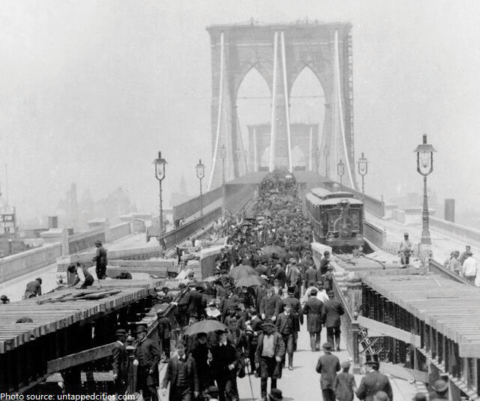
The Eiffel Tower and the Brooklyn Bridge became great symbols of their age because the general public recognized in their new forms a technological world of surprise and appeal.
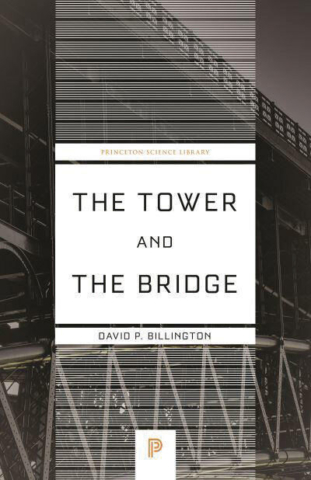
So writes the late Princeton University engineering professor David Billington at the start of his engaging book, “The Tower and the Bridge.”
He continues to say that the two landmarks also introduced a new art from, structural art, an approach that “is parallel to and fully independent of architecture.”
Since one of the structural art works mentioned above was created by a prominent figure in our region and a number of Billington’s examples are close to us, the just reissued Princeton University Press book, first published in 1985, seems written with us in mind.
But chalk that up to being fortunate enough to live near many of the artistic structures highlighted in the 308-page book that, according to the author, grew from “teaching structure to graduate students in architecture. Bored with typical engineering texts, they showed me their ideas of beautiful structures.”
In the process, he began to sense how by using “the austere discipline” of engineering, an individual could “create objects of great beauty that reflect (his or her) personality.”
“Since this subject of structural art is somewhat new, it is perhaps well to explain the criteria upon which the book has been constructed,” Billington notes before unrolling his reasoning in a clear, direct, and journalistic manner.
First, he says, he wants to show the best works of structural engineering completed during the past 200 years. “The idea is related to my wish to create a course in structural art similar to courses in painting or literature in which the finest works are studied one after another thereby suggesting the evolution of principles of form.”
Second is his decision to “start this narrative in the late 18th century with the beginning of the use of cast iron for complete structures” and through which “new structure forms began to appear; these required special study and training, which led to the creation of the modern engineering profession.”
Additionally, he writes, “like that other Industrial Revolution art from, photography, the development of the new technology of industrialized iron brought forth a new means of artistic expression. Just as there are artists who have practiced both painting and photography, so there are artists who have created works of structure and works of architecture. But the distinction between the two is, just as clear as that between photography and painting.”
Fittingly, his third criterion is to maintain the “independence of structural art from architecture.”
The reason is that “the most beautiful works of structural art are primarily those created by engineers trained in engineering and not in architecture. Almost without exception it seems that the best works of structural art would have been compromised had there been architectural collaboration in the design of the forms.”
Fourth, and finally, he says, “there is a set of ideals for structural art that separates it from architecture or sculpture” and that the structural artists he studied “had considerable freedom of aesthetic choice in design without compromising the discipline of engineering.”
Based on the above, Billington eventually formalized an evaluative approach to addresses structural art through three factors: economy, efficiency, and elegance.
Outlined more directly in the notes for the class he developed — one that continues and is currently accessible online — the three concepts are touched on throughout the book and can be thought of in the following ways:
“Economy is a spur, not an obstacle, to creativity in structural art,” he writes, adding that structural art comes from the “conscious aesthetic motivation of the engineer” and that there is a “freedom that engineers actually have to express a personal style without compromising the disciplines of efficiency and economy.”
Efficiency is related to the project’s societal purpose and “springs from the central idea of artificial forms controlling natural forces.”
And elegance is the aesthetic statement the designer was compelled to share beyond the structure’s purpose.
Here Billington shifts from the idea of art existing as something outside the utilitarian and arguing a new form that uses science and discovery while evoking a sense of beauty.
True to his intent of demonstrating a tradition, starting with Scottish engineer Thomas Telford (1757-1834), Billington connects the dots between numerous innovative structuralist artists using improve or new techniques and materials in imaginative ways.
While I was keenly interested in the New York City-region art structures built during the 1930s (especially the Bayonne Bridge that I often walked across when I lived in the region), it seems prudent for illustration purposes to focus on the designer of the bridge in the book’s title, John A. Roebling.
Billington refers to him as “the first American structural artist to attract international attention.”
Born and trained in Germany prior to immigrating to the United State in 1831 and establishing an engineering practice in Trenton in the 1840s, Roebling devoted himself to building bridges.
Billington writes that while Roebling appeared always to be the stolid, glowering German, “inwardly he seethed with an almost inchoate romantic idealism.”
Additionally, the engineer — who was “as well educated as anyone of his generation” and possessed “a restless independence” — coupled his understanding of suspension bridge behavior with “the advent of the United States as technological and political power.”
In his proposal for the Brooklyn Bridge, Roebling stated that his work’s great towers “will be ranked as national monuments. As a great work of art, and a successful specimen of advanced bridge engineering. This structure will forever testify to the energy, enterprise, and wealth of that community which shall secure its erection.”
Though proponents of pure art argued that human beings would be better served by building museums and opera houses rather than bridges, Roebling answered them by declaring that “it is through material advancements alone that a higher culture of the masses can be obtained” and that “works of industry to be soon broadcast over the surface of the earth, (so that) want will disappear.”
Billington assesses Roebling as follows: “(He) was building not just for profit; indeed it is unlikely that he made much money from his bridges. Nor was he writing just for publicity. He did both building and writing to express his ideal for society: that the spirit can be uplifted by understanding technology and by creating out of it superior works that people can afford, that they can openly use, and that they can aesthetically enjoy. That is the meaning of technology, and that is the want to be satisfied: not just materials needs but ‘a high spiritual culture.’”
A point that Roebling, Eiffel, Billington, and others eloquently make in this augments the idea of artistic expression.
The Tower and the Bridge, David P. Billington, $22.95, 308 pages, Princeton University Press.
The class, “The Art of Structural Engineering: Bridges,” led by Princeton University civil and environmental engineering professor Maria Garlock, is available for free at edX, www.edx.org.