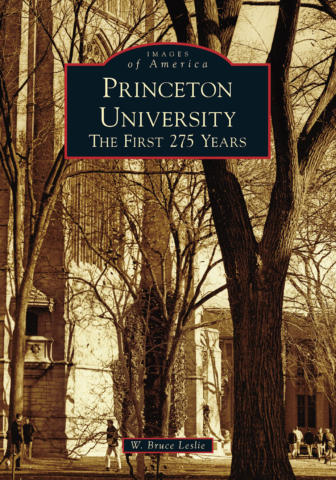
Historian and Princeton University Class of 1966 graduate W. Bruce Leslie’s recently released Arcadia Press publication “Princeton University: The First 275 Years” provides a handy history of the region and state’s most prominent educational institution.
Benefiting from other studies of the oft-examined institution and Princeton University’s archives, Leslie provides a concise 128-page overview of the life of the university from its Scottish, Protestant, and exclusively male roots to its current role as a coed, multi-ethnic, and ecumenically inclusive world-known institution.
The book provides easy invitations to linger over any of the numerous vintage photos — a hallmark of such Arcadia publications — or to focus in a specific era or theme — such as Chapter Five’s “Becoming Princeton University” and how in 1896 the College of New Jersey morphed into Princeton University.
While that general history can be found in other Princeton University references, this book benefits from the writer’s own experiences of being a Princeton University student during the second part of the 20th century and continuing to witness changes up to current times.
“The biggest cultural and social earthquake of the mid-20th century took place in the last half of the 1960s and lost steam by the early 1970s,” Leslie notes about the university. “It was a time when the verities of the two post-World War II decades — about the Cold War, race, family, gender, sexuality, and corporate capitalism — were challenged and modified or even revolutionized. Youths were seen as the vanguard of change and were at first heralded and then lamented by many.”
For him, he says the “herald of change arrived on the campus on May 11, 1966, in the form of that force of nature, Pres. Lyndon Johnson. The civil rights movement had stirred support for Martin Luther King Jr. and the push for change he led. A few brave Princeton students had gone South to join the movement, but most students still viewed the federal government as an ally. That changed with the Vietnam War.”
Leslie says the questionable justification and execution of the Vietnam War and the ongoing social clash it caused resulted in “deep cultural soul-searching. As support for President Johnson’s policies eroded on campus, divisions emerged.”
Seemingly describing something similar to what has been happening recently on college campuses, Leslie writes that “protests at Princeton grew more uncompromising. Walter Hickel, a member of Nixon’s cabinet, faced virulent opposition from some who interrupted his speech, but a petition of apology from others.”
Other shifts were nurtured in the growing alienation from cultural norms. The most obvious was external – longer hair and more colorful clothing. Cultural standards surrounding sexuality and gender shifted dramatically. For instance, the restriction on sexual activities in Princeton dorms were revoked.”
Then, in 1969, after more than 200 years, Princeton’s student body ceased being all men. As Leslie reports, “Student support for allowing women undergraduates to enroll led university president Robert Goheen and the trustees to study — and ultimately approve — gender integration. In the early 1970s, a growing minority of women began sharing classrooms with men and integrating organizations or forming their own.”
Other catalysts of change on campus included religion, race, and the civil rights movement.
Of the latter, Leslie notes, “In the mid-1960s, President Goheen committed Princeton to greater representation of African Americans. In turn, the presence of Black students led to pressures for curricular changes and social provisions such as the Third World Center. By the early 1970s, social activism had receded and traditional academic pursuits, although they were never gone, regained prominence.”
The author, who is professor emeritus of history at the State University of New York at Brockport, indicates that while the above changes were more internal, there were also tangible physical changes and that “The Yamasaki building that President Johnson dedicated” — referring to Robertson Hall, which houses the School of Public and International Affairs — was just the most dramatic statement of the university’s shift from Gothic to various modernistic styles.”
Leslie’s final chapter, “Changing Stripes in a New Millennium” — with a gratuitous reference to the university’s tiger mascot — brings us to the present day, and Leslie shares the following:
“Princeton entered the new millennium with its first female — and first scientist — president. Shirley Tilghman continued the difficult task of combining a nationally top-ranked liberal arts college with an internationally ranked research university. Inevitably, that meant a strain on undergraduate researching, but arguably, Princeton balances the tension between those two aspirations better than virtually any other leading research university.
“The establishment of a residential college system assisted in accomplishing that task. Although Princeton made a questionable decision when it rejected not only Woodrow Wilson’s Quad Plan, but also the funding from (prominent early 20th century American Standard Oil investor and philanthropist) Edward Harkness that Harvard and Yale accepted, it was now catching up. Princeton had long offered excellent academics, room and board, and social life; now, they could finally be integrated under one roof.
“There were noticeable demographic changes on campus too. For much of the 20th century, religious diversity had been the major issue. But by the time of the new millennium, Asians and Asian Americans were proportionally highly represented at Princeton, while other racial and ethnic groups increasingly matched the national representation.”
Leslie says that while the changing composition forged new religious and ethnically based student organizations, traditional ones continued: “A cappella groups still sung under the arches, Triangle Club still went on the road, and athletic teams still defended the honor of the orange and black. Indeed, Princeton became the first Ivy League college to win 500 championships and in 2018 had the school’s first undefeated football team since 1965. And despite the rise of the residential college system, the surviving 11 eating clubs stabilized and then began to thrive. Two-thirds of juniors and seniors joined a club, of which five are nonselective and six continue the controversial bicker process.”
The historian begins to wind down the book by making the assessment that while “Princeton remains small for a research university, its growth continues, often disorienting returning alumni. Most noticeable is the new arts neighborhood anchored by the venerable but expanded McCarter Theatre. Gothic architecture returned via Whitman Hall. The science neighborhood expanded on the southeast side of campus, bumping up against the successor to Palmer Stadium and other modernized athletic facilities. Next on Pres. Christopher Eisgruber’s planning board is expansion beyond Lake Carnegie to create a southern campus.”
Finally, in his parting words, Leslie says that while the university’s future is unknown and being shaped by various forces, its past is also being contested and that “alumni, faculty, students, and the administration continue a lively debate over the meaning of Princeton’s first 275 years and how that history should be represented on today’s campus.”
He should also point out that his book helps one join that discussion.
Princeton University: The First 275 Years, W. Bruce Leslie, 128 pages, $23.99, Arcadia Publishing