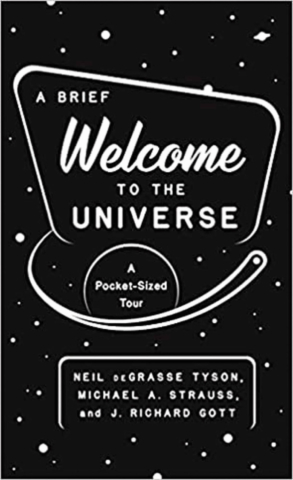
“‘A Brief Welcome to the Universe: A Pocket-Sized Tour’ is the spirit essence of our larger collaboration ‘Welcome to the Universe: An Astrophysical Tour.’ If that book was an-all-you-can-eat cosmic banquet, this book offers appetizer portions, intended to stimulate your appetite for more.”
So say Neil deGrasse Tyson, Michael A. Strauss, and J. Richard Gott on the opening page of their new book.
The book is a Princeton University affair. Strauss is a professor in the astrophysics department, Gott is a professor emeritus of the same department, and Tyson, the director the Hayden Planetarium in New York City whose television and print work has helped popularize science, is a former Princeton research assistant.
And while they may have slimmed the universe in the book down to fit into a pocket, their appetizers are mouthfuls that require some slow chewing, as some of the following excerpts may demonstrate.
In chapter one, Tyson takes on the “Size and Scale of the Universe” and notes, “It’s bigger than you think. It’s hotter than you think. It is denser than you think. It’s more rarified than you think. Everything you think about the universe is less exotic than it actually is.”
After unsettling the reader with that opening salvo he says, “Let’s get some numerical machinery together before we begin” and crunches numbers from the very simple to dense — as in the destiny of matter, celestial objects, and “neutrons — a super-high-density realm of the universe.”
The demystifying continues. Rather than use difficult-to-understand multi-syllabic words, Tyson says, “In our profession, we tend to name things exactly as we see them. Big red stars we call red giants. Small white stars we call white dwarfs. When stars are made of neutrons we call then neutron stars.”
After all, he says, “The universe is hard enough, so there is no point in making big words to confuse you further.”
There is no point in providing false comfort either. As he says as he winds down the chapter, “As unsettling as it may be, all data show that we’re on a one-way trip. We were birthed by the Big Bang, and we’re going to expand forever,” and temperatures will drop and drop. And “stars will finish fusing all their thermonuclear fuel, and one by one they will blink out, disappearing from the night sky. Interstellar gas clouds do make new stars, but of course this depletes their gas supply. You start with gas, you make stars, the stars age, and they leave behind a corpse — the dead end-products of stellar evolution: black holes, neuron stars, and white dwarfs. This keeps going until all the lights of the galaxy turn off, one by one . . . and so the cosmos ends. Not in fire, but in ice. And not with a bang, but with a whimper.”
He ends the chapter with tough spirited, “Have a nice day! And, welcome to the universe.” Thanks.
After the chapters ranging from “The Place of Pluto in the Solar System” (it’s part of a family of objects rather), “The Lives and Deaths of Stars” (or the rise and fall of its energy), and “The Search for Life in the Galaxy” (we’re still looking), written by Tyson (although one is co-authored), Strauss takes over. His first stop is “Galaxies, the Expanding Universe, and the Big Bang,” where he illuminates the unworldly world above us.
Here our guide notes “Most luminous galaxies are either elliptical or spirals, but some galaxies have irregular shapes, not fitting into either category. You guessed it. We call these irregular galaxies. The Large Magellanic Cloud, a small satellite galaxy (14,000 light years across) that orbits the Milky Way at a distance of about 160,000 light-years, falls into this category. It is so close to us that it is easily visible to the naked eye.
“Currently, the Milky Way and the Andromeda galaxy are falling together under the influence of their mutual gravitational attraction. When the galaxies collide, about four and a half billion years from now, the vastness of empty space between the stars ensures that the stars will slide past one another without colliding as the galaxies pass through each other. After the galaxies settle down in a few hundred million years, we expect them to merge and become an elliptical galaxy.”
The stars in those galaxies, he continues, “tend to be older than those in spirals, suggesting that most elliptical galaxies formed earlier in the history of the universe. The bulges of spirals share many properties with elliptical galaxies, suggesting they may have formed in similar ways. Gas that falls later onto an already-formed galaxy can cool before it has had time to form stars. The cooling causes the gas to lose energy, but not angular momentum, which can make it from a thin rotating disk. The process could make a spiral galaxy containing an elliptical bulge.”
That statement that can cause bewilderment in a lay reader is followed with the refreshing admission, “The details of this process are still poorly understood and high debated.”
Gott takes over with the final sections, “Inflation and the Multiverse” and “Our Future in the Universe.” He also has the last words about intelligent beings living in a universe that will have its last rendezvous with destiny: “If we look around, we can see the universe showing us what we should be doing. We live on a tiny speck in a vast universe. The universe tells us: spread out and increase your habitat to improve your survival prospects. We live on a planet littered with the bones of extinct species, and the age of our species is tiny relative to that of the universe as a whole. We should spread out before we die out. We have a space program only a little over a half a century old that is capable of sending us to other planets. We should make the wisest possible use of it before it’s gone.”
After all, he says, while ““we are weak” and “have not been around for very long,” “we are intelligent creatures, and we have learned a lot about the universe and the laws that govern it — how long ago it started, how its galaxies and stars and planets formed.”
And as he puts the book to a close, he also puts the world in the reader’s hands in more ways than one.
A Brief Welcome to the Universe: A Pocket-Sized Tour, $14.95, 238 pages, Princeton University Press.