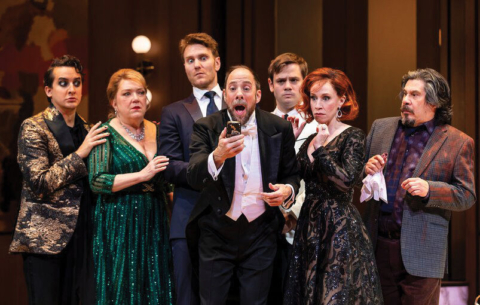
The irony of Terrence McNally’s winking poison-pen valentine to the theater, “It’s Only a Play,” and its production at New Brunswick’s George Street Playhouse, is how much better the piece works and satisfies when its characters are being natural and sincere versus when they are reeling off snappy one-liners, exuding angst, exchanging bitcheries, or being comically neurotic.
“It’s Only a Play” is a comedy, the humor in which is abundant, evident, and amusing but not trenchant enough or incisive enough to be more than a knowing portrait of theater folk rather than a satire that goes for the throat or an in-depth commentary.
It stays so intentionally middle of the road, one admires jokes intellectually more than laughing at them and appreciates character tics without caring much about the characters.
To the credit of directors Kevin Cahoon and Colin Hanlon and their talented cast, the George Street production maintains liveliness even when McNally’s story flags or characters are given too long to indulge in their anxiety of the moment. Brightness, including set and costumes, and the comedic skills of the actors keep this ship afloat. McNally’s material is flimsy, depending as much on name-dropping, insider gossip — some outdated, some updated — and egos being caught in full flight as it does on wit or insight. Cahoon, Hanlon, and company are to be congratulated for entertaining so consistently in a play the audience gets too fast and that goes on too long, especially in the more labored second act.
The upshot is a sparkly, diverting staging of a mediocre piece, albeit as George Street artistic director David Saint informs us, citing Mr. McNally’s accountant, the prolific late author’s most profitable.
Cahoon and Hanlon’s rendition benefits greatly from the overall energy of its cast, the particular inventiveness of Kristine Nielsen in giving variety and dimension to a diva on the comeback trail, and the settling reasonableness of Lindsay Nicole Chambers and Mark Junek as characters who stay steady when mayhem erupts around them and even when the children from “Matilda” throw snowballs through the windows of the New York townhouse where the play takes place.
“It’s Only a Play” is set in the upstairs bedroom of the aforementioned Manhattan townhouse while an opening night party attended by celebrities from Al Pacino to Tom Stoppard proceeds in full gear downstairs, complete with Betty Buckley and Renee Fleming doing back-to-back solos.
The bedroom belongs to the show’s producer, Julia Budder (Chambers), and eventually attracts the main people responsible for the play that may make a playwright’s career or close ignobly in one night. The play’s title, “The Golden Egg,” fable reference aside, just plays into a critic’s hands, as one of McNally’s characters notes.
Assembled are the producer, the playwright, the director, the lead actress, the famous TV actor who turned down the lead male part and who happens to be the best friend of both the playwright and producer, a critic, and a waiter/coat attendant who longs to audition for the influential in the bedroom and, therefore, is ready on any pretext to burst into “Wicked’s” show stopper, “Defying Gravity.”
Each has his or her individual fit as they wait for the reviews to come out from the New York dailies and broadcast outlets that attended the opening night. “It’s Only a Play” was originally written in 1978 as “Broadway, Broadway” and was resurrected in its current from in 1983, hence reference to same-night reviews in newspapers. It’s obvious, the piece has been updated for later productions, including George Street’s, which, in addition to “Matilda,” contains references to “Hamilton” and Lady Gaga.
The outbursts go only so far as their causes border on the stereotypical. But that doesn’t preclude them being entertaining. Kristine Nielsen, blessedly not known for restraint, makes you long for her latest worry about whether her Oscar-honored star, now adjudicated and wearing an ankle bracelet because of an auto incident that involved a death, is to be redeemed or washed up based on her “Golden Egg” performance. Triney Sandoval deftly fields and throws brick bats as the interloping critic who bears acidic disdain for his profession while issuing outrageous statements about some in the room with him and the theater in general.
Tantrums can be fun, but remember the irony I mentioned at the top. The times “It’s Only a Play” makes you sit up, listen, and take stock of what’s being said are two consecutive instances. One is when Patrick Richwood, as “The Golden Egg’s” playwright, delivers a long but heart-felt monologue about why he writes and what he sees as the potential theater has for inspiring, enlightening, and motivating people as well as entertaining them. The other when Lindsay Nicole Chambers reveals why she wanted to produce a play on her own after years of being a backer to some other impresario’s vision.
In these extended speeches, McNally seems to be speaking from the heart. His knowledge of theater, and the necessary and exasperating business that goes with it, is evident throughout “It’s Only a Play,” but via fast takes like making fun of the musicians’ union forcing plays without music to hire a contingent anyhow or noting the fair-weather friendships that are strained when an actor refuses to take a part that was written with him or her in mind. Richwood chatters on excitedly while presenting his speech, but McNally’s specific acquaintance with a playwright’s role and the things he wants to say about crafting for and working in the theater, come through. Richwood’s approach simply underscores the playwright’s enthusiasm.
Chambers’ producer is not of the theater in the way the other characters are. She’s essential but on the periphery. Her observations and commitment are more striking because Chambers shows her character’s commitment to doing what she thinks is important with her money and her time.
Chambers, because of the simplicity with which she presents her character, is a delight throughout. That character might misquote famous lines with reckless abandon or spout something naive here and there, but Chambers endows her with a variety I found particularly winning.
Mark Junek also impressed with the suave normality he gave his character, a matinee idol of sorts based on nine years of headlining a television series that, of course, is reported to be cancelled on the night of the “Golden Egg” cast party.
While all of the characters show there’s no people like show people, Junek is refreshing by seeming comfortable and unspoiled by his character’s success. He conveys sophistication with playfulness, cattiness with an ability to empathize, jealousy tempered by the memory he is a bona fide star.
Greg Cuellar has fun playing a flamboyant British director who, of course, hears how much some American theater folk resent Brits taking over our stage but is proud to bring his “genius” across the pond while secretly hoping for a bomb that will burst his Brit bubble. Doug Harris has comic flare as the wannabe waiter. Triney Sandoval is alternatively smarmy and cutting as the critic.
David L. Arsenault’s set is not only useful but opulent to be a 5th Avenue bedroom. Alejo Vietti’s costumes include coats that arrive as casts from different shows arrive at the party. Some of these are hilarious, particularly Lady Gaga’s jacket. Alan C. Edwards’ lighting matches the brightness of Cahoon and Hanlon’s concept. Ryan Rumery adroitly juxtaposes the downstairs party with the doings in Julia’s bedroom, not to mention a growling dog in Julia’s adjoining bathroom.
It’s Only a Play, George Street Playhouse, New Brunswick Performing Arts Center, 11 Livingston Avenue, New Brunswick. Through Sunday, December 19. $25 to $70. 732-246-7717 or www.georgestreetplayhouse.org.