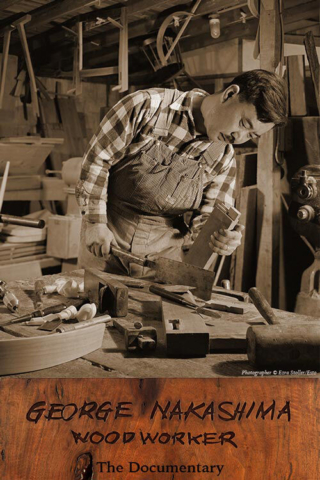
George Nakashima, the late internationally known New Hope-based architectural designer who preferred the title woodworker, is the subject of a new documentary, “George Nakashima, Woodworker.”
Written and by the artist/artisan’s nephew John Nakashima, the two-hour independent film examines a series of journeys. One is the filmmaker’s own and starts with a youthful recollection of his Midwest family’s 1965 visit to the New York World’s Fair where, as he tells viewers in his narration, corporations presented their visions of the future — one in which nature is subservient to society.
A seemingly secondary trip included a visit to his uncle’s studios in nearby Pennsylvania and meeting a man who spoke about the souls of trees and desire to work in partnership with nature to create art and beauty.
Fifty years later, the filmmaker says he needed to revisit that moment and a uncle whose life influenced not only his entire family but the paths that the filmmaker and his artist brother decided to take.
The film then focuses on the physical journey of George Nakashima through vintage photos, radio and television interviews with the woodworker, and more recent interviews with associates, colleagues, studio workers, and family members. The latter includes his wife and especially daughter, Mira, who apprenticed with the woodworker and continues the woodworking practice.
In addition to telling the story of one man, the film also focuses on how quickly the world changed in the early 20th century and picks up threads starting in Japan, where Nakashima’s grandfather had been a samurai, and continues with the woodworker’s father and mother moving to Seattle, Washington.
There they decided to live in an ethnically diverse “American” community — despite the fact that the senior Nakashima worked for a Japanese/English newspaper and taught classes in a district populated by Japanese citizens.
Other epochs include the rise of modernism, the Great Depression, World War II and the Japanese internment camps, and post-war America.
However, it is the personal journey that is the focus, and viewers join the future woodworker’s engagement with sports and more importantly the Boy Scouts hiking and the camping trips that fostered his physical and aesthetic connections to nature.
The narrative follows Nakashima’s study of forestry and then architecture at MIT, where the future designer is exposed to the leading proponents of modern architecture. A scholarship to France follows and allows Nakashima to be impressed by the communal spiritual expressions found in its ancient cathedrals.
Indeed spirituality becomes another journey as the young designer travels to his ancestral homeland and contemplates its temples and celebratory centers.
He also finds employment working on Frank Lloyd Wright’s Imperial Hotel and develops an important relationship with the hotel’s design assistant, Antonin Raymond, an architect who had also worked with Cass Gilbert on the Woolworth building.
As the viewer learns, the relationship with Raymond was providential. He connected the woodworker to a building of an astrum in India that freed him by satisfying his spiritual yearning and connecting spirituality with meaningful creation and design. It also connected him to one of the first modern designs in India.
Raymond and his wife, artist and designer Noemi Pernessin, also literally freed Nakashima and his wife and daughter after they were placed in a Japanese internment center during World War II. The Raymonds sponsored them and brought the family to New Hope.
Since after observing a shoddy construction of a Frank Lloyd Wright building and need to feel more control of his own spirit-charged works, Nakashima had turned away from buildings and focused on wood working, and ironically finding a mentor while in the detention center.
New Hope’s natural beauty and its proximity to sophisticated East Coast cities proved to be the ideal location for him to establish his life’s work. And the film then follows Nakashima’s career — including his brash but successful move to send designs of his Japanese and early American influenced furniture designs to the curator of design at the Museum of Modern Art — effectively putting the woodworker in the thick of post-war American culture and connecting him with prominent furniture design companies.
With attention given to the woodworker’s aesthetics of creating personal, well-crafted, and spiritually infused works, it is natural that the film reflects the same. Visually, the varied types of images have been arranged and toned to flow and quietly engage — such as when the woodworker’s written statements appear and words change color as the narrator reads them.
Aurally, John Nakashima’s mellow voice flows and is supported by a consistent soundtrack that combines original music by Jacob Yoffee and recordings of Hindustani classical music to evoke both a sense of the ancient Japanese and the contemporary ambient works.
The various threads of the film generally hold. As noted, the film has two personal journeys. The filmmaker’s overlaps with the woodworker family’s perspectives offering degrees of pertinent observations.
The comments by colleagues and design professionals are also interesting. And while artist Bernarda Bryson Shahn appears early in the film to offer a comment, she never reappears to continue the conversation, though she and her husband, American artist Ben Shahn, had a artistic and personal relationship with Nakashima — he designed facets of their Roosevelt home, and Shahn created a wall-sized outdoor mural for Nakashima’s hand built artist “compound” where Nakashima designed an innovative modern building that inspired him to create his most advance furniture.
Additional comments from Shahn and other artists Nakashima interacted with in the New Hope and Roosevelt region would have added another layer in an already heavily layered and ambitious and successful undertaking that ends on Nakashima’s final physical statement — the immense peace tables design to be located around the globe and presented at the Cathedral of Saint John the Divine in New York City in 1986. Nakashima died in 1990 at age 85.
Celebrating a man who stuck with his principles and who embodied the samurai ethos of meeting any expected challenge with an ethical and productive end in mind, the film tells the tale of gentle triumph — an individual whose physical and spiritual travels led him into a career that embraced irregularity, simplicity, devotion, and a creativity akin to a life of prayer and meditation.
“George Nakashima, Woodworker,” available for streaming, $15, or on DVD, $30, or Blue-Ray, $35, at www.nakashimadocumentary.com.