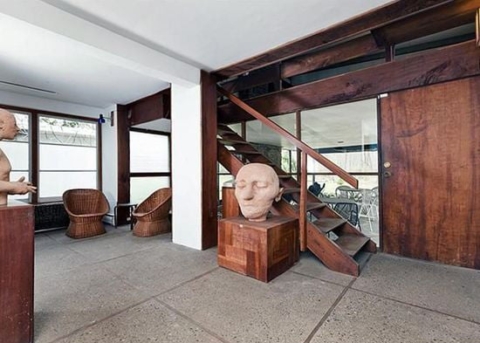
Preservation New Jersey’s recently released 2021 list of important state structures that need to be watched for damage or destruction included one important to the New Jersey arts community, the Shahn House & Studio in Roosevelt.
The house on 20 Tamara Drive was constructed in 1936 as part of Jersey Homesteads — the original name of a New Deal project to move Depression Era-effected Jewish garment workers from New York City and establish an agricultural-industrial cooperative community for Jewish garment workers and farmers.
The town was built on a model that placed modernist Bauhaus-influenced homes in a Garden City-like setting.
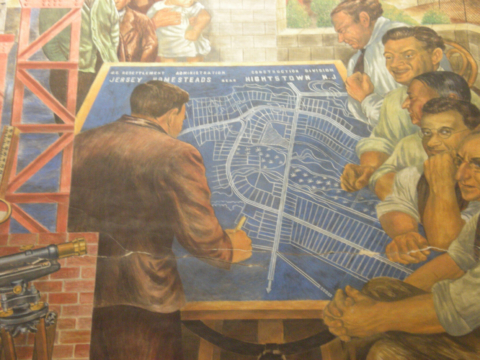
The Shahn house takes its name form Roosevelt’s most prominent residents, American painters and illustrators Ben Shahn and Bernarda Bryson Shahn. Ben Shahn was the artist for Roosevelt’s now iconic mural created during the WPA.
When Ben Shahn died in 1969, Bryson remained in the house until her death in 2004. In 2010 the family decided to sell the home and placed a preservation easement on the property through the New Jersey Historic Trust to protect its significant architectural heritage.
The building was one designed by architects Alfred Kastner and Louis Kahn. Additions, modifications, and interior work were developed by 20th century woodworker, furniture designer, and architect George Nakashima, whose studios and workshops outside New Hope still produce furniture.
While the current owners of the Shahn house have recently addressed some interior repairs and installed a new roof, PNJ urges the owners to provide the attention it needs and deserves, and a fresh look at the designers may help demonstrate why.
The more noted of the two original designers is Kahn. Recognized as one of the most influential architects of the second half of the 20th century throughout the world, the Philadelphia-based architect was recognized for combining modernism with ancient grandeur. His ground breaking design is the Trenton Bathhouse created for the Trenton Jewish Community Center, now part of Ewing Senior and Community Center on Lower Ferry Road.
Yet Kastner deserves a fresh look.
Born in Germany in 1900, he studied at the State University in Hamburg, and worked in Austria, Germany, and Holland before coming to the United States in 1924 where he worked as a draftsman for several active New York architecture companies, including designer Joseph Urban, a pioneer in Art Deco design.
Kastner established his own reputation with a series of international successes — winning designs for the Ukrainian National Theater in Kharkov, 1929, and the Palace of the Soviets, Moscow, 1930, with partner Oscar Stonorov.
In 1934 Kastner and Stonorov designed Philadelphia’s Carl Mackley Houses, called the first limited, divided, self-supporting housing project financed by the Public Works Administration.
Rather than create a tenement building, the architects used the new international style to create buildings with open space and communal areas, including a swimming pool.
After establishing his reputation as a reliable public housing designer and planner, Kastner was hired to oversee America’s first fully integrated communities, New Jersey Homesteads.
In addition to overseeing the now historic site, Kastner made two important decisions. He tapped painter Ben Shahn to paint the now important mural in the town’s public school and hired the then-unknown Louis Kahn as his assistant.
The two Philadelphia-based architects shared a belief that architecture could be socially useful, had been influenced by the Bauhaus, and admired works of the architect Le Corbusier. That modernist architect had addressed housing problems in a Paris slum by creating Immeuble Villas — a modernist structure of blocks of stacked cell-like apartments.
The WPA called New Jersey Homesteads’ sleek and flat roofed buildings designed “for efficient, comfortable and gracious living…equipped with modern conveniences unknown in even the better class tenements.”
While some critics saw it as fit for Soviet Russia or “a mathematician’s nightmare,” the Museum of Modern Art included Kastner’s New Jersey Homesteads and Mackley Houses in its 1939 exhibit on modern architecture.
While Kahn went on to create large modernist projects, Kastner served as the city architect for Albany, Georgia, and worked on major post-tornado reconstruction projects.
He then served as director of the bureau of advanced housing at Princeton University from 1965 to 1971, where he explored housing construction techniques.
As one source puts it, Kastner’s work was international in scope, but he concentrated on commercial and residential projects in the Mid-Atlantic region of the United States.
The third — and later — designer for the Shahn house is George Nakashima, a wood designer whose works “represent the nexus of various craft-based traditions, ranging from American Shaker design to traditional Japanese joinery. Among his many celebrated forms, Nakashima Tables are cherished for their live-edge, naturalistic surface positioned atop a man-made architectural base, united in harmony,” according to the Smithsonian Institute.
Nakashima was born in Spokane, Washington, in 1905, to Japanese immigrant parents who prepared their son for a college education.
However, he attributes much of his artistry to his Boy Scout hiking and camping experiences where “these trips dramatized for me the joy of living simply, close to nature.”
In school at the University of Washington, Nakashima studied forestry before transferring to the architectural department after two years. After earning a scholarship to Harvard, he followed by attending M.I.T. and working with Antonin Raymond — a disciple of Cass Gilbert and Frank Lloyd Wright. He then spent several years studying and working in Japan and India where he became interested in Asia’s tradition of fine craftsmanship.
He returned to the United States in 1939 and was disappointed by the architecture movement and the work of Wright and decided to make woodworking his life’s work.
The plan was put on hold after the Japanese bombed Pearl Harbor and Nakashima, along with thousands of other Japanese citizens in the Northwest, was sent to an internment camp where he collaborated with Japanese woodworkers to create designs made from scrap wood.
Eventually with the support of former employers and colleagues, Nakashima was released from the camp and was given a place to stay at Raymond’s farm/studio in New Hope, Pennsylvania.
There he established himself as an artistic craftsman, interacting with other designers and artists, such as Bucks County designer Harry Bertoia, and Roosevelt, New Jersey, artists Ben and Bernarda Bryson Shahn, and the influential Knoll design company.
Eschewing mass-production and embracing an artist’s approach to letting the wood be the soul of the project, Nakashima emerged to become in the words of Architectural Digest, “the preeminent name in classic modern and contemporary furnishings.”
Summing up his work, Nakashima says, “Since I am a woodworker, the practical aspects interest me primarily. The materials used, the utility of an object, the forms developed are vital. The necessary skills and the resultant beauty must be there. Arts and crafts should be based on pure truth, taking materials and techniques from the past to synthesize with the present. We should be content to work on a small scale and integrally with nature and not violate it.”
While Nakashima created interior designs for the Shahn house, the artist in turn created a large mosaic mural on an exterior wall of one of the woodworker’s buildings on the grounds of the New Hope studio and workshop — currently closed for the pandemic.
Summing up the Shahn’s house current situation, PNJ notes despite owners involved with a “preservation easement on the property through the New Jersey Historic Trust to protect its significant architectural heritage, the new owners had an interest in Kahn and Nakashima’s work and expressed their intent to restore the home. However, due to a work relocation, they were never able to fully occupy the home, and it has suffered from a lack of attention and regular maintenance over the years. Unless the property receives the full attention it needs and deserves, it will continue to deteriorate. Preservation New Jersey encourages the Trust to maintain the intent of its easement and work to ensure the preservation of this important resource.”
For more on Preservation New Jersey and other houses on its 2021 Watch List, visit www.preservationnj.org.