Those looking to get moving into the new season can easily do it by moving to music, thanks to several area dance organizations.
One is Central Jersey Dance.
It’s a nonprofit organization that has been hosting dances in the Mercer county community for more than 20 years.
As active member Jackie Stone says in a recent note, “As an avid dancer and regular attendee for the past seven years, and additionally a board member for the past eight months, I believe this organization is a true asset to the community. We host three regular dances per month. Dances are open to all, usually include a lesson, and no partner is needed.”
Coming up is its “Dancing Under the Stars” free outdoor dance session held in partnership with the Princeton Public Library on Hinds Plaza on Witherspoon Street. The fun is set for Friday, September 22, 7 10 p.m.
While this musical mix event is the last of its outdoor summer dances, CJD doesn’t miss a beat.
Coming up is “No Name Dance Swingin’ Evening of Cal-Mix,” Saturday, September 30, 8 to 11 p.m. (with a Hustle lesson at 7 p.m.).
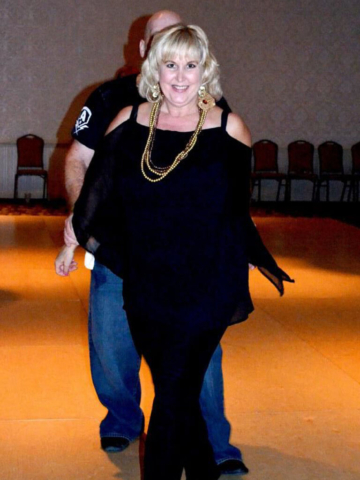
The night features Disco America Dance Championships founder Donna Boyle showing dancers a new twist on the Hustle and then “spinning the disks as DJ and playing a great playlist of all favorite No Name dances, including East Coast Swing, West Coast Swing, Hustle, Rumba, Night Club 2-Step, Country 2-Step, Cha Cha, Bachata, Salsa and more.” Boyle will also take requests and get on the dance floor.
The event with instruction and refreshment is $15 per person and takes place at the Suzanne Patterson Center, 45 Stockton Street, Princeton. www.centraljerseydance.org.
While Hustling and Rumba may be just right for some, others may be looking for something different.
Yet, sometimes, it’s difficult to step out when it isn’t clear what you’re stepping into.
Hopefully my following visits to three other regular dance groups may be just the ticket to get you on your feet and get your dance card stamped.
Tango
Viva Tango, meeting at the Patterson Center and elsewhere, is a Princeton nonprofit dedicated to “furthering public education, interest, and awareness of Argentine Tango, Argentine Music, and Argentine Culture.”
Designed mainly for dancers who know the basics, the monthly sessions mainly include a class or workshop and then an open dance to recorded music. But once a month the dancing is supported by the presence of a live tango-performing group or artist.
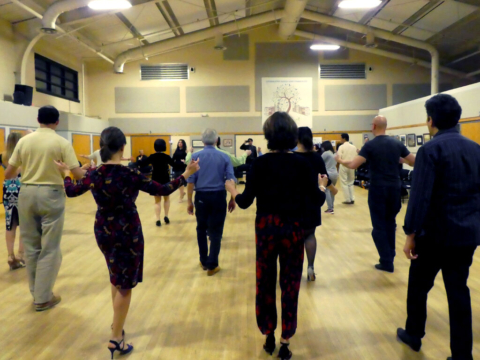
When I make a Thursday night stop at the Patterson Center, a guest artist is busy demonstrating a series of traveling-forward steps to 40-some adults.
Most dancers seem to be over the age of 40, and there is an approximate balance between women — many wearing dresses and high heels — and men, with some in ties and stylish shirts.
I take a place in the rear of the group and try to follow. And as I struggle as to recall movements learned in the tango lessons I had taken several years ago, suddenly the guest changes focus and announces people should form a circle and find a partner, putting the “no partner needed” statement found on the group’s website to the test.
Like the odd kid at the prom, I observe regular attendees, friends, and couples gathering together. A partner-less woman gestures for me to join her, and I take her left hand in mine and put my right hand on the small of her back. Meanwhile, a guest artist starts demonstrating a series of steps that require a rebound (or bounce). He and a woman selected from the group do it a few times before he says “Okay” — as in “Let’s do it!”
When they finish the bright overhead lights go down, mood lighting goes up, tango music plays, and the real dancing begins — with some couples moving awkwardly or mechanically. But others are more expert, close their eyes as if enchanted, and glide across the floor.
I have a quick chat with one of the organizers who reminds me that they partner with the Princeton University Tango Club and its beginner session (see U.S. 1, March 29, 2017). Yet they won’t turn beginners or anyone away, especially during the special events featuring live musicians or nights where tango fashions are featured.
But the good news for those who want to get the basics down is that a six-week series is set to begin on Tuesday, October 17, offered by the Princeton Adult School.
Viva Tango, Suzanne Patterson Center, 45 Stockton Street, Princeton. Thursdays, 8 p.m., $15. 609-948-4448 or www.vivatango.org.
International Style
Princeton International Folk Dancing, a nonprofit uses the tagline “Beginners are welcome! Old pros are venerated!”
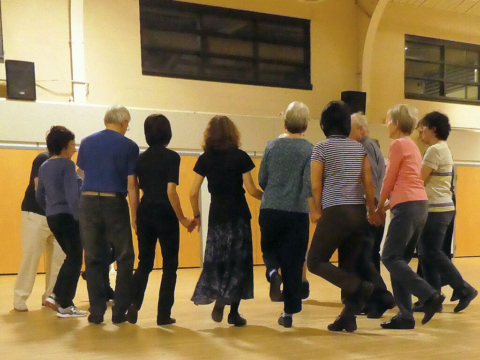
The mood during a Friday night session is noticeably looser than the tango one. Walk in, drop the admission charge in the donation jar, and check out the cookies and soft beverages. Then take a look at the group of a dozen women and men working on a type of dance easily summed up as Greek line dance. The dancers are dressed more casually — with women wearing soft or sensible shoes. Blue jeans are the norm, and only one woman wears a skirt.
This evening’s coordinator, Princeton area physicist Boel Denne-Hinnov, is stationed to one side of the room. She picks up her microphone and announces a dance from Bulgaria and then pushes a console button.
The music is slow and stately, the dancers solemn and thoughtful as they execute the steps.
Meanwhile, a steady stream of participants arrive and greet one another like old friends.
While some rush to join the line, others head to the far wall where poster-sized sheets of paper serve as a dance request list — they range from a Romanian folkdance to the Maple Leaf Rag.
Since the website mentioned a class, I am waiting for a way to get involved and notice dancers watching from behind and imitate the dancers forming the line and later a large circle. I join them and try to figure out the patterns and steps and just abandon myself to making mistakes.
When I stop, I watch a few regulars say hello and offer some advice or info. During the give-and-take I learn that tonight is “dance night,” the weekly session where regulars get to apply the steps learned over the past several weeks.
A visual estimate indicates again that most are over 40 and that about two-thirds are women.
One regular and I start chatting, and she tells me many of the people who have been coming for years are professionals. There are teachers, professors, scientists, artists, and museum curators.
The group of dancers has swelled to around 50 and a fast-moving Greek dance has begun.
I shrug, start following, and am moving something like this: step, step, step, stomp! I don’t really get it, but I decide it doesn’t matter. After all, it’s a nice night out.
Sessions are Tuesday nights, 7:30 to 9:30 p.m., at Christ Congregation, 50 Walnut Lane, Princeton, and Friday nights, 8 to 11 p.m., at the Suzanne Patterson Center, 45 Stockton Street, Princeton. Admission is $8 but free for first timers. www.princetonfolkdance.org.
Morris Dance
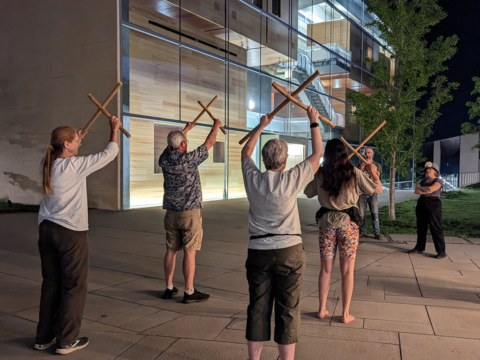
It’s the Millstone River Morris Dance Team’s regular Thursday night practice session, and I’m attempting to do some sort of odd bouncing step next to the Lewis Center on the Princeton University campus.
I am not getting it and not likely to get it as the session winds down.
But I am not concerned. I joined as a group member, so I know I’ll have another opportunity to get it next week.
I got involved last autumn when I decided I was going to make a change at work and wanted to get out and move more.
While I knew what was available in the region, I also knew that I wanted to do something that touched on my interest in ancient rituals and folk practices.
After connecting Morris Dancing to another one of my cultural interests, the Philadelphia Mummers, I decided to give Millstone River a try, went online, and connected with Louise Senior.
She is listed as the group’s squire, or its public representative.
After a short email conversation, I was invited to show up for practice on the university campus.
There I met and learned about a core group, including Senior, a garden educator at Riverside School in Princeton; her husband, Rutgers University professor Dunbar Birnie; musician Brian Hudson; and Highland Park-based writer and editor Amy Livingston.
In addition to being married to Hudson, Livingston is also the foreman of the group.
I don’t think anyone knows much about the actual origins of the Morris,” she says. “There’s a lot of speculation that it might be in some way related to ‘Morris,’ perhaps by way of ‘Moresco’ in Spain, but there’s no proof. We do know that Morris dancing has been part of English culture for centuries. It was already old in Shakespeare’s time; Hamlet laments that ‘the hobby horse is forgot,’ implying that this old custom is beginning to die out. But it survived and went through a big revival around the start of the 20th century, and Cecil Sharp brought it over to the Americas and got the Morris merriment rolling on this side of the pond.
About her involvement with the dance form, Livingston says, “I first came to see Millstone perform on the battlefield on May Day, 1996, at the suggestion of a former boyfriend. I wasn’t initially enthusiastic about getting up before the crack of dawn to watch a bunch of weird dancers, but I ended up loving it.
“By May Day, 1997, the boyfriend was out of the picture, but I showed up on my own to see the dancing again, and when Millstone said they were looking for more dancers, I joined the team, and I’ve been with them ever since. So, as of last month, I’ve been with Millstone 25 years — more than half my life.
The biggest challenges I face now are related not to the dancing itself, but to my role as foreman, trying to get new dancers up to speed and trying to give them more help and encouragement than I had at the beginning.”
But when it comes down to the basics, Livingston says that involvement in Millstone, “Gets me off my butt and forces me to move around.”
I know the feeling.
Millstone River Morris Dance Team meets Thursday evenings, 8 to 9:30 p.m. Free. www.princetoncountrydancers.org/millstone-river-morris.