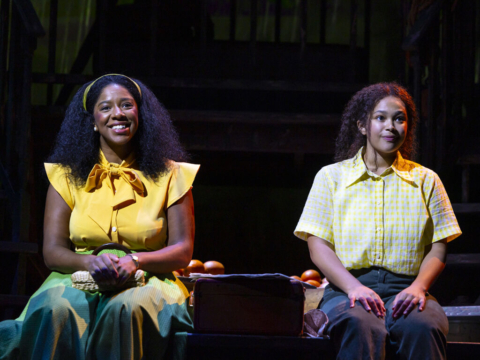
“Bulrusher” unravels before you with so many ideas, themes, plot twists, revelations, and surprises, the play is difficult to characterize neatly.
Except Eisa Davis’s writing brims with so much wit, wisdom, sentiment, and pure, unspoiled humanity, “Bulrusher” doesn’t need to be categorized to be enjoyed. Make that savored.
Nicole A. Watson’s production for Princeton’s McCarter Theatre effectively brings out the best in Davis’ work by letting it proceed as a rich, yet simple slice of life. Abetted by a universally excellent cast, Watson lets you see and bask in all that Davis deftly cooks up.
Which is plenty. The charming, engaging thing about “Bulrusher” is its abundance and even its poetic moments are couched in a directness that keeps you riveted to every second of it. It’s thought-provoking, full of astute observation, and accessible at once.
Adding to its rewards is “Bulrusher” being a tautly constructed full-length play. Davis avoids what I call the “90-minute wonder” that so blightingly dominates 21st-century theater. Rather than a single-pointed piece that dances around its payoff with scenes of partisan blather, Davis refreshingly provides depth and scope. “Bulrusher” addresses many subjects — identity, racism, relationships, parochialism, individuality, community, personal satisfaction, freedom, and love, genuine, unexpected, requited, unrequited, delayed, patient, experienced, naïve, seething, violent, and purchased — it could be daunting in its detail if Davis wasn’t so smart and Watson wasn’t so clear in realizing her humor and intent.
Lawrence E. Moten III’s set loads even more texture to Watson’s production. Atmospheric, provocative, and alive on its own with movement and lushness, Moten’s creativity mixes with practicality to match the essence of Watson’s overall staging, encompassingly ample yet authentic and purposeful.
There are moments, including a crucial scene at the end, in which Davis doesn’t quite weave “Bulrusher’s” multifarious threads into a perfect braid, but they are few and relatively inconsequential. In general, Eisa Davis, Nicole A. Watson, their superb cast, and their shrewd designers have crafted a flowing, evocative, joyful occasion of theater that not only impresses and satisfies but engenders the kind of affection it depicts.
“Bulrusher” introduces us to a setting that suggests a Hillary Clinton village. The denizens of a small town, Boonville, or Boont, near Mendocino, California, but as self-contained as Mendocino is expansive, are individual to the point of being eccentric yet cohesive and connected enough to be a genuine community in which one resident can trust another with his or her dignity and well-being.
The time is the middle 1950s, and while Boont is primarily white in population, its compact borders include Native Americans original to the area and the rare Black person. Davis and Watson make clear the acceptance the main characters display while, this being the ’50s, those characters speak openly about divisions, prejudices, and friction elsewhere. A character arriving from Alabama, one whose Blackness precluded her being served in most shops and restaurants along her route to California keys us into the difference between the American South, the border states between Alabama and Nevada, and the more open and pretty much nascent American West.
Boonville is so parochial, Davis provides it with its own language, Boontling. People in Boonville “harp the ling” and have their own terms, easily decipherable in context, for various kinds of behavior and even more various sexual acts and attitudes. McCarter minimizes confusion by providing a glossary of Boontling in its program.
Each character we meet is closely connected with another. Love in all the assortment mentioned above is the main link between them. Watson’s cast makes you feel them smolder as one character looks longingly or reproving at another whose posture and expression exudes valentines.
Love is a defining factor in most Boonville relationships, but so is basic human compassion. The allegedly toughest, most hard-hearted, and pathologically practical resident can have her standards softened and hauteur notched down a peg in response to the authentic, unaffected need of another.
Ultimately, refuge or the bad luck of being born there brings folks to Boonville. Degrees of love keep them there.
While Davis nimbly fleshes out each character, creating absorbing complexity and giving each character a claim to our attention and regard, the focus is on the title character, Bulrusher, so named because her mother, abandoning her in infancy, chose to put her in a reed basket and float her down the Navarro River like a latter-day Moses. The baby’s survival instincts kept her alive after she landed in the brush by Boonville, was found by one man there, the lone Black man, and raised by the town’s schoolteacher.
Bulrusher is of mixed race. When we meet her at age 18, she is a cognate to so many of the contrasting elements in Davis’ play, being adept by observation at knowing the vegetation and river life in Boonton but being as innocent as Congreve’s country wife in understanding the sophistication of the world. Bulrusher can adroitly prevent calamity in nature but can blurt out things others would be wise or prudent enough to keep to themselves.
Also, in keeping with Davis’ emotional dichotomies, the cast for “Bulrusher” shines individually while blending together as a perfect ensemble. You believe all these characters have known each other for years and can predict each other’s moves as surely as Bulrusher can read the future in water currents.
Jordan Tyson is lovely in the title role. Part adventurous tomboy, part brat, and part attractive feature feeling her way towards adulthood and all that come with it, Tyson captures the opposing forces that make up Bulrusher. She makes her the ultimate creature of nature, attuned to the environment around her, and smart at both business and survival. Yet she is also innocent beyond naivete at the workings of the heart or the choices the adults around her make.
Shyla Lefner, so impressive in last winter’s “Between Two Knees” at McCarter, scores largely again as Boonville’s most rigid resident, who also runs the town brothel and is called solely Madame with the accent insistently on the second syllable. Lefner is a master at nuance. You see Madame’s hardness crack though Lefner’s face never changes. In Madame, Davis once again presents all sides of an octagon-shaped coin. Lefner subtly but clearly displays every one of them.
Jeorge Bennett Watson relaxes moments with his easygoing, live-and-let-live portrayal of a man who picks up side jobs during the week to spend weekends at Madame’s house. At home in Boonville, where him being Black doesn’t matter, Wilson makes Logger the picture of reason and contentment, even when the character is faced with confusing situations and tough decisions.
Cyndii Johnson provides fresh air at just the moment it’s needed when Vera, fleeing a situation in Alabama, comes to Boonville. Johnson is so quick and pointed with Davis’ smart, funny dialogue. She also joins her castmates in being so natural even as she wrestles with various emotions and genuine personal dilemmas.
Rob Kellogg is all energy, wide-eyed bluster, spirited joy, and yet sincerity as a character called simply “Boy.” Just watching Kellogg dance is a treat. Seeing him give facets to “Bulrusher’s” least dimensional character impresses greatly. Jamie LaVerdiere is all firmness and quiet longing as Schoolch, the teacher who raises Bulrusher and spends most of his non-academic hours at Madame’s hoping to make an honest woman of her.
Lawrence E. Moten III’s magnificent set, a show on its own, is matched by Valerie St. Pierre Smith’s astute choice for costumes, especially for Madame, Sherrice Mojgani’s mood-creating lighting, Kate Martin’s sound design, and Eisa Davis’ original music.
Bulrusher, McCarter Theatre, 91 University Place, Princeton. Through Saturday, October 7, Wednesday and Thursday, 7:30 p.m., Friday and Saturday, 8 p.m., and Saturday and Sunday, 2 p.m. $25 to $60. 609-258-2787 or www.mccarter.org.