There is a small, easy-to-miss house in a quiet post-World War II Hamilton development that is the home of an unexpected beauty — one that has spread both regionally and nationally.
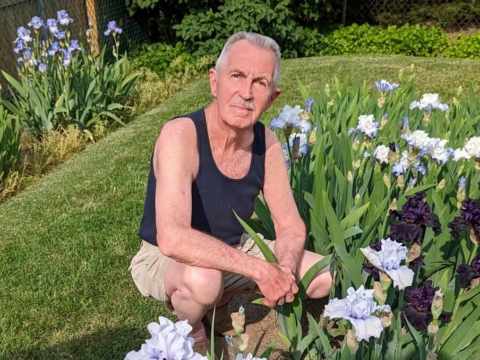
Meet George Hilton, one of the region’s active practitioners of the quiet art of hybridizing irises — an ancient practice with roots leading back to circa 1800 B.C. Syria.
But for Hilton, 78, his devotion to the flower connected with deities and a world of color is pretty much an everyday thing.
“I always liked irises because my mother had them,” he says referencing the garden his housewife mother tended in Wilmington, Delaware.
That’s where he grew up and spent some early years working with his cabinet-maker father.
Hilton says he started growing irises after some personal journeying: studying biology at colleges in North Dakota and Delaware, moving from cabinet making to being a teaching assistant in Pennsylvania, and eventually becoming an employee with the Mercer County TRADE program. He has since retired.
A personal relationship brought him to Hamilton Township, where he and his partner have lived for 37 years.
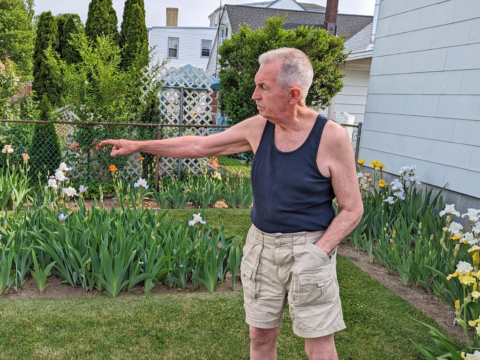
It is also where he renewed his interest in gardening and irises in a plot of land where it would be difficult to accommodate a built in swimming pool.
As he tells it, a friend moved to Lawrenceville and told him that she had discovered irises on her property.
Used to the common type of blue irises known as flags, he says he was astonished when he went over and saw “modern day” irises that were “so beautiful. These were multiple colors. I was just fascinated by them.”
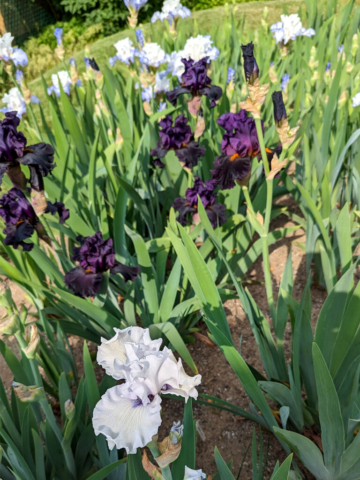
He soon began working with these “bearded” irises — the variety whose with a bit of fuzz on the petals — at both his friend’s place and at home, where he plants the flowers in plain and tidy rows.
“It became an obsession,” he says, adding that in 1999 he moved into hybridization and “made my first cross” — as in cross-pollinating.
And while he reached out for information from the American Iris Society (AIS) and its New Jersey affiliate, the Garden State Iris Society (GSIS), he sums up the process with simply transferring pollen from one plant to the pistil of the other “to see what happens.”
That includes seeing what was in the plants’ family history. For example, he says he crossed two samples of yellow irises only to find that one of its seeds produced a lavender iris.
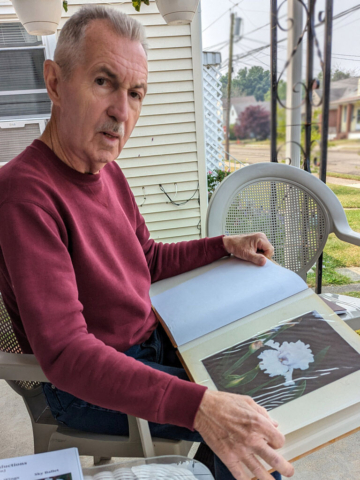
He then consulted the genealogy of the specimens — keeping his own records in a handy brown volume — and found that one of them had a lavender-hued parent.
“You never know what you’re going to get,” he says about the slow moving and mysterious process. “That’s what makes it exciting.”
Hilton also admits that it is exciting when his hybrids get recognized. As in the case of having his hybrids receiving AIS awards. That includes the Contemporary Award-for Best New Iris for “a divine new offering from a new hybridizer from New Jersey” and “not just another white — it has flawless plant qualities and a very sophisticated flower.”
His irises have also gained him a mention on the GSIS’s list of prominent active state hybridizers and is proud that one influential Iris Society member said one of Hilton’s hybrids was one of “the most beautiful irises he had seen.”
“That’s all it takes,” he says about being satisfied.
Hilton says he slowly emerged to become one of the only iris hybridizers in a region where it was once prominent — thanks in part to the internationally known iris breeder Frank Carr in Bordentown.
“I am, to them my knowledge, the only individual in a 20-mile radius who grows (hybrid irises) to this extent.
“We used to have a regional iris group here up to about eight years ago, but a lot of the old-timers passed away and the young people didn’t keep it up. The chapter merged with a chapter in Philadelphia.”
He says that change has disrupted some past practices, including members involved with the Carr Iris Garden in Bordentown’s Hill Top Park.
There are, he adds, several iris farms and companies in New Jersey. Among those mentioned are the Grinder Family Farm in Crosswicks and Lambertville Iris Patch.
Hilton also has a little toe in the iris trade: selling to cover the costs of ads placed in state and national publications to let the public know that his new “introductions” are available — at $55 per bulb.
And while it isn’t a business, it does have some regional product appeal. His neighbors, friends around the region, and the businesses he deals with around the region all grow his plants.
And thanks to a fellow county employee, Hilton’s irises have been introduced into Sayens Garden and other parks around the county.
“I am growing New Jersey, one iris at a time,” he says.
But what about the do-it-yourselfers who don’t want to drop $50 for a new iris?
“Go buy an iris for $2.50 or $3. It is really inexpensive. There’s really not that much needed: ground, good drain soil, and the love of flowers. You put it in and they grow. They’re an easy plant to grow.”
And for those who want to venture into hybridization, he says, “All you need are two irises, a pair of tweezers, garden tags, and a pen. You pull the stamen off one flower and wipe the pollen on the stigma of the other.”
Then start looking for the signs that the fertilization has taken place. “When the flower dies back, the ovary will swell and will continue to grow and grow and looks like a little watermelon. Then you keep that on the stalk until it dries. When it does, there is a split on the top and you dump the seeds out. The seeds are a deep reddish color and they have a pyramid or triangle shape. Then you put them in the ground in November or before the ground freezes. If they germinate then (you’ll see them) in April. But sometimes they will germinate in two or four years. It is very easy.”
That said, there are things that the novice iris-grower should know. The plants need sandy soil and sun: a full day is optimal but a half-day works.
Also, too much water and their rhizomes — or part of the stem — will rot. So plant the bulb half-in and half-out of the soil.
Other things to look out for include fungal growth, such the non-deadly but ugly Leaf Spot, and Iris Bores. And if you have the tall variety of irises, “you have to use a stake,” he says.
Although the iris flower season has peaked, Hilton says he is preparing for July when seeds will be ready for shipment to those looking to add to variety to their gardens.
But no matter the level of entry or interest, Hilton says iris growing appeals to “everyone across the board: men, women, children of all nationalities. People who are rich and poor people who enjoy beautiful flowers.
“Iris was the goddess of the rainbow, and irises come in every color. There is so much variety that attracts people.”
And for himself?
“When I go out there, my mind is clear. I am thinking about the iris and pulling weeds and all my trouble pass away.”
“You plant a flower and it grows and it gives you a sense of peace and calm” and “an appreciation of nature. This is what god created and what is more beautiful than that?” he asks on the porch of his small, unassuming Hamilton home.
To find out more about Hilton’s irises, contact him at gahjr46@aol.com.