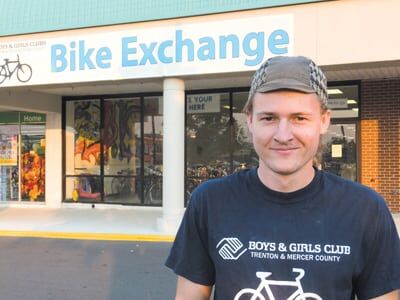
Wills Kinsley is more a wheeler than a dealer, though the 25-year-old Trenton-based entrepreneur, mechanic, and artist is getting a lot of good street press for his bicycle-related enterprises.
That includes his job as a bicycle maintenance instructor at the Boys and Girls Club Bike Exchange in the Capital Plaza shopping center in Ewing, his bicycle-themed art exhibitions and artistic treatments, and his monthly First Friday night bicycle tours — or “Social Rides” — in Trenton (bring your own bike).
The next bike up (a different level of a “meet up”) is set for this Friday, September 6, leaving at the regular take off time of 6 p.m. from the Trenton Social restaurant on South Broad Street. Its focus will be a nature and history ride along the Delaware River.
Accepting the fact that he is getting known in the area as “that bike guy,” Kinsley — who prefers Wills over the formal William — readily offers that bikes are more than just part of his life. In fact, they seem to be his wheels of fortune (as in destiny).
“Both my parents went to Rutgers,” says Kinsley. “My dad was a bicycle mechanic at the time. My mother needed a bike repair, and someone told her to talk to him. I owe my whole life to bicycles.”
After his parents — his father is an antique restorer and his mother is a chemist with Firmenich, the French fragrance company with a division on Plainsboro Road — married and settled in Franklin Park, where Kinsley was raised, his father continued to work on bicycles and his son followed the practice. “If anything went wrong with my bike, I would just fix it. (My father) had the tools, and I would just go out and figure it out,” he says.
That figuring-it-out spirit is something that he took with him to Hampshire College in Massachusetts, an institution near Amherst where, as its website says, “students design their own programs of study instead of following predetermined academic pathways (no ‘off-the-shelf’ majors here).”
There Kinsley, who graduated in 2010 and had worked in bicycle shops in New Jersey and Massachusetts, says he studied critical theory (or theories of philosophy) and labor. He also began using the college machine shop to explore appropriate technology and design. “It’s about technology that focuses on the need of the specific end and user,” he says. “There were some guys there who made tall bikes,” — with extended or raised portions to set the rider high — “so I learned to weld and started then. That’s when I also learned that I could use things that were junk and free.”
Fittingly, one of Kinsley’s final college projects focused on bicycle technology and social need. “(Students) do a team project, and I did a mobile bike shop. I went out into the community and did workshops and house calls. In Amherst and Hampshire, a lot of people depend on bikes. There are five colleges and the college kids use bikes. And then there are the old industrial towns where people depend on bikes. The project was an access project to make bicycling and workshops accessible.”
He says that the idea was inspired by the work of a student who was building carts from inexpensive and found materials. “It’s ‘Open Source Technology,’” says Kinsley. “The idea is that you make something simple, a design that takes into account available resources, and instead of buying a hitch, you make it out of nuts and bolts. The idea was to make bike specific tools out of old bikes.”
It is similar to a short-lived food cart that he used in Trenton to make grilled cheese sandwiches and now various experiments with cycle trucks — a bicycle with smaller front wheels and integrated basket. “I really want to perfect that design. So I’m still tweaking that. I’m looking actually to start a small company and would welcome investors.”
The move to Trenton came indirectly through music and his role as bass player in a band called the “Bubonic Souls.” Kinsley — who had taken piano lessons but mainly learned the bass while playing with others — says, “It was like a funk band neo-funk, a college party band. All original stuff. We started in college, put out an album, and organized a tour after we graduated. The drummer and I bought this short school bus, painted black, and did a tour to Vermont, then New Jersey, then went to Chicago. The drummer and I went west. California was good. The Pacific Northwest was good. But I didn’t feel like settling down. It was too laid back. It wasn’t Jersey.”
When the bus broke down, Kinsley returned home by riding cross country by bicycle. That’s when his life shifted into another gear.
“A friend” — Maxwell Pollock who wrote half of the songs for the band — “was an AmeriCorps worker and involved with (Trenton-based street artist) Will Kasso. And Kasso was hanging out with Pete Abrams at the Trenton Atelier. My friends told me that they’re doing some crazy stuff, and I went down and have stayed since. It worked out well. They had a lot of bikes, and a lot of kids were around. And I set up shop and started making tall bikes and choppers. Then someone was involved at the bike exchange,” where he has been working since last October.
When asked to explain a chopper, Kinsley says it “is any sort of extending or lowering. It’s typically when you extend the fork of the front of the bike and use home-made elements. Something you can’t buy at a store.” He adds that it is also impractical and sometimes dangerous.
The bicycle art also started in Trenton. “Before I was mainly functional, like the trailer, and I never made something that wasn’t functional. The ‘ride-able’ art is equal part form and function,” he says.
The art bikes are often seen at Gallery 219 on Hanover Street — where Kinsley participates with the S.A.G.E. (Stylez Advancing Graffiti’s Evolution) arts group on urban art projects (they call him “the most famous man on two wheels in Trenton”) — and include custom features, graffiti or street art designs, lighting, and even sound. “Everything runs off a car battery and taking wires from car radios and lights. It’s all for fun. It’s interesting to me that cars are status symbols and desired and playing with bikes makes them like a status symbol. People get a kick out of it, something they haven’t seen. At the end of the day, it’s to get people to think about bike riding in another way and make people want to ride and have fun, which it is,” he says.
Seeing bicycles in a new way was the focus of the exhibit “Unchained — the Art of the Bicycle,” organized by Kinsley this past May at Artworks in Trenton. “Bicycles are not only the most efficient and versatile human-powered device, they are both an inspiration and a canvas for countless artists,” he says. The exhibition included sculptures, paintings, prints, and photographs by dozen of area artists inspired by or using parts of bicycles.
The interest in bikes also went off the wall and into the streets. “The tours started when I had a bike art show at Trenton Social last May. I wanted to do a check point race in Trenton. I had a map and people at all these places giving things to people to bring back. About 10 people showed up, we had fun. Then (Trenton Social owner T.C. Nelson) suggested that I do it again but make it more leisurely. It’s taken off since,” says Kinsley.
At the last ride, approximately 50 people — artists, a few lawyers, a real estate agent, and community members — showed up with bikes and for the approximately 11-mile ride through Mill Hill Park, past Trenton City Hall, and along East State Street to visit the nonprofit community development organization Isles’ site for artists, nonprofits, and business groups. The tour then moved to the New York Avenue to visit artists preparing for the Jersey Jam graffiti event at TerraCycle, to the Trenton Battle Monument, and finally back to Trenton Social.
During the recent tour, car drivers — often surprised to encounter a mixed race and age group of bicycle riders touring the city on an early Friday evening — yielded and often gave thumbs-up signs, and people sitting on their porches or walking on the street likewise cheered and waved as the ride went through their neighborhoods. A few young men, however, shouted “get out of here” and “you won’t come back here again.”
And while the only problems encountered on the tour where an occasional tire that needed to be filled, a few falls at corners, and a broken pedal, one of the route’s intersections was the site of a shooting later that night.
“There is a certain amount of danger riding your bike, driving a car, taking a bus anywhere,” says Kinsley about taking a tour through a city besieged by crime. “It’s best to be aware of your surroundings and know where you’re going. Besides that, a bicycle is the best way to navigate any city, especially Trenton, regardless of certain stigmas.”
That stigma was touched on by a recent editorial in the Times of Trenton when a Trenton resident and former reporter noted, “The perception is that because violence rages in impoverished communities, it must affect the entire city. That perception is what stands in the way of small cities from growing in the 21st century at the exact time they should be growing. Take my experience in Trenton these last four years: I’ve walked to the train station four days a week and never been accosted. How about the 40,000 state workers who come in every day? The effective crime rate for them is nearly 0.”
It is others with similar experiences and awareness that are joining Kinsley’s tours in growing numbers. “We get new people all the time,” he says. “I think the word got out by Facebook and word of mouth. People know to meet at Trenton social at 6 p.m. on the first Friday of the month. It’s a like a mini parade. The idea is to take people to places in Trenton they haven’t been to before and discover history. There’s enough stuff to keep things going for a few years. It’s a social ride. People ride together and then have a drink. It’s an idea of creating a little cycling community.”
But for the “bike guy” from Franklin Park, it is a bit more. “There’s no environment that has the freedom that there is in Trenton,” he says. “It was like a journey to get here. I was looking for something and it was only 20 miles away.”
It is easy to figure out what he used to get there and continues to use on his journey.
Social Bike Ride, Trenton Social, 449 South Broad Street, Trenton. Friday, September 6, 5:30 p.m. $10 ride special includes dinner and a drink. www.facebook.com/events/589839964401907/.