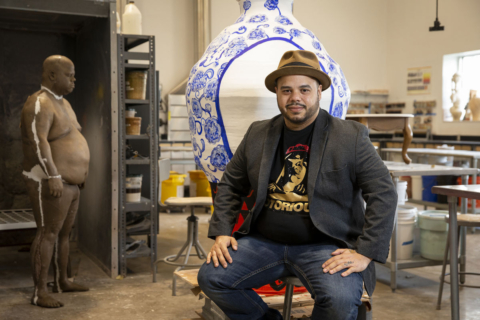
It’s a Wednesday afternoon, and Roberto Lugo sits down for an interview in his makeshift pottery studio at Grounds For Sculpture.
Beams of sunlight shine on several works in progress that he’s been working on for the past several months at the space that will be used to engage visitors in making pottery during his solo exhibition, “Roberto Lugo: The Village Potter,” opening May 22.
The Philadelphia-area ceramicist mentions that he has to watch the clock in order to get to his home to pick up his two sons, Theodore and Otto, from school, but he is also ready to talk about his journey to becoming a nationally known artist who in addition to winning the 2019 Rome Prize has work in the permanent collections of the Philadelphia Museum of Art, Brooklyn Museum, Metropolitan Museum of Art, and others.
Born in 1981 to parents who left Puerto Rico to build a new life in Camden and Philadelphia’s Kensington section, Lugo says his first connection with art was through graffiti.
His formal studies came after family efforts to improve his life — including his mother’s push to get him into a magnet school — and sent him to live with relatives in Florida.
It was there he enrolled in a community college and took a ceramics class.
Lugo says he was drawn initially to the practice because he could meet other students and have a college experience without having to write too much. He also felt that the physicality of the materials because it reminded him of something he saw in his community, physical labor.
Then he found something more. “When I started working in pottery, it felt so right. And it was the first time people gave me encouragement.”
However, he says, there was also doubt. “I realized that there weren’t a lot of people I know who were artists and none who were potters. And it made me realize how few people could make a living from the (potter’s) wheel. I tried to make functional production pottery, but I kept asking why people would buy these when (mass-produced pottery works) were cheap.
“(Then) I saw a Ceramics Monthly (magazine). It had on the cover a pot with graffiti on it. My teacher showed it to me because I had just started a series of pieces. (The cover figure) had a shape I had never seen before and used the wheel in a different way. It made so much sense to me, and I felt that moment that I could do that. That I had something to contribute.”
That also included representing the people and artists he couldn’t see in the studio.
With an imagination fired with the thought of a career firing ceramics, Lugo began finding and creating opportunities, including his decision to go to Kansas City Arts Institute, which he says has “one of the best undergraduate ceramic programs.”
“I had to go there,” says Lugo, who knew he needed a portfolio of work and money to be accepted.
“I had kiln,” he continues. “And I broke my back. I’d sell my pottery for $10 or $15. That’s how I got my portfolio to go to undergraduate school.”
From there, he applied to Pennsylvania State University to work with Chris Daly, whom Lugo calls a legendary potter and educator and mentor.
“His whole life is art. He’s very poetic. He always shared quotes and constantly acknowledged the ideas of other people. He made me want to read.”
Also at Penn State was Shannon Goff, an “influential mentor as a teacher and the first person who understood what I wanted to say with my work, understood the content.”
As part of a tribute, Lugo includes both artists in an exhibition section devoted to the artists who mentored him as well as the artists he mentored. “I wanted to show it takes a village to make an artist.”
While at Penn State, where he received an MFA, he took a leap that launched him into a gallery and into the art world.
Established California-based documentary photographer Richard Ross was on campus to discuss his work photographing incarcerated youth for a book and to critique student work.
Lugo says that at the time his brother had been arrested back in Kensington and that Ross was planning an exhibition in Philadelphia. He decided to talk to him and ask him to critique his street-inspired pottery.
“He was the first person who was actually interacting with people from the neighborhood that I was from. I didn’t understand hyper-conceptual art and art from other countries,” Lugo says.
The result? “Richard asked me to be in an exhibition.” It was the 2013 “Juvenile In Justice” exhibition at the Crane Arts Center in Northern Liberties section of Philadelphia.
Lugo says the exhibition “was one of the big things that got me out of the college mentality” and put his blend of traditional pottery, street design, and social commentary on the art map.
Asked about having the confidence to make the jump, Lugo says, “I have confidence for certain things. When it came to Richard Ross, I didn’t have anything to lose.”
Other opportunities included being an artist-in-residence at the Clay Studio in Philadelphia, an instructor at Marlboro College in Vermont, and a current faculty member of Temple University’s Tyler School of Art.
He also had a series of exhibitions, including a 2016 Philadelphia exhibition that provides a glimpse into his work, “Defacing Adversity.”
About that title, the artist says, “I grew up doing graffiti art. It was my first art form. I never took art classes before I did pottery. People often see graffiti as just vandalism. And use the word defacing. So I thought of different ways of defacing. I thought of defacing adversity. I had lots of experiences, growing up, with racism, so making art in spite of it was defacing over it, defacing it and negative things.”
Lugo’s 2018 work in the Smithsonian National Museum of African American History and Culture, “Reckoning: Protest. Defiance. Resilience” also provides an entree into his work. As museum materials note, “In this piece, potter and activist Roberto Lugo reframes the traditional color, form, and repetitive imagery of ancient Greek kraters to focus on the issue of violence that disproportionately affects people of color in economically disadvantaged urban communities, including violence at the hands of law enforcement.”
Imagery includes “figures playing basketball, a set of arms in handcuffs, a figure kneeling while pointing a gun, a figure crouching with hands on their head, a police officer in riot gear raising a baton, a police officer handcuffing another figure, a dollar sign pendant, and a city skyline.”
Speaking about the themes and images, Lugo says that while he focuses on urban situations, his intent is broader.
“I want to clarify that my entire experience is not negative, it’s about celebrating people who contributed. A lot of my work is a celebration and rooted in that. Even in situations where you find yourself with different people of color, they all have different experiences. Poverty and race are distinct.”
One way to follow his intent is to look at what inspires him. “I approach art from the place I know: hip hop culture.”
To make the point, he explains his affinity for the Staten Island hip hop group Wu-Tang Clan. “They took a combination of Kung Fu movies and hip hop and synthesized them together to give a unique sound. They gave the beauty of how you can fuse two cultures.
“I’m referencing and making connections, but I’m not trying to own that culture as an identity. My work is trying to synthesize, combine.”
And while he pulls from his interest in Royal Porcelain tea cups he also pulls from his memory.
“Both of my parents are from Puerto Rico,” he says. His father was a Pentecostal minister and spray painter, and his mother was a school cafeteria worker turned registered nurse.
“Culturally I’m from the indigenous people from Puerto Rico, Portuguese, and Spanish. It’s a huge part of what I paint and draw.”
He also pulls from his background and experiences for public presentations as both a spoken word artist and a lecturer – with both demonstrated during his 2015 National Council on Education for the Ceramic Arts (NCECA) emerging culture presentation available on YouTube.
As one cultural reporter noted, Lugo’s NCECA address wove “his background, his body of work, and poetry into one cohesive thread. His work is often views of race and poverty, filtered through the lens of his personal life” and related a “harrowing story of child abuse and humiliation at the hands of a racist school teacher and a power tripping jail warden who wanted to make Lugo the subject of his own impromptu ‘Scared Straight’ program. But even with the grim background that informs his work, Lugo resists the (more than understandable) urge to write society off. He excels in being hopeful, taking opportunities to educate, and make connections with people. His thoughtfulness is at the heart of his work, and that’s more than evident in the closing lines of his presentation.”
The above reporter also cites Lugo’s final words to the audience of 3,000 ceramic educators, “We’re a culture that can change the world.”
Lugo says having the opportunity to deliver that speech was “a huge honor” and “was the most influential thing I had done.”
He also says it started him on a different career trajectory to focus on connecting with exhibiting venues where his ceramics would be seen as “visual art and design and allowed me to take on unique projects – like working here (at GFS).”
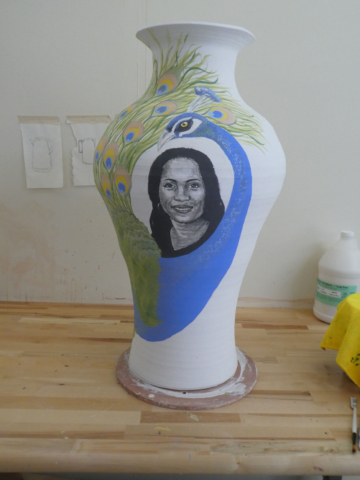
The decision also seems to support Lugo’s approach to creating. “With my particular practice, most of my time is spent painting pots. I take twice as long to paint. Part of my aesthetic is to (paint) over things. It comes from my graffiti days. I just paint over (the work) until it makes sense and all that layering gives a depth to the piece that I find appealing.”
Yet despite his success, Lugo says, “I ask myself, ‘Do I have the agency to make the work that I do?’ I ask myself, ‘Why do I have the opportunities I do?’ I think a lot of the challenges. Pottery lends itself to patience and lot of detail, two things I’m not good at. People are looking for a refinement of craft, but I fail in a lot of those ways. My obsessions are different. (But) I’m working on it. It’s a lifetime commitment.”
Looking at the exhibition, Lugo appreciates that he is exhibiting next to Trenton and mentions the city’s history as a major world ceramics producer.
And while he hopes that connection stimulates interest, he is also betting on something bigger.
“One of the great things about this exhibition is the 20-foot-tall vase,” he says.
“Usually, I make a vignette on one. But people can walk into this vase and be the vignette in the pottery and become part of the artwork. Part of the art is having people interact with it. It becomes about people remembering the big pot, not the artist. I never had the opportunity to make a piece like this, bigger than human size.”
The late afternoon sun reminds Lugo that he has to get in the car, pick up his two children, and return to the home he shares with his artist wife, Ashley.
But he has to time to share one final thought. “I really hope that this exhibition makes Black and Brown communities feel that there is art here that connects with them. I hope to be a bridge and make connections. Going into any space and gallery can be intimidating. But going into any space where there’s familiarity can be less so.”
Roberto Lugo: The Village Potter, Grounds For Sculpture, 126 Sculptors Way, Hamilton. May 22 to January 8, Monday, Wednesday, and Thursday, 10 a.m. to 6 p.m., Friday, Saturday, and Sunday, 10 a.m. to 9 p.m. $10 to $20. 609-586-0616 or www.groundsforsculpture.org.