by Michele Alperin
Artifacts have stories to tell, but to “hear” requires observing them with great care. Take the early form of computer core memory — called a magnetic memory array — that Benjamin Gross points out at the newly opened Sarnoff exhibition at the College of New Jersey (TCNJ).
The exhibition, “Innovations That Changed the World,” traces the history of telecommunications from the invention of radio to the dawn of information age. It uses objects drawn from the famed David Sarnoff Collection, now permanently housed at TCNJ after being relocated from the original Sarnoff Labs on Route 1 and Washington Road.
The curator and consulting scholar for the exhibition, Gross is also a postdoctoral fellow for sustainability in innovation at the Chemical Heritage Foundation in Philadelphia,
Gross explains what can be learned through careful visual observation of one artifact in the exhibition that shares the history of the Radio Corporation of American (RCA) Labs and the consumer electronic industry it spawned.
The magnetic memory array consists of 256 tiny magnets shaped like spools of thread, mounted in a wooden frame and held together vertically and horizontally by a grid of wires (see photo at upper right).
Gross says that he could see that each of the wires was hand threaded through the spools, which told him that constructing it was a time-intensive process. From the fact that the spools were set in a regular array, he could see that any single spool could potentially be selected by picking the correct x and y coordinates of the wires.
“You can read the lab notebook and can see it in a photograph, but if you don’t get a chance to actually see it, you might miss some of details,” says Gross. Each of the spools could be set to one or zero in binary code, and indeed these arrays were used in early computers. Given how time consuming it apparently was to put together this 256-bit memory, the question arises as to how hard it would be to move to bigger computer memory.
Not only do the scientific and technological artifacts in the Sarnoff Exhibition speak to history of science scholars, like Gross, but for people born in the mid-20th century, give or take a few years, the exhibit lays out their lives before them — from the clunky black-and-white televisions that decorated family dens (not yet designated “playrooms”); to the transistor radios teens glued to their ears; to computers so big they required a room the size of a small auditorium to house them; and finally to the liquid crystal display, or LCD, screens that today occupy our phones, computer monitors, watches, and so forth.
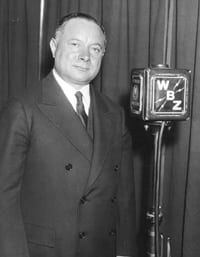
Much of the basic research behind the electronics of the 20th and 21st centuries happened in Princeton’s backyard, at RCA labs, and the exhibition — which features items from the Sarnoff Museum’s new home at the College of New Jersey — covers the life and legacy of David Sarnoff, president of RCA and a driving force behind the rise of consumer electronics.
Accordingly, the exhibited artifacts tell the story of the phonograph, radio, black and white and color televisions, the electron microscope (which RCA was the first company in the United States to commercialize), semiconductors and integrated circuits, computers, home video players, and flat panel displays.
Sarnoff’s life was a real life Horatio Alger story. Having immigrated to the United States in 1900 from Uzlian, now in Belarus, this technological autodidact eventually climbed his way up to becoming one of most important industrialists of the 20th century.
Given Sarnoff’s critical role, Gross and his co-curator, Emily Croll, the director of the collection and the art gallery at the college, decided they wanted the exhibition to include a biographical section, using both artifacts and related archival materials that now reside at the Hagley Museum in Delaware. “We worked closely with Hagley to find photos and advertisements that would help place the documents we found in a broader social, political, and economic context, to tell a broader story that will appeal not just to engineers but to people interested in the history of business, communications, and consumer culture,” says Gross.
Sarnoff worked early on at the Marconi Wireless Telegraph Company, which led to his lifetime interest in electronic innovation. While at Marconi, he used its wireless telegraph in 1912 to find out the names of the Titanic survivors, by tapping out Morse code (the telegraph is part of the exhibit).
Lots of photographs of Sarnoff working in various radio and telegraph stations attest to his unmatched interest in the technological side of his business. He had a bedroom set up in Princeton so that he could easily stay overnight if he wanted to talk to his scientists, and Gross surmises that the library’s location in the labs rather than the company’s corporate office may be due to Sarnoff’s close connection to his research staff.
In 1929 RCA bought a record player company that shared its interests in the electronic reproduction of sound, the Victor Talking Machine Company. The company brought with it some other assets that RCA needed: headquarters in New York City, a large factory in Camden, and another factory that a made vacuum tubes in Harrison, outside of Newark. RCA also inherited one of the most famous trademarks in history, the dog Nipper looking at a Victrola.
Realizing that both factories had scientists and engineers doing research and development, Sarnoff decided to consolidate the technological staff halfway between Camden and Harrison, in Princeton, which also had the benefit of a major university. In the Sarnoff archives are records of discussions between a Sarnoff vice president and a Princeton University president enthusiastic about having the RCA labs nearby.
The Sarnoff archive also has correspondence he received from presidents of the United States, starting with Franklin Roosevelt and up through Lyndon Johnson, as well as medals he was awarded from his time in World War II when he coordinated radio and press coverage of the D-Day invasion. Appointed brigadier general during the war, he was always referred to as “The General” within RCA and as “General Sarnoff” to outsiders.
One of the technologies developed at RCA was color television. “This arguably was RCA’s greatest and most significant technological achievement in terms of its complexity and social impact,” Gross says.
RCA’s influence in this realm grew out of its success in a heated debate at the highest levels of government over the color television broadcast standard. Sarnoff and RCA ultimately beat out William Paley at the Columbia Broadcasting System (CBS), and the RCA standard ruled until the digital changeover in 2009. “Sarnoff put all of his personal weight, credentials, and prestige behind the battle and ended up winning, but it took a lot of time,” says Gross. “We have every step of that process documented, including the very first color TV picture tube and the first color TV that RCA ever sold, for about $1,000 in 1954 — about as much as a used car,” Gross says.
The struggle between the two companies mirrors struggles today in the consumer electronics world. CBS’s color television system worked only with CBS color televisions, whereas RCA — which owned National Broadcasting Network (NBC) — wanted to develop a color system that would enable owners of black and white televisions to watch color shows in gray scale. Had CBS won out, says Gross, “all of RCA’s older TVs already sold would have been worthless.”
The issues around color television were similar to those faced today regarding new technologies, like high-definition television: selecting standards on the one side and, for the consumer, selecting the technology with the most staying power. “We wanted to tell a story and show that these devices and technologies are not just important for what they could do but how they were promoted and how difficult it was to get people to accept them, both government to accept the technical standard and the general public to buy in,” Gross says.
Not only is the exhibition an opportunity to learn about specific technologies and how one led to the next, it also shares fascinating trivia, for example, that the source of the name for the Emmy Award (and, by the way, Sarnoff won a lifetime achievement award for his working in the cameras and sets that made television possible) was the nickname for the image orthicon tube, called an “Immy,” which was part of an early television camera.
Or who knew that RCA itself was formed by the United States government as a holding company for American radio patents? Marconi was a British company, and the U.S. government was concerned that another country would control all radio patents.
Or — for people who remember a little yellow record of “Davy Crockett” or “How Much Is That Doggie in the Window?” — that the RCA-developed 45 rpm records were initially color coded, red for classical, green for country, and yellow for kids?
Or that Sarnoff was very much concerned about winning the fight between the Americans and the Soviets during the Cold War, and he created a hand-cranked plastic phonograph that could play cardboard records? He envisioned these being air dropped behind the Iron Curtain. As Gross observes, “You can’t jam a record.” But the United States Information Agency never did anything with the technology.
Gross’s relationship with Sarnoff archive began when he was a graduate student in the history of science program at Princeton University. For a pre-dissertation research paper, he wanted to use a local archive and checked out the Sarnoff Library. He chatted with its head, Alex Magoun, who suggested that Gross might like to write about liquid crystal displays. “I had heard of and seen them, but what I didn’t know was that the first LCDs were invented at RCA labs,” he says. “I was being given a chance to look into the lab notebooks of people involved in that project.” Ultimately that research paper became the foundation of Gross’s dissertation, which he defended in 2011.
David Sarnoff organized the Sarnoff Library in the late 1960s as RCA’s main technical archive and museum. He was influenced by the fact that many United States presidents whom he knew were setting up personal libraries to honor their careers. “In the beginning, it had a biographical mission,” says Gross. “It was intended to be dedicated to the life, career, and achievements of David Sarnoff.” After Sarnoff died in 1971, the library’s mission expanded to also include the achievements of the company he led, and it accumulated a sizable number of artifacts, papers, documents, and photographs related to RCA and the history of electronics.
In 2009, while Gross was doing his research, SRI, the company that oversaw the former RCA labs, decided to close the library. The archival materials quickly found a home at the Hagley Museum and Library in Wilmington, a business history archive that already held the RCA technical archives from its facility in Camden. Because Hagley was one of the best organizations to process this very large collection, the choice was a no brainer.
The question of what would happen to the artifacts was more complicated. Many museums expressed interest in the collection — for example, the Smithsonian, the Henry Ford Museum, and the Chemical Heritage Foundation.
“Ultimately the decision was made that they should try to keep the collection intact and, if possible, keep it near where it was originally,” Gross says. The decision was to make the College of New Jersey the home of the RCA artifacts, with the expectation that an exhibition would be developed.
The first step for the two curators was figuring out what exactly was in the collection of over 6,000 individual objects. They had an appraisal done that they were able to use as the basis for classifying the documents in a searchable database.
In taking the next step and actually structuring the exhibit, Gross said, “I thought perhaps the most effective way was to look at the “crown jewels of the collection” — to find most significant objects historically and technologically and use those as organizing pillars.”
The objects not on display reside in an open storage area of the exhibition space and serve as part of a study area — funded by a grant from the Institute of Electrical and Electronics Engineers (IEEE) and used by TCNJ researchers and classes. Recently various classes visited the artifacts and an interactive multimedia class is helping to design visual and computer simulations that show how the different technologies in the exhibit work.
The research and interaction fit curator Gross, who was born in Philadelphia but moved with his family to Simsbury, Connecticut, north of Hartford, when he was eight. His father is an anesthesiologist and his mother an occupational therapist.
After studying diplomatic and military history at Yale University, Class of 2003, Gross enrolled in Teach for America, “where like every good history major from Yale, I taught science.” This was simply because Teach for America saw physics and a lab on his transcript.
While teaching science for three years in West Philadelphia, perhaps not surprisingly, he started to bring history lessons into his science classes. “It was a good way to engage students who didn’t understand the relevance of the concepts,” he says. He realized that he liked both history and science and discovered there was a discipline that combined the two; so he enrolled in Princeton University’s history of science doctoral program, where he focused on the history of Cold War innovation and 20th century science.
Since defending his dissertation in 2011, Gross has been a post-doctoral fellow at the Chemical Heritage Foundation.
Ruminating on his involvement with the exhibition, Gross says, “It was a wonderful experience using these objects to tell stories and show how the story of electronics innovation and the consumer electronics industry has very strong roots in New Jersey. Before the Silicon Valley, New Jersey was the center of America’s electronics industry.”
While he has worked with the Sarnoff collection, Gross has talked to many of the Sarnoff scientists who live locally. “They all talk about how wonderful it was, how much freedom they had to pursue their research interests,” he says. “It was a place where if you were interested in something that didn’t seem to have an immediate technical application or was a laboratory curiosity, you could work on it. Especially during the 1950s and 1960s, it was a research scientist’s dream.”
Sarnoff knew, Gross says, that the time he lived and worked in was one of great change and that the one constant in the consumer electronics industry was obsolescence. He saw research as key in this environment. “If you are in a business defined by change, the best way to stay ahead of the curve is to set the pace of change yourself — that’s why he funneled so much of the company’s resources into its research labs,” says Gross. “The results speak for themselves.”
Speaking to the significance of the Sarnoff Collection, Gross says, “It is one of the great treasure troves of American electronics history. Visitors are going to have a chance to examine some of the most iconic artifacts of the 20th century and will also learn about the challenges involved in turning complex technical concepts into successful commercial products. It is also a great place to learn about the history of electronic innovation.”
“Innovations That Changed the World,” the Sarnoff Collection Museum, second floor of Roscoe West Hall, the College of New Jersey, 2000 Pennington Road, Ewing, Wednesday, 1 to 5 p.m., Sunday, 1 to 3 p.m., and by appointment for groups and school visits. Free. For more on the Sarnoff Collection, go to www.tcnj.edu/sarnoff or call 609-771-2633.
Opening reception, Wednesday, October 2, noon to 2 p.m., Roscoe Hall, free and open to the public.
A reception will also be held following the Mercer Makes symposium on Friday, October 4, at 4:30 p.m.