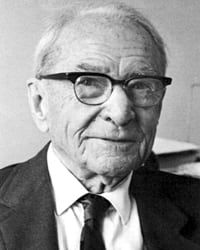
It is impossible to talk about the titans of technology in Mercer County without mentioning the great inventor Vladimir Zworykin. Zworykin, the son of a Russian aristocrat, fled to the United States during the Russian Civil War of 1917. He moved around the country before settling in Princeton, where he lived until he died in 1989.
Zworykin is best known for his contributions to the development of television. RCA was the first company to commercialize electronic television. In the late 1920s and ’30s, the RCA Lab in Camden, led by Zworykin, was instrumental in designing and building the earliest televisions sold in the country. In the 1940s, when the lab was in Princeton, Zworykin further perfected TV so that it was ready for mass production in the 1950s.
He is also credited with many other inventions, including night vision devices, an ingenious but ultimately impractical electronic automatic highway, and several medical devices.
Whether Zworykin should be considered “the inventor of television” is a matter of dispute. Most historians credit the American-born Philo Farnsworth with being the first person to create an all-electronic television. He is certainly the first one to demonstrate such a device to the public, having built a TV pickup and display system in 1927, and having shown it to reporters in 1928. His claim is well documented and corroborated by multiple witnesses to the event. Some of Farnsworth’s ideas were incorporated into RCA’s TV sets after Zworykin visited his lab in 1930. This led Farnsworth to successfully sue RCA for $1 million for violating his patents in 1934, the first such legal defeat the company had ever suffered.
Despite the legal verdict, there are those who believe Zworykin, not Farnsworth, built the first all-electronic television system in 1923 (There were mechanical televisions even earlier, that utilized spinning disks instead of cathode ray tubes.) One of Zworykin’s most ardent defenders is Frederick Olessi Jr., a Lawrence Township resident who knew Zworykin when he worked at Sarnoff labs.
In 1968 Olessi was a technical writer at the labs, assigned to help Zworykin write his autobiography, since Zworykin was not very good with English. Olessi interviewed the inventor, and completed an autobiography called “Iconoscope” in 1971 that was never published. It is available online at www.davidsarnoff.org/vkz.html. Olessi, who later worked in Princeton University’s development office, remained a close friend of Zworykin until he died.
Below is the section of the autobiography where Zworykin describes his invention of the first electronic television system, which Olessi believes took place in the summer of 1923, when Zworykin was employed by Westinghouse in Pittsburgh:
I plunged enthusiastically into my new work. In a few months, working practically alone with occasional help from an excellent glassblower, Chris, I had assembled a completely electronic television system. I was so proud of the results that I spent considerable time in the library trying to find a proper name for it. The electronic pickup tube I named “Iconoscope” from two Greek words, Icon (image) and (scope) to see. The reproducing tube I named “Kinescope,” from kineo (to move). Mr. Kintner [the Westinghouse research manager] was very impressed by the performance of the system, which proved the feasibility of electronic television. Although the quality of the transmitted image was very poor in the beginning, it was obvious that it could be improved with further work.
To continue the work more help, space, and a budget were needed. So we decided to show the installation to the general manager of Westinghouse, Mr. H[enry] P. Davis. I will never forget that day. To start with, in trying to improve the performance, I blew up some condensers and had to spend the entire night repairing the circuit. But in the morning when Mr. Davis arrived with Mr. O[tto] Schairer, Director of the Patent Department, and Mr. Kintner, everything was working. I was able to demonstrate instant transmission of images without mechanical means.
Furthermore, I was particularly anxious to prove the most important aspect of this system — the storage effect. This resulted from the presence in the Iconoscope of a photo-electric mosaic in which every photo-electric element was combined with an individual condenser. The condenser charged continuously while the corresponding photo-electric element received light from a particular point of the transmitted picture. Since the picture transmission is repeated 30 times per second, the picture signal is generated by light falling on the mosaic for 1/30th of a second. At the same condition, systems without storage effect, for comparison, utilize for the generation of the picture signal for a given picture element only light emitted by the element at the moment at which it is transmitted. This is many thousand times shorter. The two systems may be compared with photographic cameras with exposure times of 1/30th second or 1/300,000th second, respectively.
However, Mr. Davis was not at all impressed. He asked me a few questions, mostly as to how much time I spent building the installation, and left after saying something to Mr. Kintner which I did not hear. Later, I found out that he had told him to put this “guy” to work on something more useful.
This was a tremendous blow to me and to soften the effect Mr. Kintner suggested that I write a patent application on my television work and then begin working on something in which Westinghouse was currently interested. He decided on sound movies, since they required the use of photocells with which I was familiar.”
Unfortunately for Zworykin, he was not able to sufficiently document this incident for the 1930s court case. Olessi believes Westinghouse’s archives must contain some contemporary reference to Zworykin’s television that would corroborate Zworykin’s claim, but no one has found them yet.
One key piece of evidence in the trial was that when Zworykin visited Farnsworth’s lab in 1930, he said to Farnsworth, “What a nice idea. I wish I had thought of it.” Olessi says he doesn’t believe this means Zworykin took Farnsworths’ idea. “Zworykin was such an open person,” he says. “I heard him say that many times. That was part of who he was.”
Zworykin himself, in his later years, apparently didn’t care much whether he was given credit for the invention, since the commercial version of television incorporated elements designed by many different people. Olessi recalls the subject coming up now and then, especially because the Encyclopedia Britannica had listed Zworykin as television’s inventor. “He always said, ‘There are many fathers of television and I don’t claim to be one of them,” he recalls. “But history has put it upon me.”