The staff of the New Jersey State Museum was all set to host a 125th anniversary celebration in 2020 when the pandemic put the kibosh on those plans.
And since “126th anniversary” or “127th anniversary” just doesn’t have much of a ring, executive director Margaret O’Reilly and her staff had to be content to wait until another round number came along — which is why the museum is finally celebrating this month with a party marking its 130 years in existence.
On Thursday, April 17, from 6 to 8 p.m., the New Jersey State Museum Foundation plans to commemorate the museum’s anniversary with a celebration that will include an exclusive preview of the museum’s newest exhibition, “Ecosystems at Risk: Threatened and Endangered in New Jersey.”
The event takes place at the museum at 205 West State Street, Trenton. Tickets are $125 and must be reserved by Thursday, April 10. Visit givebutter.com/LPxIm8 to register.
At this fundraising event, former museum trustees Karen S. Ali, Larry Conti, Gabrielle Deen, Sally Lane, and Dolores Yazujian, as well as former foundation executive director Nicole Jannotte Stubbs, will receive the Museum Legacy Award.
The exhibition, which will be on view from April 19 through March 15, 2026, takes visitors through each of New Jersey’s major ecosystems: Skylands, Piedmont, Pinelands, Delaware River, Delaware Bay, and Atlantic Coast.
The exhibition highlights the threatened and endangered wildlife that are native to each region, from bobcats in the Skylands to piping plovers along the coast. There are more than 2,000 plant species native to the state as well.
The exhibition also details the threats that our wildlife and habitats face, as well as what residents can do to help protect them. The exhibits also provide examples of research underway that may offer hope for the future of biodiversity in the state.
O’Reilly has worked at the museum for 36 years, serving as the executive director since 2015. She says the new exhibition makes sense now because climate change is a topic that is front and center.
“We try to do programs that relate to what some of the schools are doing, because fully 40 percent of our visitors are students,” O’Reilly says. “We are all talking about climate in New Jersey right now. Climate change is an important topic in New Jersey because we’re right up against the ocean and feeling and seeing the effects of it.”
The New Jersey State Museum has four main areas of focus: archaeology and ethnography; cultural history; fine art; and natural history. O’Reilly says that when coming up with new ideas for feature exhibitions, she and her staff look to rotate through those main subjects, though there is no specific pattern to how they rotate.
The most recent feature exhibition at the museum focused on the work of a single artist, Robert Duran. Duran, well known in New York art circles in the 1970s and ’80s, dropped out of sight when the gallery that represented him closed.
He moved to New Jersey and continued painting, but he never again sought representation. “He had been in big shows and reviewed by big critics, but after the 1980s he never showed again,” says O’Reilly, who was the museum’s curator of fine art before becoming executive director. “After he died, a gallery in New York got his estate from the family and saw the work he had been producing. He became a New Jersey artist after moving here, so I’m really proud that we reintroduced this artist to the world.”
When a curator has an idea for a possible future exhibition, the first thing O’Reilly and her staff do is think about how the idea might be executed. They consider how would it look, what it would cost, and whether there would be adequate space to display it.
“Once an idea jells, our curators develop an exhibition idea, they reveal it to the entire exhibition committee, and we talk about budget and that kind of thing. If we can figure out a budget, or know we can fundraise for it, we put it on the schedule.”
Three staff members took the lead on bringing “Ecosystems at Risk” to life. Dana Ehret, the museum’s curator of natural history; Julie Vastano, assistant curator of natural history; and Devra Hock-Reid, assistant curator for science education, ran point, with other staff members providing advice and expertise as needed. Museum staff worked closely with members of the Department of Environmental Protection as well.
Ehret had the original inspiration for the exhibition. Ehret grew up in the state, making regular visits to the beach and taking hikes in state and local parks with his family. He studied marine biology at Stockton University and worked at the Wetlands Institute in Stone Harbor during college.
He says these experiences gave him a deep appreciation for the diversity of New Jersey’s ecosystems. “I hope visitors to the ‘Ecosystems at Risk’ exhibition take away a greater appreciation for New Jersey’s natural areas and the rich diversity of wildlife that shares our great state,” Ehret says. “I also hope our visitors learn about some of the wonderful work the New Jersey Department of Environmental Protection, Division of Fish and Wildlife staff do to protect our environment.”
Shortly after “Ecosystems at Risk” opens to the public, it will serve as the centerpiece for another event, this one coinciding with Earth Day. On Saturday, April 26, from 10 a.m. to 2 p.m., the museum will host a variety of activities including urban birdwatching, a water health talk, a discussion on tidal marshlands, and a planetarium show, “We Are Guardians,” that offers perspective on ecosystems worldwide.
The feature exhibition is just one of many things that visitors will be able to see on the four floors of the New Jersey State Museum at any given time. Anyone who grew up in New Jersey can probably tell you what is on display there from the school field trips they took there as children — fossils, Native American artifacts, colonial home furnishings, flags of the Civil War era.
The pieces on display may change, but many standing exhibitions have been active for years. “Almost any museum you go to, there are things that have to be on view — things that visitors expect,” O’Reilly says. “If you go to the Louvre and the ‘Mona Lisa’ is not on view, that’s a problem. Forty percent of our attendance is school groups, and those teachers are teaching the same things every year.
“Some things can’t stay on view for long — photographs, textiles, things that start to break down if on display for any length of time. So that quilt you saw three months ago might not still be on view, but another quilt might be.”
O’Reilly and the museum’s curators are always looking for ways to ensure that the standing exhibitions stay fresh, even after decades on view. “The way we evolve as humans, we learn differently (over time). Our educators are always thinking about that in terms of the programs they do, working with the curators in terms of making the exhibitions understandable to the general public,” O’Reilly says. “We look at exhibitions now and again and say, this needs to be changed completely, or this needs to be updated.”
As a state agency, the museum receives an annual appropriation to cover operations. The appropriation does not always allow for the budgeting of everything on the agenda, which is where the New Jersey State Museum Foundation comes in.
Formerly known as the Friends of the State Museum, the nonprofit foundation serves as a major fundraising entity for the museum, hosting events such as the 130th anniversary celebration. The foundation also helps the museum secure grants that are only open to nonprofit organizations. Some exhibitions are funded partially or entirely by grants and donations.
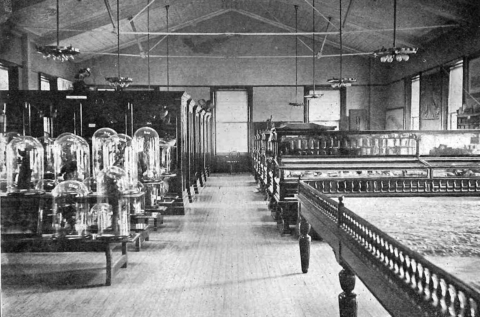
The museum was established by the New Jersey Legislature in 1895 during the term of Gov. George T. Werts. It began as a collection of display cases on the third floor of the State House. After the State House Annex opened in 1929, the museum took up residence in a wing of the new building.
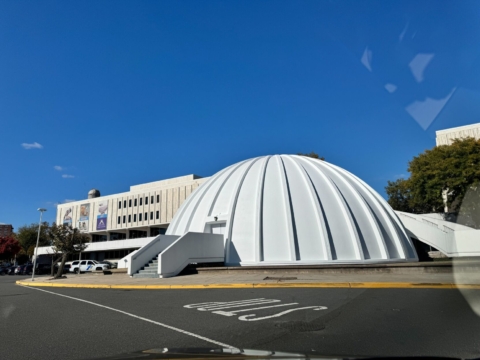
Then in 1965, the museum moved to its current, standalone space, a Mid-Century Modern building whose architecture has fallen out and then back into style over the past 60 years, along with the New Jersey State Planetarium that connects to the main building’s lower level.
The main building underwent significant renovations between 2004 and 2008 but for the most part remains much the same as it was when it first opened. O’Reilly says it has generally held up well.
“Of course, every museum will tell you they need more space,” she says. “None of us shows the majority of their collection. Museums worldwide show somewhere between 8 and 12 percent of their inventory full time. We would love more space for teaching, for exhibits, but it works for where we are right now.”
New Jersey State Museum, 205 West State Street, Trenton Open Tuesdays through Sundays, 9 a.m. to 4:45 p.m. Free admission. nj.gov/state/museum.
130th Anniversary Celebration, New Jersey State Museum Foundation. Thursday, April 17, 6 to 8 p.m., at the museum. Register by Thursday, April 10. $125. givebutter.com/LPxIm8.
Sky’s the Limit at State Planetarium
The planetarium at the New Jersey State Museum is one of the capital city’s most prominent landmarks. Its bright white dome rises like an alien spaceship along Route 29, which skirts the back of the Capitol Complex where the planetarium resides.
Modern planetaria are movie theaters, first and foremost. Yes, visitors to the New Jersey State Museum also get to enjoy the stars of the night sky projected onto the ceiling of that dome, accompanied by a “sky talk” presented by planetarium staff. But these sky talks are merely a prelude to the main attraction: a high-definition motion picture short that has been specially formatted for planetarium viewing.
The movies have proven to be successful in entertaining visitors at planetariums across the nation. Schoolchildren arrive by the busload during weekday field trips, followed by tourists in their SUVs on weekends. NJSM has a catalog of show licenses stretching back to the early 2000s, many of which are still in the regular rotation today.
But the planetarium is also always adding new shows into the mix, such as “Spark: the Universe in Us” and “We Are Guardians,” two 2023 short films that have had their NJSM premieres this year.
The shows both tie in to the museum’s upcoming feature exhibition, “Ecosystems at Risk: Threatened and Endangered in New Jersey.”
Jacob Hamer is the curator of the planetarium at the New Jersey State Museum. An astrophysicist by training, Hamer says his very first experience in astronomy was in a planetarium. “I did a senior year internship in a planetarium, and now I’m hosting a senior in high school doing an internship with me,” he says. “Things have kind of come full circle.”
Hamer says that “We Are Guardians,” a story about deforestation in the Amazon rainforest and the impact it is having in global climate stability, is geared toward younger audiences. “Spark: The Universe in Us,” meanwhile, is perhaps more appropriate for older viewers.
“Spark,” narrated by Diego Luna, looks to connect the air we breathe and the carbon we are made of to exploding stars millions of light years away and billions of years in the past. This interconnectedness of all the elements in the universe and all life on earth is symbolic of the interconnectedness of the fragile ecosystems across the earth.
“I really want the shows here to tell people something new, something that they haven’t heard before,” Hamer says. “I really want the shows to instill a sense of wonder. I don’t want them to just be dry lists of information. It’s important to me that they’re visually stunning.”
Films like these may fill out the majority of the planetarium schedule, but they are not the only attractions. Since joining the NJSM two years ago, Hamer has instituted a free monthly lecture series called “Science Under the Stars” that features area scientists and researchers.
“I think it’s really special to connect the public directly with scientists,” Hamer says. “I’ve started to have a really dedicated audience of people who come every month.”
In the March lecture, Philippe Yao, a graduate research fellow in astrophysics at Princeton University, discussed black holes and their surrounding environments. April’s lecture, “From Beginning to End: The Story of Our Universe,” scheduled for 4:15 p.m. on Saturday, April 26, is set to feature Dr. Cyril Creque-Sarbinowski from the Center for Computational Astrophysics.
Creque-Sarbinowski will present on what we know about the origins of the universe — and what it might be like in the distant future. To attend, register online at nj.gov/state/museum/events-calendar.shtml.
The planetarium is also available to be reserved for private viewings on weekend mornings. Those reserving private viewings can invite up to 40 people for a fee and choose a show from the planetarium’s catalog, presented by planetarium staff. For more information email njsm.reservations@sos.nj.gov.