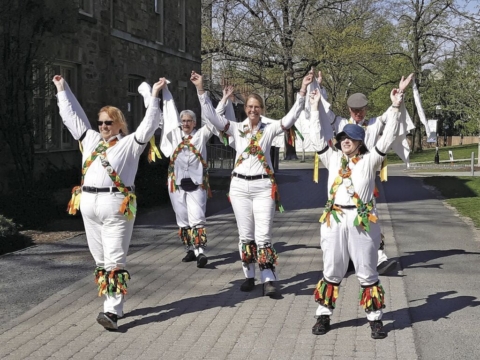
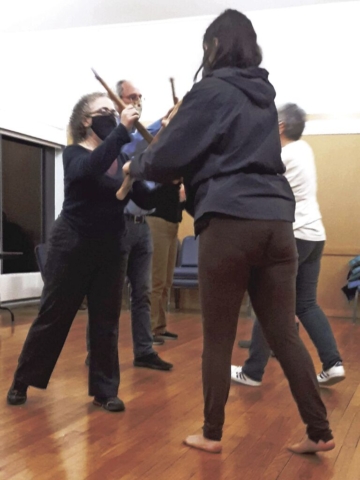
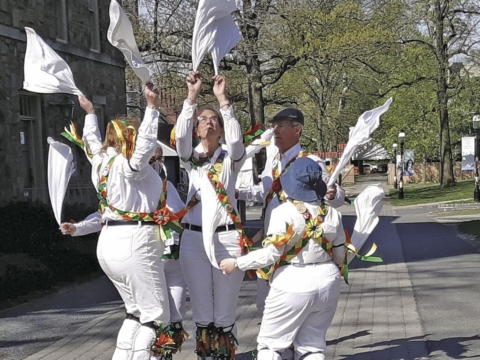
It’s the Millstone River Morris Dance Team’s regular Thursday night practice session, and I’m attempting to do some sort of odd bouncing step next to the Lewis Center on the Princeton University campus.
I am not getting it and not likely to get it as the session winds down.
But I am not concerned. I joined as a group member, so I know I’ll have another opportunity to get it next week.
I got involved last autumn when I decided I was going to make a change at work and wanted to get out and move more.
While I knew what was available in the region, I also knew that I wanted to do something that touched on my interest in ancient rituals and folk practices.
After connecting Morris Dancing to another one of my cultural interests, the Philadelphia Mummers, I decided to give Millstone River a try, went online, and connected with Louise Senior.
She is listed as the group’s squire, or its public representative.
After a short email conversation, I was invited to show up for practice on the university campus.
There I met and learned about a core group, including Senior, a garden educator at Riverside School in Princeton; her husband, Rutgers University professor Dunbar Birnie; musician Brian Hudson; and Highland Park-based writer and editor Amy Livingston.
In addition to being married to Hudson, Livingston is also the foreman of the group (more later on that).
Since I know from experience that to do something some reasonably passably one has to first do perfectly poorly, I left my inhibitions behind, dove in, and just started trying to follow directions.
I also continued coming and eventually was accompanied by my wife, artist Liz Roszel, who ended up partnering with me on the dances that interested me most: those that featured smacking pole-like sticks.
But I have to admit, while I was in the midst of it, I would ask myself, “What exactly are you doing here besides looking dopey?”
Since I realized years ago that a lot of things people do look silly (every see a Shriners parade?), I just pushed the idea to the cellar of my thoughts and continued on my merry way — stumbling through some footwork and making sure I didn’t hit someone with a stick.
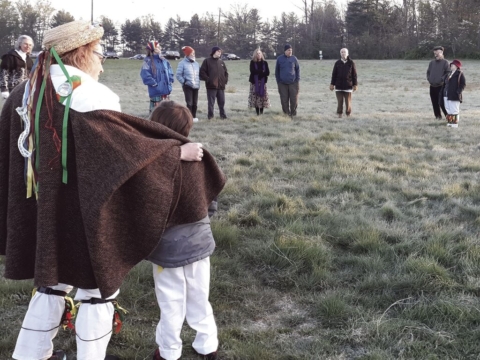
The lingering question was finally banished in early spring when Liz and I were asked to participate in the annual May Day celebration at Princeton Battlefield — the day based on the cross-quarter Celtic celebrations connected to my interest in the ancient seasonal rituals.
White we knew the invitation was based on presentational needs rather than our new found — and limited — abilities, we agreed.
It was then that it happened: We were presented with the bell pads that get tied on the dancers’ shins and provide the bright rhythmic sounds.
The sensation was like receiving an unexpected holiday gift — something sparkling to both the eye and ear.
That feeling returned on May Day when we were up at 4 a.m. to make sure we were dressed in our white slacks, shirts, sashes with buttons, and bells, and ready for our list of May Day presentations in Princeton.
One included an informal event in downtown Princeton, where I never imagined walking around in a strange outfit with bells and realized that if I dressed even crazier I’d be mistaken for someone attending a university reunion.
I also began to wonder more about the history and ideas of Morris Dancing and began a dialogue with deputy Livingston about what it was.
“I don’t think anyone knows much about the actual origins of the Morris,” she says. “There’s a lot of speculation that it might be in some way related to ‘Morris,’ perhaps by way of ‘Moresco’ in Spain, but there’s no proof. We do know that Morris dancing has been part of English culture for centuries. It was already old in Shakespeare’s time; Hamlet laments that ‘the hobby horse is forgot,’ implying that this old custom is beginning to die out. But it survived and went through a big revival around the start of the 20th century, and Cecil Sharp brought it over to the Americas and got the Morris merriment rolling on this side of the pond.
About her involvement with the dance form, Livingston says, “I first came to see Millstone perform on the battlefield on May Day, 1996, at the suggestion of a former boyfriend. I wasn’t initially enthusiastic about getting up before the crack of dawn to watch a bunch of weird dancers, but I ended up loving it.
“By May Day, 1997, the boyfriend was out of the picture, but I showed up on my own to see the dancing again, and when Millstone said they were looking for more dancers, I joined the team, and I’ve been with them ever since. So, as of last month, I’ve been with Millstone 25 years — more than half my life. Next year will be my 25th May Day with the team.”
Livingston says the Millstone goes back another 15 years before she joined.
Yet, she recalls her own beginnings and some of her challenges. “At the time I joined, the foreman was Ben Bolker, and his approach to training new dancers was very different from mine. It was basically ‘chuck them in at the deep end and force them to swim.’
“So he just showed me the steps and figures quickly, and after that I had to do my best to follow along in the dances before I’d even really got the stepping figured out. It took me several practices to feel like I had any idea what I was doing, but I just kept plugging away at it until my feet got the hang of it. The biggest challenges I face now are related not to the dancing itself, but to my role as foreman, trying to get new dancers up to speed and trying to give them more help and encouragement than I had at the beginning.”
Livingston equates the foreman to a sports coach whose job is to train new dancers as well as keep current dancers in shape. “I lead practices, choosing the dances to do and going over the parts that need more work. I’m also in charge of choosing the dances at our performances and making official decisions about which dances to keep in our repertoire — though I prefer to involve the rest of the team in those decisions.
“I took on the role because our previous foreman left the team, and there was kind of no one else who was able and willing to do the job. I generally dislike being in charge of any group; I’m not comfortable with that role and try to avoid it when I can. But, somehow, I seem to keep having leadership thrust upon me.”
Livingston says that Millstone’s official repertoire includes about 30 dances, “far more than most Morris sides have. We have another five dances that have been retired since I joined the team. I’d be interested in retiring more and getting our repertoire down to a more manageable size, so we could review all our dances regularly and know them really well. But people are attached to the dances we have and don’t want to get rid of them, and we keep adding new ones, and so the list grows.”
She says her involvement with the dance came through her life long love of old traditions, “especially old English traditions. The first music I ever liked was old English folksongs; the first Renaissance Fair I ever went to was the best fun I could imagine. This has nothing to do with my own heritage — despite my very Anglo-sounding name, I haven’t a drop of real English blood. Maybe it was just all the fairy tales I read as a child. But something as old and English and quirky as Morris dancing was a natural fit for me.”
Livingston is also not from the region. She was born in Baltimore but moved to New Jersey before she was two when her statistician father took a job at Educational Testing Service and her mother took various jobs at ETS and Princeton University before deciding to stay home and raise two daughters.
“My parents still live in the house in Hopewell where I grew up; after I moved out I lived in a series of apartments in Princeton before moving to Highland Park with my then-boyfriend, now husband. The only significant period I spent outside New Jersey was my four years at Haverford College, where I majored in English.”
“I’ve been a freelance writer since 2004, the year I got married. These days I work mostly for online publishers: a financial website, an energy blog, a food blog. Before that I spent nine years in publishing at Visual Education, a small textbook development house in Princeton Junction that eventually became part of McGraw-Hill. That was my first real job after college, so I’ve been in some form of publishing for my entire career.”
Aside her participation in Millstone, Livingston says she “volunteers for the Folk Project, a folk music organization in North Jersey, and is involved with a couple of small groups that play board games and role-playing games. And I maintain a personal blog called Ecofrugal Living and sing and play the ukulele on a casual, sporadic sort of basis.”
Johnson says that since she isn’t a “social butterfly” one of the appeals of participating in Millstone is that it that it ensures “that I get out of the house and interact with other people at least once a week. That may not sound like much to someone with a very active social life, but because it’s such a big part of mine, I miss it a lot when it’s not there. Giving up our Thursday practices was one of the hardest parts of the COVID lockdown for me.”
She also looks forward to the May Day event that is “the best chance we get to show off our dances to a real live audience” and the Morris Ales, “a chance to get together with teams from other states and show off our dances to other dancers. I enjoy going to Ales because in addition to the dancing, there’s usually lots of good group singing (accompanied by drinking, if you’re into that).”
But when it comes down to the basics, Livingston says that involvement in Millstone, “Gets me off my butt and forces me to move around.”
I know the feeling.
Millstone River Morris Dance Team meets Thursday evenings, 8 to 9:30 p.m. For more information, visit www.princetoncountrydancers.org/millstone-river-morris.
For more on Amy Livingston, visit her website, amylivingston.webstarts.com, or personal blog, Ecofrugal Living.