Those looking to take a walk on the hiking trails less traveled should pack up the car and go east or south east and escape into the New Jersey Pinelands.
Part of a designated 1.1 million acres special growth management region governed by the 1978 National Parks and Recreation Act and the 1979 New Jersey Pineland Protection Act, the NJ Pinelands is the biggest surviving forest on the eastern seaboard south of Maine and an International Biosphere Reserve by UNESCO (United Nations Educational, Scientific and Cultural Organization).
Its vastness may be a deterrent for the uninitiated to start exploring, but with the following overview of a few easy day trips, it opens a new world of outdoor opportunities.
Something helpful to know is that the Pinelands are two large state forests: the Wharton and Brenden T. Byrne.
The Wharton State Forest is the largest single tract of land within the New Jersey State Park System.
It is named after Philadelphia businessman Joseph Wharton, who began purchasing various iron and paper mills and property in the mid-19th century.
When Wharton died in 1909, his empire of 100,000 acres was sold to the State of New Jersey for public lands in 1954. Sometimes called the Wharton Tract, the forest is home to the following attractions:
Atsion Recreation Area
Hiking and history are just part of the attractions at this easy-to-find spot about 45 minutes south of the Princeton area on Route 206.
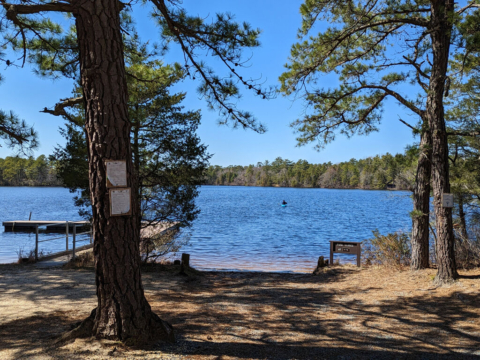
The 100-acre park features two color coded trails — red and blue — that start at the parking lot and loop along the shores of Lake Atsion.
There is also a bathhouse and beach at Lake Atsion where one can take a dip in its fresh — but white staining — cedar water.
Across Route 206, there’s Atsion Mansion. It was built in 1826 as a summer home for prominent Philadelphia ironmaker Samuel Richards. Wharton bought the property in 1892 and used the mansion for packing and storing cranberries.
Today, the building is restored to appear and function as it did in 1826. All tours are free; sign up at the Atsion Office or call 609-268-0444.
Atsion’s official summer hours are 10 a.m. to 6 p.m. from Memorial Day to Labor Day, and there are various small entry or swimming fees. But, like most state parks, visitors can hike free from fall through spring.
For more information, go to nj.gov/dep/parksandforests/parks.
From Atsion, adventurers can either drive south on Route 206 or canoe on the Mullica to the next designation:
Batsto Village
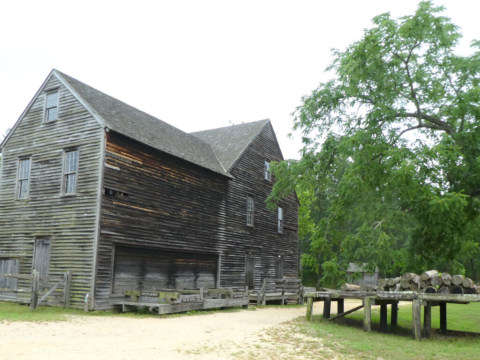
Nationally recognized for its natural beauty and historical significance, the 1,200-acre site is home to a former mill town founded in 1766 to produce iron and then glass.
Its attractions include hiking along Batsto Lake, strolling through a late-19th/early-20th century workers’ village, visiting an old mill, sending a letter from one of the oldest continuously used post offices in the United States, and visiting a Victorian-era mansion.
Park admission is free, but mansion tours are scheduled several times on various days throughout the week and cost $1 to $3. A free visitor center features an exhibition that examines the site’s natural and social history.
The Batona Trail
Throughout Wharton State Forest are a variety of hiking trails, including a major section of the Batona Trail, a 49.5-mile hiking trail that starts at Bass River State Forest and cuts through the Wharton and Brendan T. Byrne forests.
It was established in 1961 by the Batona — aka Back to Nature — Hiking Club of Philadelphia, whose members still maintain it.
The trail is divided into sections where hikers can follow the trail in short installments. One section connects two small but major Pinelands attractions.
The Carranza Memorial
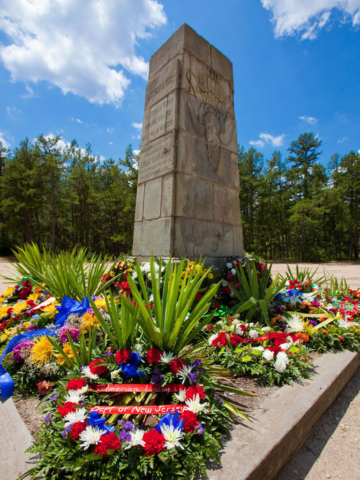
This is a 12-foot-high monument dedicated to celebrated Mexican aviator Emilio Carranza.
In the spirit of building stronger cooperation between Mexico and the United States, Carranza participated in a 1928 goodwill round-trip flight between Mexico and New York City.
During the July 13 return flight, Carranza’s plane crashed in the Pinelands near the town of Tabernacle.
The memorial features the image of an Aztec Eagle plummeting to the earth. It was funded by small donations collected by Mexican and American school children.
There is an annual July 13 ceremony in honor of the person called the “Mexican Lindbergh.”
Apple Pie Hill
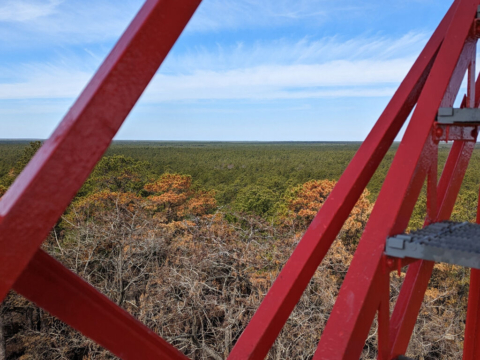
Located 8.4 miles away from the Carranza Memorial (or short car ride away), Apple Pie Hill is a 205-feet land elevation that supports a 60-foot-tall fire watch tower.
The tower provides a commanding view over the short Pitch Pines that populate the forest, and on a clear day visitors can spot Atlantic City and Philadelphia.
It’s a bit tricky finding out when the tower is open to visitors, but one method is to look at the unofficial Apple Pie Hill Facebook page.
Harrisville Ghost Town
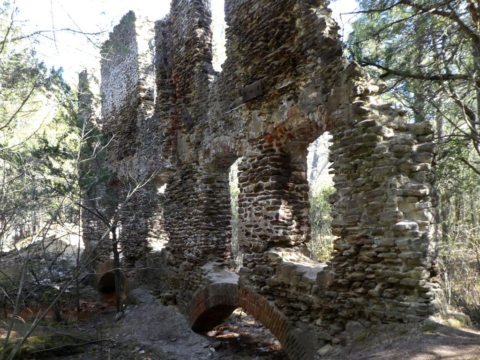
The remains of this abandoned mill town are easily accessible and a great introduction into ghost hunting towns in the Pines.
It started as a grist mill in the 1750s and continued through a number of business owners until 1832, when three investors turned it into a paper mill.
Eventually, one, William McCarty, bought the others out and made infrastructure improvements that included building a canal. The business prospered, and McCarty built a mansion for himself, cottages for workers, a company store, and a dining hall and dormitory.
A fire in 1846 set McCarty back both in production and finances. In 1851 Richard Harrison took control of the site and invested in the mill, built more mansions, created a town public school, and introduced a gas generator to illuminate structures and homes.
Harrison eventually found that he could not compete with more modern facilities and companies with easy access to railroad lines, and the business floundered.
After some stalled sales and lapsed ownership, Joseph Wharton picked up the property in 1896. The business never returned as it had, and in 1909, when Wharton died, the Atlantic City YMCA ran a summer camp there.
The town died in 1914 when a forest fire swept through it. Looters and scavengers followed, leaving portions of walls and foundations.
Harrisville is located about 60 miles from Princeton on Route 679 (aka Chatsworth Road) next to Harrisville Pond. Since some of the old factory walls and the tall fencing around it can be spotted from the road, it’s fairly easy to find. Park by the pond and explore both sides of the roads for ruins.
Brendan T. Byrne State Forest
Formerly known as Lebanon State Forest, the forest is now named after the late former governor Brendan Byrne, who championed the Pinelands Preservation Act and saved the ecology at the heart of the Garden State.
The original name was connected to another industry, the Lebanon Glass Works, which was established in 1851 and was successful until 1867, when it closed because the company depleted the surrounding forest for fuel use.
Today, the Brendan T. Byrne State Forest has more than 25 miles of marked trails and loops ranging from long single-track hiking trails to a trail accessible for people with disabilities. It is also home to another historic village.
Whitesbog
As the Whitesbog Preservation Trust notes about the early 20th century company town and agricultural community, “In the early 1900s, Whitesbog was the largest cranberry farm in New Jersey. Its founder, Joseph J. White, was a nationally recognized leader in the cranberry industry.”
In 1916, Elizabeth C. White, Joseph’s daughter, collaborated with Dr. Frederick A. Coville of the U.S. Department of Agriculture and developed the first cultivated blueberry at Whitesbog.
The State of New Jersey calls White’s achievement “an important part of New Jersey history and the history of the blueberry and cranberry culture in the United States.”
So much so that the site is listed on both the national and state registers of historic sites.
Whitesbog today includes a restored village, general store, and 3,000 surrounding acres of cranberry bogs, blueberry fields, forests, and 18 miles of crisscrossing sand roads for easy hiking and walking.
The grounds are open from dawn to dusk, 365 days a year, but the buildings are opened mainly for scheduled events or tours.
For more information, check out the Whitesbog Preservation Trust’s Facebook page at www.facebook.com/whitesbog.preservationtrust.
Happy hiking and exploring in the Pinelands.