Those looking for a one-of-a-kind trip into art, history, and New Jersey culture can sign up to join the military — or the members of the Navy Lakehurst Historical Society — for a free tour of the Navy Lakehurst Heritage Center.
It’s located at the active U.S. military base that is part of the Joint Base McGuire-Dix-Lakehurst — less than an hour drive from the Princeton/Trenton region.
Among other attractions, the base is the site of one of the memorable moments in the New Jersey history — the Hindenburg disaster.
I’ve been interested in visiting for a variety of reasons. So, when the formerly pandemic-closed tours resumed, I went online, signed up, and after a two-week period of getting government clearance, headed out with my wife to the site.
An interesting facet of the tour is that one doesn’t have to wait until arriving at the base for the tour to start.
The reason is that one can take Route 571, which cuts through the town of Cassville.
That’s the place where drivers encounter two traditionally built Russian churches and a small statue memorializing 19th-century Russian romantic poet Alexander Pushkin.
While there is no signage that explains it, the out-of-the-way Russian village has a direct connection with the naval air base.
So, let’s start the tour with the following:
It’s 1914, World War I erupts, and European nations are racing to upgrade their armaments.
One then-modern producer of military hardware is Eddington Chemical in Eddystone Pennsylvania, just south of Philadelphia. The company purchases property in Lakehurst in 1915 to provide armament training for a special client, the Imperial Russian Army.
When the Russian Revolution erupts in 1917, the Russian officers and other military personnel at the site decide to remain in New Jersey and create a haven for those escaping communist Russia.
They eventually raise enough money to purchase property near the training site and create a Russian village — complete with an honor to the revered Russian poet.
Also in 1917, the United States enters the war and the U.S. Army buys the property from Eddystone to train U.S. forces in gas warfare. The site becomes Camp Kendrick and is paired with another new nearby World War I military training camp, Camp Dix (later changed to Fort Dix).
After the war, the U.S. Navy arranges to take over the property and purchases an additional 1,499 acres to create a station for air ships — zeppelins and dirigibles — for military use.
The navy renames the camp Naval Air Station Lakehurst in 1921, erects the first of several towering hangers, and starts building crafts with the support of German military experts, who were barred from building military crafts in post-war Germany.
Now with the Russian churches and some history behind us, let’s make a right turn onto Chapel Road and get a view of Maxfield Field.
Named after a World War I officer killed in a dirigible, it’s the latest name of the portion of the Joint Base operating the air engineering station used to train naval pilots and provide air support for naval operations. The road’s name indicates the meeting place for the start of the tour, the ethereal-sounding the Cathedral of the Air.
Located at the border of the base, the cathedral is a gray stone building where the NLHS orients the pre-registered and military-cleared tour visitors.
It is also the place where NLHS volunteers prepare to escort visitors through the military checkpoint.
Here we meet Lydia Pochatko, the volunteer who guided me through the online registration process, and Peter Garvey, our volunteer guide. Both are retired and live in the region.
More like a country chapel, the cathedral’s connection to air initially seems tenuous — especially from the outside.
To get a good idea of the structure and history, here’s what Time Magazine reported when the building was completed in 1933:
“Conceived as a ‘Cathedral of the Air’ by the Rev. Gill Robb Wilson of Trenton, N. J., onetime National Chaplain of the American Legion, the chapel’s solemn purpose is to memorialize the U. S. military dead, particularly those of the aviation service.
“Under the auspices of the New Jersey American Legion, famed Philadelphia Architect Paul Phillipe Cret has prepared plans for a sturdy Norman-Gothic edifice with a steep-gabled carillon tower, suggesting the village churches of France.”
Time also connects the cathedral to Naval Lakehurst’s problematic experimentation with aircrafts and says, “A minute side chapel, seating possibly a score, will have altar vessels of duralumin salvaged from the wreck of the Naval dirigible Shenandoah which soared away from Lakehurst and crumpled over Ava, Ohio, in 1925.”
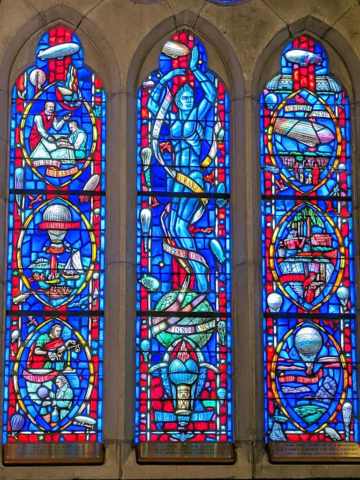
While that makes one airy connection, it’s when one steps into the structure that the theme lifts off with 18 stained-glass stations.
The numerous-images in each area, created between 1933 and 1957, are all about flight — both actual and imaginary.
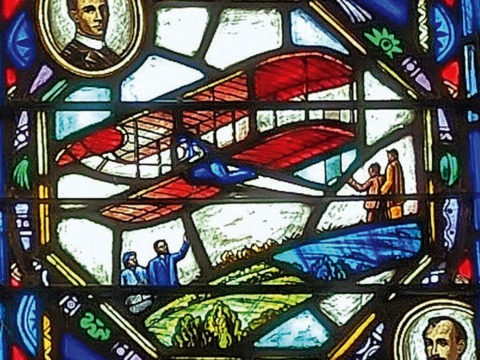
Those interested in history can happily check off Leonardo da Vinci and his model plane, the 18th century Montgolfier Brothers’ balloon, the Wright Brothers’ flight at Kitty Hawk, the first airmail flight, and several early airships and their designers.
Meanwhile, others can enjoy such flights of fancy as a magic carpet ride from the “Arabian Nights,” Elijah riding a heaven-bound flaming chariot, the ill-fated flight of Icarus, Bellerophon riding Pegasus into battle, and more.
There are also works that celebrate heroic Americans: President Abraham Lincoln praying for God’s guidance to end slavery, General George Washington praying for guidance at Valley Forge, and, suitably for the military place of worship, a glass known as the “Four Chaplains in World War II.” It commemorates the two Protestant ministers, Catholic priest, and rabbi who lost their lives ministering to troops during the sinking of the S.S. Dorchester.
Most of the glass pieces were created by the still prominent Willet Company, which created stained glass for Princeton University and Trinity Church in Princeton. Originally based in Philadelphia, Willet was purchased in 2014 and became Willet-Hauser Company in Minnesota.
Two sections were created by another Philadelphia-based company, the now long-gone, but artistically significant, Nicola D’Ascenzo Studios, which created works for Princeton Chapel and the windows at Princeton Abbey (formerly St. Joseph’s Seminary) in Plainsboro.
In addition to being fun to see, the Cathedral of the Air windows are easily one the most thematically enchanting suite of stained-glass windows in New Jersey – if not beyond.
After taking in the sights at the cathedral, now mainly used for various military and public ceremonies, Garvey leads us to the parking lot and — under a threatening stormy sky — provides instructions regarding visiting the active base: photos allowed at the tour sites but no photos of the entrance or guards.
He then directs us to follow his car in caravan style into the base, where each car is stopped by a military police officer who checks in the visitors and, if all is fine, lets them pass.
Within minutes after the checkpoint, the caravan arrives at an open field near Hanger 1. It is here we encounter the site most connected to Lakehurst: the place of the Hindenburg disaster.
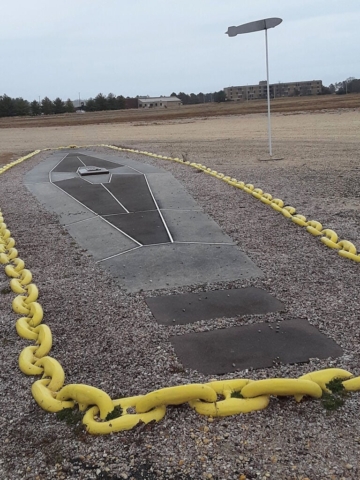
As we move from our cars to a small field with a small sign and a zeppelin outline drawn with a yellow painted chain, Garvey retells the horrifying story of May 6, 1937.
It was the age of elegant, slow-flying zeppelins and the 804-foot-long Hindenburg — alighted by 7,000 million cubic feet of combustible hydrogen gas — was completing one of its 17 transatlantic flights at Lakehurst.
Here — in what had become the center for lighter-than-air craft traffic in the United States — some of the craft’s 93 passengers would disembark and head to New York City.
Running late because of stormy skies, the craft’s crew finally saw a break in the weather and made landing preparations around 7 p.m.
Then as ground crews began taking the lines to pull the ship down, the craft suddenly dipped, abruptly erupted into flames, and plummeted to the ground.
Although the cause is still debated, the death toll is not: 13 passengers, 32 crew members, and one Lakehurst grounds crew worker perished.
Thanks in part to a newsreel camera footage and on-the-scene commentary — with the reporter shouting “Oh, the humanity!” as the fiery craft crashed downward — the event killed the romance of using such crafts for travel and caught an enduring moment of the 20th century.
As our small tour group looks up at the now rainy sky and attempts to imagine the distant tragedy, Garvey instructs us to go back to our cars and follow him to Hanger 1 for the next part of our tour.
The first major facility at Lakehurst, the hanger was built in 1921 to house and build helium-filled dirigibles.
According to the United States National Park Service, “The hanger measures 961 feet long, 350 feet wide, and 200 feet high. At each end are two pairs of massive steel doors, mounted on railroad tracks. These double doors are structurally separate from the hangar itself. Each door weighs 1,350 tons and is powered by two 20 horsepower motors, although provisions were made to open the doors manually, which required the assembled manpower of nine men.”
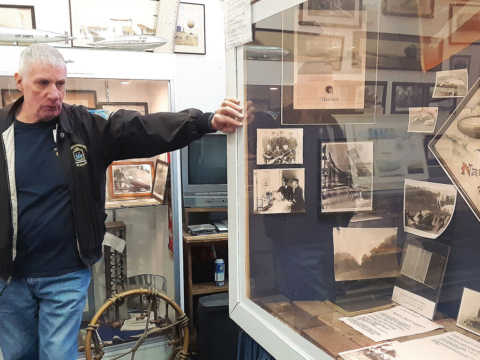
Our first stop within the hanger is the Heritage Center, an exhibition/gift shop room that focus on the lighter-than-air ships connected to the base.
The most eye catching is a suspended 12 model — allegedly fashioned from popsicle sticks by a volunteer — of the Hindenburg, complete with the German emblem of the era, the swastika.
Other features bring attention to the base’s history and the American-built crafts. They include the Shenandoah, a zeppelin-design aircraft that killed 14 crewmembers when it crashed in Ohio in 1925; the Akron, which killed 73 when it crashed into the sea off the New Jersey coast in 1933; the Macon, which crashed in waters off California in 1935, killing two of the 85 crew members aboard; and other unsuccessful endeavors that led the navy to drop the lighter-than-air crafts and focus on using planes at sea.
Garvey now turns the tour over to another volunteer whose name I don’t get — and don’t find out from follow up emails.
But I know he’s a retired naval and airline pilot and is leading us through a hallway to the main section of the hanger — once the major hub of aircraft travel in the United States.
More like a cathedral like than the Cathedral of the Air, Hanger 1 is a cavernous space where one easily imagines the building and housing massive aircrafts — including the visiting 685-foot-long German Graf Zeppelin.
As our guide leads us deeper into the structure, we hear rain hammering on the roof and air vents flapping.
We also feel raining dropping in the hanger and realize the historic structure’s roof needs repair.
It’s been reported but not addressed, notes the guide as he leads us to a near-exact replica of the Hindenburg cockpit.
It was created for the 1975 feature film “The Hindenburg” and then donated to the center.
We then move into a building built within the hanger where we visit The Ready Room and its display of air, land, and sea materials representing the base’s joint forces.
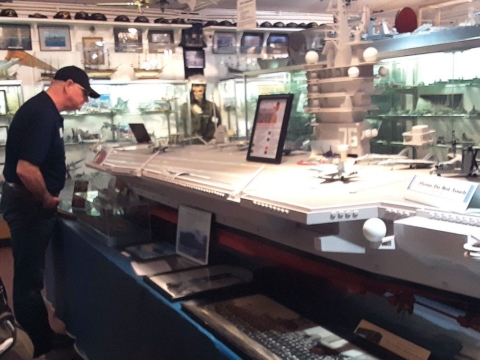
Here our guide lingers at a large aircraft carrier model and shares some tricks of the trade about landing a plane on a floating airfield as well as a few tales about his transformation from young over-confident wise guy to experientially chastened pro.
Other veterans-turned-volunteers now appear and walk us through several connecting chambers of home-made styled exhibitions of donated and acquired materials.
The rooms readily spotlight the contributions of all military personnel — with special attention to American women and minorities.
The walk concludes with an exhibition on the Vietnam War and the stories of its prisoners of war and those missing in action.
Now, after nearly three hours, we move back into the hanger and are invited to ascend stairs that go to the area that served as the roof for the exhibition areas.
It’s here we find ourselves on a simulated aircraft carrier deck, half the size of the real thing, and are invited to wander and inspect the structure that had been used for decades to train naval personnel – but is slowly losing a battle with digital training.
As we walk on the rain-dampened deck within a historic structure and storm sounds overhead, it is easy to start daydreaming about Russians fleeing a revolution and finding themselves in a strange land, young men preparing for the horrors of gas warfare, and the lives and hopes going up in flames on another rainy day.
It is also wakes one up to the reality that a troop of volunteers are marshalling their time to hold together a fascinating part of New Jersey history — and racing against time to share it with the public.
For more information or to register for a free tour, visit the independent nonprofit Naval Lakehurst Historical Society website at www.nlhs.com.