One stop on the 28th Covered Bridge Artisans Tour — set for November 25, 26, and 27 — is up the hilly Swan Street section on the eastern side Lambertville.
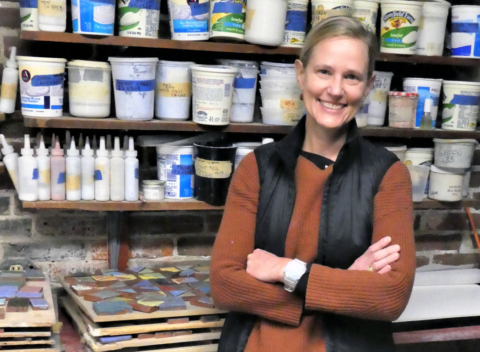
There on the left at 226 is an old brick structure that houses an artisan well known for her one-of-a-kind fine pottery works reflecting different styles and traditions, as well as her imaginative ceramic wall tiles for homes and businesses.
Yet to others, Katherine Hackl is a link to the region’s pottery tradition, especially to Trenton’s glory days when it was an internationally known center for ceramics.
Simply put, Hackl’s tiles are part of the capital city’s artistic landscape.
Seen at the Trenton Transit Center, the River Line stations, New Jersey State House Annex, Thomas Edison State University, Trenton War Memorial, and the Anne Klein Forensic Center, her work continues the nearly forgotten Trenton tradition of beautifying the city with clay — like the elegant tiles on West State Street’s Kelsey Building by tile master Herman Carl Mueller (1854-19410).
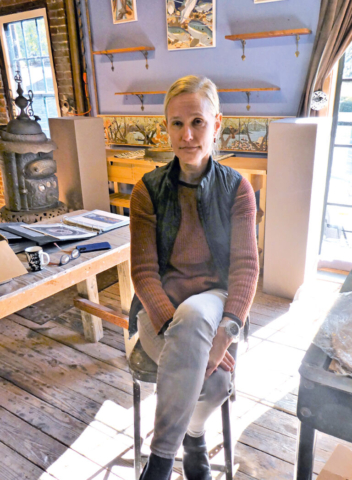
On a recent autumn afternoon with bright sunlight pouring through hazy windows and illuminating the two-storied 19th-century storehouse-turned-workshop, Hackl provides a tour of a studio glowing with tiles, pottery, small statues, and rows of glazes that are like a trip into the past.
As she reaches a chair to be interviewed, she quietly shares a surprising history about her first Trenton project: providing tiles for the New Jersey State House Annex.
It — as well as her resume listing a series of public art jobs — was unplanned.
She says she had just finished college and was completing an apprenticeship at Moravian Pottery & Tile Works in Doylestown, Pennsylvania, a center known for its embrace of the American Arts and Crafts aesthetic — one that promoted a return to handmade works by artists/designers in a world becoming more industrial.
“I was just at the point where I was asking what was going on my life,” she says.
At the same time, unbeknownst to her, about 30 miles to the east, someone else was asking questions when, as Hackl says, “something fell though” with engaging an artisan to address the deteriorating tile work at the New Jersey State House Annex.
New Jersey State Council on the Arts Public Arts Coordinator Tom Moran (with whom I had worked during my time at the NJSCA) found an answer to his problem when he contacted Moravian administrators and asked if they knew of any New Jersey artist who could provide tile work in the Arts and Craft tile style.
“I got a call, and he asked for a proposal,” says Hackl.
The only problem, she adds, “I was an unknown and didn’t have a portfolio. But (Moran) said bring some work by and we’ll talk about it. I filled my backpack with tile and he met me. He looked at (the work) and said, ‘Okay.’” He advised her on how to write a proposal. She submitted it to the state review committee and become a candidate.
Selected to participate in the State House restoration project that took place between 1996 and 1999, Hackl says she worked first on restoring some of the Mueller tiles in the area that had once been the home of the New Jersey State Museum and Library.
Then she was asked to replace some of the tile works in what had been an area for young visitors with designs of her own.
Since the existing images were stylized animals — something that was also incorporated in her training at Moravian — Hackl felt confident in making the decision to create new images based on the animals found in the popular “Just So Stories” by British writer Rudyard Kipling (1865-1937).
“I said let’s keep the same cast of characters (meaning the animals existing on the Mueller tiles) and connect them to stories visitors read in their childhood. It is fun when people see tiles and remember stories.”
Fun and familiarity are part of the spirit of Hackl’s artistic approach. “Keep it light,” she says, “It engages people. Taking everything seriously is dreary.”
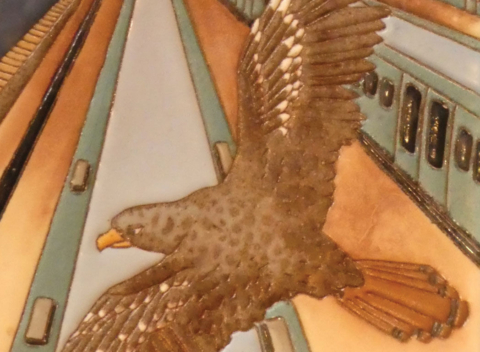
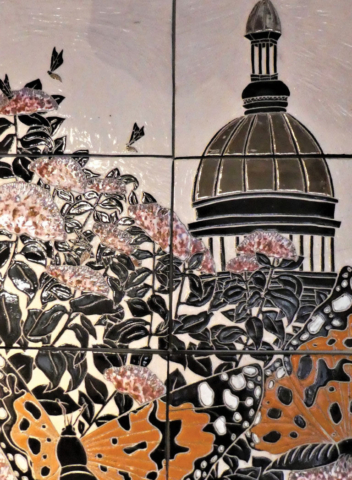
It is also evident in her most public Trenton work, the tiled interior walls of the Trenton Transit Center, part of the renovation project completed in 2009.
Left to her own design, Hackl decided to explore something that was present yet overlooked in Trenton.
“I proposed nature and the urban environment, to show that it was all around us and that there was a great, rich outdoors around Trenton,” she says, mentioning the Delaware River, green areas, canals, parks, Duck Island, and the Abbott Marshlands.
She says she wanted to highlight “this amazing relationship between wilderness and industry” and let Trentonians know “that we’re living with this natural world.”
Once the theme was established, she immersed herself into Trenton ceramics history and wildlife.
The former included delving into the ceramic and pottery collections held by the Trenton City and New Jersey State museums.
The latter involved walking around the city, taking notes of seeing newspaper boxes sharing spaces with frogs and pigeons, and reading books and discovering facts that became part of her work — such as the tile that shows a Delaware River project that traced sturgeons by putting radio transmitters on their backs.
She also kept her ears open to hear what others had to say or what was going on.
For example, she says one of the tile images came about when she learned during a chat with renovation workers that a hawk flew over the building every day. Another came from the buzz running through the community in 2006 that a beluga whale had ventured into Trenton waters and lingered in town for several days.
To Hackl, the hawk, whale, foxes near a power plant, and the State House gardens are as much a part of Trenton’s city life as the bustling people.
“Working with nature is a theme throughout my work,” she says, as she elaborates on creating a tiled mural of trees for the forensic hospital job.
In addition to her Trenton projects, Hackl boasts a series of public art commissions for New Jersey transit stations in Edison, Somerville, and Bayonne; New York City MTA stops; and Roosevelt Borough Hall, to name a few.
She has also created tiles for Princeton Public Library, where she included an image of the Martian invasion conjured up in the imagination by the notorious 1938 radio play broadcast of “The War of the Worlds.” The program’s realistic reporting that Martians were landing outside Princeton in Grovers Mill frightened those just tuning in and caused panic in and beyond the region.
“It is in the Princeton collection room,” Hackl says of the Martians tile. “I wanted to highlight some of the stories and history of Princeton. That was a bit of a stretch, but I wanted some humor and kind of things you might remember. The story has Princeton professors in it. I said, ‘That’s good enough.’” So too was the Walker-Gordon Rotolactor in Plainsboro in a facility decorated by tiles created by Herman Mueller.
While Hackl is connected to the Trenton region and its history, her own story started 20 miles north along the Delaware.
“I was raised in Stockton, New Jersey, and went to the University of Chicago and studied political history. I came back right out and worked at Moravian and started studio life.”
The daughter of a successful Hunterdon County real estate agent and a father who worked at Princeton’s Squibb Laboratory in global licensing and negotiation, Hackl attended the Buckingham Friends School at Lahaska, and then the George School in Newtown, where she was introduced to ceramics.
“The school had a four-year art requirement, and I stuck with ceramics for four years and loved it. I put all my time into the studio, and they had great facilities. When I left the George School, I had developed a type of proficiently.
“I took a year off between off between high school and college and I worked with (accomplished Lambertville ceramicist) Byron Temple and an apprenticeship in Japan.”
Then she went to Chicago to study history because she was enthusiastic about the subject and never imagined she could make a career creating ceramics. “My family was in business. I never saw (ceramics) as a model.”
But when she came back to New Jersey, she realized that she missed working with clay and became involved with Moravian Tile, where her artistic vision expanded.
“I had just done pottery up to that point, and the tradition here is very narrative, integrating storytelling into clay (and) architecture.”
It also expanded her opportunities. In addition to finding herself beginning a career in public art, she also co-started a pottery barn and began attracting clients.
Looking back, Hackl says, “Life unfolds and certain doors open, and you will find out what happens next as long as you’re engaged in things and it’s interesting. But you don’t know where it is going to lead. I didn’t know I had a job doing this until I was in the middle of it.”
Other unfoldings along her journey included eventually taking over the Swan Street studio, marrying environmental justice lawyer and former New Jersey Department of Environmental Protection Commissioner Bradley Campbell, and dividing her time between Lambertville and Boston, where Campbell serves as president of the Conservation Law Foundation.
She says that her work for individual clients looking for ceramic work for homes and businesses has been “pretty steady. Public art has been less so. The last was a restoration project for the (New York City) MTA, in 2019. Yet every two or three years, you get a phone call and an email. It just crops up.”
Like the upcoming New York Transit tile project involving 20-foot walls. “I’m looking forward to the job. But the scaffolding and hauling buckets up and down? I don’t look forward to that chapter. It is physically demanding and the aching back and joints are real. You just have to pace yourself — and get help.”
She is also looking forward to the upcoming open studio event she helped launch and exposing visitors to the slow process of creating with clay and glaze. Or as she says, “The old-fashioned way, the Medieval way.”
Covered Bridge Artisans Tour, named in honor of New Jersey’s only vintage covered bridge near Stockton is set for Friday, Saturday, and Sunday, November 25, 26, and 27. The free event features eight open studios and a center showcasing 14 artists. For more information, visit www.coveredbridgeartisans.com.
For more on Katherine Hackl and her studio at 226 Swan Street in Lambertville, visit katherinehackl.com.