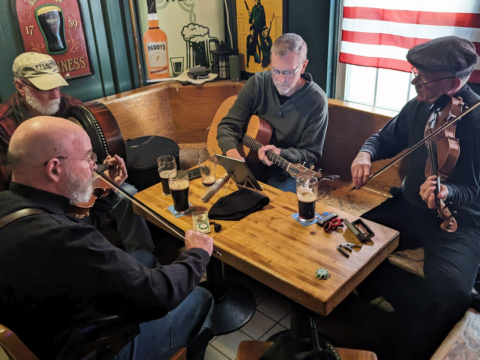
It’s the monthly Sunday traditional Irish music session at Tir na Nog in Trenton and a quartet of musicians with fiddles, pipes, guitar, and bodhrán are reeling — in the musical sense of playing a lively and winding dance tune.
And while there are only four players here, they’re not the only ones playing on a weekend afternoon.
Roughly 15 miles north, musicians regularly gather on both sides of the Delaware River for the Irish sessions at the Dublin House in New Hope and Mitchell’s Café in Lambertville.
Then there are the scores of places to the north in New York City and to the south in Philadelphia, not to mention a mere 3,000 or so thousand miles to the east and in Ireland itself, where the music was born.
No matter where, there is a general formula to the session. Musicians arrive in an informal setting and give themselves up to a sound that is so distinctive one immediately identifies it as Irish or Celtic.
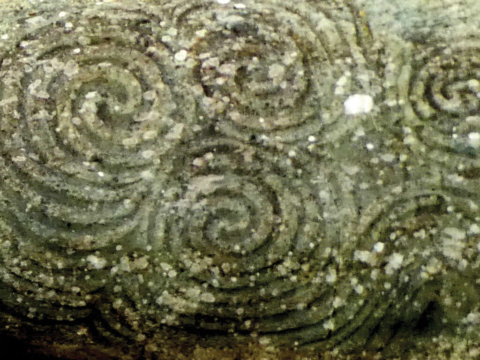
And while the music makers may say they’re just following a tradition, they seem to be following something beyond the sound — the replication of the coiling shapes that weave through Ireland’s pre-Celtic, Celtic, and Viking history.
Since Irish traditional music is in the air this time of the year, it seems a good time to explore this potential connection between Irish music and visual art — something I’ve been doing for some time and communicating with those who live their lives with such music and art.
“It is an intriguing question,” says Dr. Helen Phelan, professor of arts practice at the Irish World Academy of Music and Dance, University of Limerick, Ireland.
Phelan and I met when she gave a presentation on Irish music for the Fund for Irish Studies at Princeton University.
“The truth is, we know very little about the music which would have been contemporaneous with the production of that art (outside of the Latin chant which has survived in manuscripts) and in all likelihood, what we now call ‘traditional Irish music’ is largely based on a dance music tradition which emerged later (c. 17 and 18th century),” she continues.
It is the word “tradition” that had fixated me and got me wondering how the shape of art becomes meaning.
It’s a subject that pops up in various studies. For example, in 1913 British art critic Clive Bell proposed the idea of “significant forms” that inform the creation of sacred and secular art. And in his 1968 “Form: The Silent Language,” composer and Boston University music professor Hugo Norden argued that it was a work of art’s proportional or geometric design that gave it the power to engage
So, encouraged by Phelan’s remark that the question about the connection between Irish music and art was “intriguing” — rather than flat out wrong — I kept sleuthing and was in touch with Ancient Music Ireland.
True to its name, the group is dedicated to presenting such music — exactly what the group was doing when I happened to stumble upon a few public concerts during an ancient Irish music festival in Galway.
One presentation focused on the harp. For centuries it was the dominant musical instrument in Ireland — and is now the official emblem of Republic of Ireland and trademark for Guinness beer. The now common fiddling seems to have started around the 18th century.
As AMI founders Simon and Maria Cullen O’Dwyer say, there isn’t a lot written about the subject but offer one study by a scholar, who while not Irish shares ancient Celtic heritage — contemporary Scottish composer John Purser.
The paper directly connected Celtic music with Celtic images, except these images used for an ancient alphabet.
As Purser notes, “For more than a hundred years, scholars have suspected that the early Celtic Ogham alphabet was used to notate music. More recently, it has also been suggested that the Celtic iconography of crossing wavy lines (‘Celtic knotwork’) served the same purpose.”
As part of that exploration, Purser quotes a Norwegian scholar who writes, “More than any other style of decoration, with the possible exception of the Moslem arabesque, Hiberno (Latin for Ireland) Saxon art aims at kinetic effects. In other words, there is a time element involved, which in its lilting quality suggests an affinity with music.”
Purser also mentions another musicologist whose believed that the interlacing quality of Irish music and writing “embodies one idea. It is the same basic premise of cartomancy, of astrology, indeed of all forms of divination: that all things proceed from one substance, and that all things are composed of various embodiments of that one thing — a substance, or energy, or consciousness, whose sentient elements turn and contort themselves is an effort to see the entire pattern of which they are a part. In this view the knots and patterns of interlace represent the complicated whole of creation as the embodiment of one strand of essence.”
While Purser says he found many of the arguments connecting Irish art and music unconvincing, he admits that “one or two examples suffice to justify further research.”
The now octogenarian composer seems to have taken his own advice and picked up the hunt in the book “Window to the West.”
In it, he and co-writer Meg Bateman, a University of the Highlands and Islands professor, write, “In an oral culture, memory is vital and the various techniques used to assist it have many visual elements” and that “the wholeness of creation as expressed in the forms of triskeles, triquetras, and other symbols popular in Celtic art and implying circularity and motion.”
Now that the search was getting somewhere, I decided to continue it in our region.
“I am not an expert on the subject,” says Donnacha Dennehy, the internationally known Irish-raised composer and member of Princeton University music department faculty, during a recent telephone conversation.
Instead, Dennehy is an experienced practitioner of traditional Irish music and used elements of it in his self-described 2018 “docu-cantata,” “The Hunger,” a music and theater evocation of the Great Famine.
Yet more importantly, Dennehy grew up playing Irish music and was a busker playing the flute on popular Grafton Street and Johnson Lane in Dublin, “One of the best paying jobs I had before becoming a (college) lecturer,” he tells me.
Dennehy says that while the music is played in pubs where people have had easy access to it for generations, it also “a serious art form,” one that has a “returning and obsessive quality” about it.
“I think there is something in dancing and how the patterns keep turning,” he says before referencing a familiar Irish object. “Do you know St. Brigid’s Cross? (It) has an intertwining pattern, so there is something like that in the music.”
Then thinking aloud, Dennehy remembers an idea, pages through a nearby book, and finds the following quote from 20th century Irish composer, traditional music performer, and proponent, Sean Ó Riada:
“The first thing to note, obviously enough, is that Irish music is not European,” starts the individual credited with reviving the popularity of “trad” music during a decline in the mid-20th century. “Ireland has had a long and violent history during which she remained individual, retaining all her individual characteristics. Traditional Irish art never adopted the Greco-Roman forms spawned by the Renaissance, which have become the basis for European art. “
Then O Riada digs in and says, “The simplest picture of traditional Irish art is the ancient symbol of the serpent with its tail in its mouth: ‘In my end is my beginning.’ It is essentially a cyclic form. It is represented in the carved stones of the great burial ground at Newgrange, in the curvilinear designs of the Book of Kells, in the old mythological stories, episodic and cyclic in form, in all Gaelic poetry — even in James Joyce’s ‘Ulysses’ and ‘Finnegans Wake’; and in the sean-nós (old style) singing which still survives as an art-form today. The basic pattern of the song remains in each verse, but the events, the ornaments, vary.”
While O Riada’s statement may seem a grand and imaginative claim, it is interesting to note that James Joyce made a same point. In a letter to a friend, the author of literary works charged with music-like phrasing mentioned following about the ornate pages found in The Book of Kells housed in Trinity College in Dublin:
“It is the most purely Irish thing we have, and some of the big initial letters which swing right across the page have the essential quality of a chapter of ‘Ulysses.’ Indeed, you can compare much of my work to the intricate illuminations. I would like it to be possible to pick up any page of my book and know at once what book it is.”
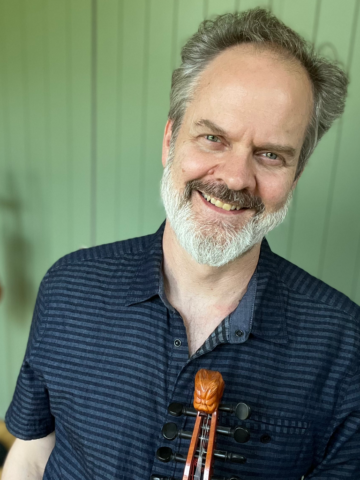
Despite having gathered a good amount of speculative information that pointed to the art and sound connection, I checked in with American-born composer, internationally known Irish “fiddler,” and Princeton University music department head Dan Trueman.
In an email exchange, he says,” I am not actually particularly knowledgeable about the traditions, and while I can well imagine there are relationships between the music and Celtic visual design, I actually don’t have any expertise to offer there. There is such a relationship in Norwegian traditional music, which I know more about, and so I can well imagine there might be with Irish music, but I’m not sure.”
“Ironically,” he says, “I play with some of the most renowned living traditional Irish musicians.”
But perhaps it is not so ironic and something also intriguing.
Since numerous artistic traditions continue through a kind of “spirit” that keeps it alive, it wouldn’t be a stretch of the imagination to say he and those renowned others come together for something grander than themselves.
And just like those showing up at the Tir na Nog, Dublin on the Delaware, and Mitchell’s, they’re there to fill the air with musical shapes — and to reel.