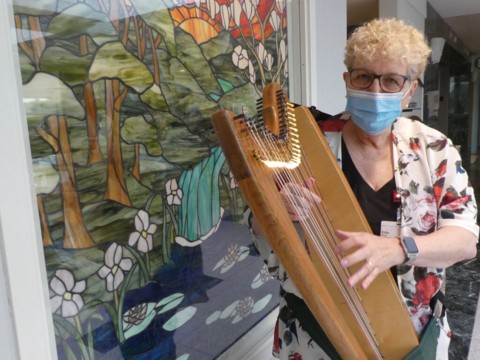
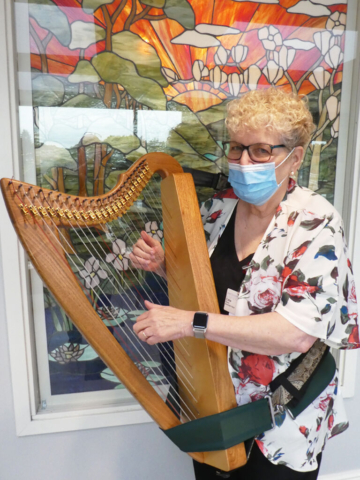
Perhaps it was that same spirit that led the Biblical David to refresh the ailing King Saul that also inspired the 2002 launch of Bedside Harp.
That’s the regionally based hospital-hosted therapy program that places harpists in health care settings to provide comfort and release emotions.
“The harp is a very special instrument,” says Bedside Harp founder Edie Elkan recently in the lobby of Robert Wood Johnson in Hamilton, where the program started.
Elkan is there in part to commemorate Bedside Harp’s 20th anniversary of officially working with hospitals, although she says the partnership with RWJ stared a year earlier.
“(RWJ vice president of Health Promotions) Diane Grillo saw me in a health fair in St. Mary’s in Langhorne. I was there with my harp and trifold and it said Bedside Harp. I had been trying to partner with a medical facility for two years.”
Elkan says the program works on three levels.
The first part is playing for patients, visitors, and staff. The second is to invite the community to learn how to use the small harp for their own health and enjoyment. And, the third is a harp therapy program that teaches people to play, become certified, and participate in an internship program.
Elkan credits Grillo’s openness and thinking creatively to seeing the potential of a program offering a different approach to therapy.
“We started here,” says Elkan. “And no sooner than that happened, (a story on the project) hit The New York Times and other hospitals said they wanted that. So overnight, it went crazy. Before that, no one heard about what we did.”
Referring to RWJ as the program’s flagship hospital, she notes involvement with a dozen others, many in northern New Jersey.
Elken, who runs Bedside Harp from a home office in Langhorne, Pennsylvania, understands the harp and its power from personal experience.
“My husband (Matt) ended up being on critical care and was on life support. I brought my harp in because I was trained,” she says.
When the hospital staff told her she couldn’t bring the instrument into his room, she convinced them otherwise and played even though her husband was unconscious and being electronically monitored.
She says that soon hospital staff “came running into his room because all his levels came down to his normal levels. They asked what was I doing, and I said I’m playing love songs and they opened the door and said play for everyone. Then I realized that hospitals were a place that have the circles of life.”
When her husband — a retired air force pilot and FAA inspector — recovered, she says she asked him “if he remembered the harp playing and what did he feel? He said it gave him hope. That’s what I tell people, you’re not bringing just music into the environment, but hope and soothing. And that’s huge.”
Discussing her involvement with the harp, Elkan starts with her birth in Los Angeles to parents who had a World War II romance. Her military — and later car company — auto mechanic father and bookkeeper mother moved to Philadelphia, where Elkan was raised.
“I was always drawn to music from the time I was little. I was attracted to it very young. There wasn’t anyone in my family that was musical. I took piano lessons when I was 7. I went to school in North East Philadelphia. The high school was the only one that had a harp. I saw it in the practice room and said I wanted to play that instrument.
“Philadelphia was one of the two hubs of some of the finest harpists in the country (the other was New York). It was a rich experience. I planned to become a concert harpist. That was my dream.”
Elkan was serious about being a musician and went to the Philadelphia Musical Academy until she encountered financial and familial problems. “My parents didn’t want their daughter to become a musician — back then it was hippies and beatniks. I had to work my way through and had to practice six hours a day and I got burnt out.”
While she continued in music as a piano teacher for 28 years, the mother of four changed her academic focus and earned a bachelor’s in English and nonfiction writing from the University of Pennsylvania and a master’s in liberal studies from Thomas Edison State University.
“I didn’t play the harp, and then three people died. Someone left me a sum of money. (But) I felt my own mortality. I was mourning their deaths, and I went to a grief counselor. The counselor said, ‘What could you do to put joy back in your life?’
“I couldn’t give her an answer. When I got to my car and put the key in the ignition and said, ‘I need to get back to playing the harp.’”
Using the money a friend had willed her, Elkan says she sought out her first harp teacher, who advised to go to a Chicago harp dealer to secure her own harp.
Since she had previously studied with the former first harpist of the Philadelphia Orchestra, she contacted the current one, Elizabeth Hainen, and began again.
She says several years after she resumed playing, she realized that small quality-made harps had the potential to be used to help heal others.
To support the basic claim that harps can enhance healing, Elkan refers to a study she conducted when RWJ opened its cancer center in 2003.
Patients arriving for treatment were invited to participate and “fill out the form and assess how they felt — physically, spiritually, mood — and they did it again after the session, and we found that there was a huge difference. People were relaxed, and their anxiety levels were lowered.”
She also refers to her work at St. Joseph’s Regional Medical Center in Paterson, where people over 65 needed to make multiple visits to a geriatric center that the hospital made into an “oasis with softer lights, floors were not as shiny, gowns were softer, and they had aroma therapy and Bedside Harp.”
Elkan adds that “it’s a challenge to do a research project in the hospital” because “it is dependent on the staff” that is already engaged in normal operations and may not be available to monitor results.
However, she says, the principles reflect other studies that explore “the power of vibrations. Molecules change. Everything vibrates. Inside and outside of us. And there are good vibrations and not so good vibrations — like a jack hammer. But we feel the harp vibrations.”
She calls the harp sounds pure vibrations or “anything that is not digitalized. CDs will not give you anything. There are no healing qualities from CDs or anything digitalized.”
Elkan says the biggest challenge in making Bedside Harp part of the medical practice was getting paid for it.
“It’s always money. Everyone wants us to do something for free. I have been promoting both Bedside Harp and an actual occupation where we have people who are supporting themselves.”
She says there was a change of attitude that occurred after the attacks on the World Trade Center in 2001. “The country was so broken after 9/11 and seemed to realize that then we needed more than the allopathic medicine. That can’t be beat, but humans need more than science to be fulfilled. And (Bedside Harp) fits the bill.”
Elkan says in person and on her website that Bedside Harp’s professionals and interns have delivered one-on-one sessions to more than 100,000 patients in host hospitals and trained and certified more than 150 harpists hailing from all over the U.S., Canada, and Europe.
Although she says service costs to hospitals are dependent on a variety of factors, the website has a schedule of costs related to training. That includes $45 per half-hour online classes with trained instructors; new student materials, $125; and an intensive, $1,000 that includes classes with Elkan, materials, and open visits to classes and other harp related activities.
Students who master 10 songs are then eligible to enter the harp therapy certificate program. The cost is $3,950 and requires the completion of 310 hours of music and ethics study.
Bedside Harp’s website also offers a selection of harps ranging in price from a $350 10 String-Davidic Lyre to a $4,616 hybrid harp.
Returning to the healing aspect of harp playing, Elkan shifts her harp and says, “It is a very sensory experience. You lean it towards you, you pluck it with your bare fingers, and you immediately feel the vibrations. The first person to be healed is the harpist. And when people see it in the hospital room, they go ‘ah!’ They get it. In days of old, (harp playing) was only for kings and queens. They knew what was good.”
For more information: www.bedsideharp.com.