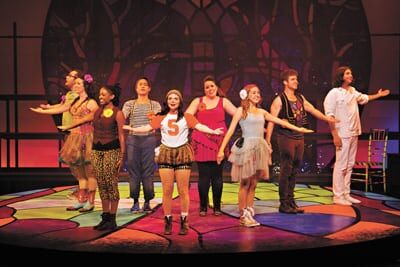
The road show stop of “Godspell” — set for Sunday, November 10, at the State Theater in New Brunswick — may seem routine. After all, the musical premiered in 1971, was both an off and on Broadway hit, became a popular film, boasted a popular song (“Day by Day”), is a staple of community theater productions, and is frequently revived on professional stages, as illustrated by a recent New York City presentation that closed this past summer.
But for Princeton resident Stu Duncan, the road show or any manifestation of “Godspell” is a blessing. And why not? Duncan — known regionally for his theater reviews for the Princeton Packet and U.S. 1 — is directly responsible for putting the show on the stage in the first place.
The 86-year-old producer and writer recently reminisced about how he and fellow New York theater producer Edgar Lansbury took a modest little work by a devoutly religious college student, brought it to a Princeton living room, and launched a legend.
“Godspell” was a master thesis by Carnegie Mellon student John-Michael Tebelak who arranged a brief showcase of the show in New York City. “Edgar Lansbury, Angela’s younger brother, and I were producing in New York, Lansbury/Duncan. The shows we were producing were ‘A Long Day’s Journey into Night,’ a revival, and ‘Waiting for Godot,’ also a revival,” says Duncan.
“Our company manager, Joe Beruh, went to Carnegie Mellon. This professor there knew that (Beruh) was with us, called, and said, ‘Hey, you might be interested in (Tebelak’s) show.’ So the three of us on a cold February night in 1971 went to (off-off-Broadway experimental theater) Cafe La Mama where this show was playing for the weekend. It had no music, except one guitar song, ‘By My Side,’ written by a cast member.”
Duncan says that one of the first things that struck him was the overtly religious nature of the work and the minefield of politics of producing such a show. “Godspell” is based on the Gospel of Saint Matthew. Yet it uses a modern setting to present Christ’s message of peace and love, his conflict with religious and public authorities, and his persecution. In 1971 that setting included the anti-Vietnam War protests, the women’s rights, black power, and environmental protection movements.
Despite his partners not being fully in tuned about the show, Duncan says there was opportunity. “Joe was Jewish and recognized a small part of it, like the ending. Edgar claimed to be atheist (he really isn’t; he’s an agnostic). I was the Episcopalian and had a reasonably formidable New York social religious education — that is, I got sent to Sunday school. So I recognized it. I also knew who Saint Matthew was, that he was dead, and that he didn’t have a lot of family members left,” alluding to the fact that producers need to purchase producing rights from the original author or their descendants.
After some discussion about how a play with religious themes is a two edge sword that can attract and offend audience as well as generate publicity, Duncan says that he and Lansbury decided that they would let audiences members make up their own minds, and they talked to Tebelak, who, Duncan says, “was real devout and wrote it from a real love. We said that it should be a musical. He said that he wrote it as a celebration I don’t write musicals.”
The solution was, in a sense, an act of God. “We had these two hits (‘Long Day’ and ‘Godot’) and people were interested in what we were doing. A week earlier we had a young kid coming in and presenting a musical. It turned out to be a major show, a thing with magic and music, ‘Pippin.’ But we felt that it was far too big for us,” says Duncan, adding that with two shows running he and Lansbury were maxed out in raising money.
But, he says, “this kid can write music and he’s a nice kid.” The “kid” was Stephen Schwartz who would eventually collaborate with Leonard Bernstein on “Mass,” provide the hit stage adaptation of Stud Turkel’s “Working,” was the lyricist for Disney’s “Pocahontas,” and is the composer and lyricist for the popular Broadway show “Wicked.”
Duncan says that he and Lansbury decided to try to team Schwartz with Tebelak and were surprised to find that the two young artists had attended the same directing class at Carnegie Mellon. “We teamed them up, and we had a score in 10 days. The score included ‘Day by Day,’ which was so good. Edgar and I had no musical background, but we said that it could be the thing to make the show.”
The producer says that they started rehearsals for an off-Broadway production with no money but lots of faith and naivete. “I said we have two shows running — how hard could it be to run another? Which shows you what an ass I could be,” says Duncan, whose advice to young producers has been summed up with “when you think you know what you’re doing, you’re in trouble.”
Undaunted and resourceful, Duncan remembered (from previous experience) that charity and investment began at home and rented a bus, brought the cast to Princeton, and had them perform for a gathering of potential backers at his home at 114 Elm Road. With the production’s start-up value estimated at $45,000 (approximately $250,000 in today’s economy), $22,500 (or $126,000 today) was needed for a cash infusion, and the plan called for selling shares for $900 ($5,000 today). The response was providential. “We raised the money in my living room in one afternoon. This happened with the cast showing up a little bit into rehearsal and a few songs just written. Everyone (there) took something, and it made a lot of people rich.”
Duncan says that the investors “were people we knew who were interested in theater and had said so.” That included familiar area names such as the Sturhahns and Stackpoles, Herb Kendall, and the late Sam Kind (owner of LaVake Jewelers and father to sit-com actor Richard Kind). He adds that their investments “paid out about 50 to 1 over the years.”
The arrangement to meet the entire budget, he says, was a mixture of hard cash, invested services (including legal fees), revenues, and partnership with the presenting venues, including a theater that Lansbury owned.
Since the production company had developed with actors and musicians already working, there were irregularities in the arrangements for a traditional professional production that includes contracts with various unions integral to creating a professional production in New York. Duncan says, “When we opened we were not union. We opened non-(Actors’) Equity. They were furious, but it became obvious that we were going to be running a hit. So we went back, paid everyone to enter (Actors’ Equity), and gave (each actor) one percent of the show if they stayed in for a year.”
“We never completely revealed this before, but it has been hinted at,” says Duncan. “We broke all the rules. The cast was back-paid from the first day of rehearsal. The union didn’t want any part of it; they hated us. In the process, we tied the cast up for a year, which was unheard of it. The people showed trust in us and we showed trust in them too. It was unusual. It has never been done before and never done since.”
The result, he says, is “that eventually the union ended up with a show that employed over 500 people (over the seven years that it ran off and on Broadway). The original cast — who were hired at Equity minimum — all made over $200,000 from their investment. These kids have done well over the years.”
Listing a variety of factors — the simple, familiar, and popular show with no set — Duncan gives a quick list for the show’s success: “The show was cheap; we paid the cast off; we paid our investors back; and the next thing we began to put the show on the road in London and San Francisco. We had five shows going on at one time.”
The creation of a major motion picture version, produced by Edgar Lansbury, added to the revenues as do the royalties of the ongoing performances around the world. And, in theater parlance, the show still goes on.
The Back Story. Stu Duncan, as befits a New York theater producer, was born in 1926 in the middle of New York City. His family controlled the distribution rights to the popular Lea and Perrins Worcestershire Sauce.
Duncan stayed in the city until he was 14 when his parents divorced. Since his mother, he says, “had been remarried and was divorced again and was looking for a third husband or fourth,” he chose to live with his father in Ridgefield, Connecticut.
With the advent of World War II, however, his father joined the navy and — since he learned to speak French from his grandmother’s maids — was sent overseas, and Duncan moved in with his stepmother. “I was in effect on my own at 14, looking out for myself and being aware of it,” he says.
Duncan says that although he had become introverted he decided to join a community-created theater production of a musical written by an award-winning film composer, Alex North. “I have never been accused of carrying a tune,” he says about his selection for a non-singing role.
“At the end of the summer I was no long shy. I was on the stage all over the state of Connecticut. I was a traveled actor. I realized that theater was okay if you did it right. I took it up as a means to an end,” says Duncan.
He also had an understanding of what theater could do for him. “I realized that if you wanted to take it up, you’d need talent. Then I decided that I would be a producer. I came to (theater) with a need. It satisfied the need and it works if you do it right. You can somehow make something out it.”
But actualizing that realization would come much later, after he was enrolled in the Wooster School in Danbury. “I was like a fish out of water, with my dad away. So I studied very hard and made the honor roll — I had never made the honor roll before — and I thought that I could do this, and I stayed in on the honor roll the entire time. The headmaster was from Princeton asked where I was going to school. I said my father went to Harvard and I wanted nothing to do with it. He asked if I would be interested in Princeton.”
Duncan says that he took the test to the university, was accepted, and then made a bold decision. “I was 17 and enlisted in the navy. It was 1944 and the war was still on. I went into the service, had a wonderful time, spent 22 months, and came back to Princeton (to study English). The government paid for my tuition. I discovered that there were two words in the navy that if you said them you were given a seat right where you were. The words were ‘I type.’ I stayed mainly in Maryland and had a very good war.”
The war years were followed by his finishing college, his father dying of a heart related problem that developed during the war, and falling in love.
When the Princeton-based Miss Fine’s School for girls needed men for a school play, Duncan, whose interest in theater involved him with Theater Intime, was enlisted, and found himself smitten by young Nellie May Oliphant, also known as Petie (for some forgotten reason). The 21-year-Duncan asked the young woman out on several dates and to his dismay discovered that instead being 18, as he been come to believe, she was actually 15. He decided, however, to invest time and wait. “(The age difference) doesn’t make as much a difference now,” he says of after 62 years of marriage.
After their marriage, Duncan now faced something that was always silently looming. “My family was Lea and Perrins Sauce, and I’m the fifth generation. I finally went into the business,” he says.
Lea and Perrins were two early 19th century British chemists who concocted a sauce that a British aristocrat had become accustomed in India. Also known as Worcestershire Sauce, the flavoring became popular in Europe. In the late 1830s American John Duncan ordered the sauce for his high end New York City grocery business, established a large and lucrative American market for the product, and obtained the exclusive American distribution rights that the company still holds.
Duncan became sales manager and vice president of sales at the company headquarters in Fairlawn, New Jersey. “It was not terribly exciting, but when you’re fifth generation of anything you want to prove yourself. My father died, and my grandfather said, ‘This is the son that I never had, and we’re going to make him a very important person.’ The idea was you were fifth generation and that was the end of that.”
Only “that” was the end of Duncan’s career in the family business. “I am one of those persons who don’t like being handed things. I didn’t think it was going to work, and I didn’t really wanted to do it all for the rest of my life,” he says.
“So I cut myself off and resigned from Lea and Perrins, and I wasn’t pulling a salary any more. I sold the stock back to the company. I had the stock because my grandfather thought I would be working for the company. That’s what he set up; I wasn’t doing that. For me it wasn’t right to keep drawing dividends when I wasn’t contributing to the company. It was risky,” says Duncan.
Remembering that theater was more interesting than working in the family business, he took more risks, including producing his first New York play, “Yes Is For a Very Young Man” by Gertrude Stein.”It’s not a particularly good play. But I thought New York might be ready for it. The critics and I somewhat disagreed. It was not a success. (The critics) admired the intent but thought that it wasn’t needed.”
When asked about producing the first major New York revival of Samuel Beckett’s “Waiting for Godot,” acknowledged as one of the seminal art works of the 20th century, Duncan shrugs and says that a number of elements were in place. “It was a good four-man show. We had entry to the Sheridan Playhouse. I had an author and director — Alan Schneider who had worked with Beckett — and they wanted to do it. The theater said it would work with us. Everything was in place. If ever there was an off-Broadway show, it was this one.”
Duncan says that he doesn’t recall meeting future partner Lansbury the first time, yet says that “it was a very small universe in New York those days. Edgar not being Jewish and my not being Jewish, it was inevitable that we would meet.” He remembers that it was Lansbury who approached him to help produce “A Long Day’s Journey into Night” (which included investors from the Princeton area).
“Edgar and I never battled,” says Duncan of their relationship, especially during “Godspell.” “Edgar felt that his end was the artistic end, and I felt that he was half right. The guy who raises the money has a lot of muscle in the theater. And since all the money come from my living room that one afternoon, we never had an argument. We never had to battle.”
It also helped that they had a hit show brewing. “We knew the night before we opened that we had a hit. I was standing in the back of the Cherry Lane Theater, and in the final act, when they were carrying the body out the door, we had an audience of priests from a variety of religions and half of them genuflected and others crossed themselves. I said to Edgar, ‘We’ve got something here.’”
Other things they “got” were a few surprises, including the best selling original cast album that was produced by an underdog recording company wanting to assert itself. “Bell Records said, ‘We need to do the cast album because nobody knows us. We know you can get money (from other record companies), but what would you like from us?’ I said, ‘We would like you to run a full page ad in the New York Times with all our reviews.’ It hadn’t been done before. We took the money from Bell Records, and they paid for the double page ad.”
One of the reasons for the advertisement, says Duncan, was that “we did not have a good review from the New York Times. (Critic Clive Barnes) made it very clear that he did not like religion.” So as the show celebrated its third year, the producers decided to run the Times ad and include Barnes’ assessment: “nauseous.” “It was fun. Bell Records went along with it, and it helped make the show. (The ad) made it important and gave us the importance that we may not have had. The record went platinum. (Bell) won a Grammy; they were happy. It made them look good,” says Duncan.
During “Godspell” Duncan tried his hand unsuccessfully at a few other productions, but it was too costly and too risky. “You need to run four or five months to get your money back. In Broadway you have to run for a year. It costs a lot more to run a Broadway play, mostly advertising.”
So when “Godspell” closed, so did his producing. “I could never have done it again. We pulled everything we could and got away. ‘Godspell’ was pretty good. We did make a lot of money off God.”
After theater producing, he says, “I never worked for a firm. I did some opinion polling for Opinion Research Corporation (in Princeton). I walked in and said, ‘You don’t know how much you need me.’ I still did theater. I reviewed. I have never had any trouble saying what I thought. Wherever the chips fall, they fall. I was head of the Princeton Community Players for two years. Community theaters have gone out of business. There’s a place for them, but I am not sure if Princeton is the place. I was asked in Trenton to join a group, but I couldn’t,” even though Petie Duncan came from a once prominent Trenton family, Oliphant.
After marrying Petie, the couple moved to Connecticut. Then he took the job with the family company in Fairlawn, and they decided to move to New Jersey. “I didn’t like North Jersey and thought I could make a commute from Princeton. So we looked around, and I thought if we lived anywhere this is a place we both know and have friends. We lived in Plainsboro for two or three year. We lived for 20 years in Coventry Farm, which is more or less permanent. Our roots were here in a very real sense. I can’t say the university was roots, but (Petie) felt more connected to Princeton.”
The Duncans had four children, two daughters and two sons. Like plays, the endings are not always as expected. “We lost our two boys. We lost one in a boat accident and one died 10 years ago of a brain tumor. One daughter lives with us and is an equestrian judge; the other lives down south near Jacksonville, Florida.”
About the upcoming road production, Duncan says, “I haven’t seen this company. I may go up and see what it’s like. I try not to let anyone know who I am, unless something is very wrong.”
Then thinking as a producer, he says that touring a show is not easy. “The first thing is that theater is the most expensive way to attract a small audience. If you travel you add on expenses, not just machinery. You need a bus to carry the cast and the truck to carry the lights. You end up with having to put all these people up. That’s on top of the cost of putting it in front of the smallest amount of people. It’s not an easy thing. The people on the road have to be able to sell tickets on the basis of the show. You’re not going to sell a show that no one has heard of. And you’re only as good as your last performance.”
Or your last Broadway show.
Godspell, State Theater, 15 Livingston Avenue, New Brunswick. Sunday, November 10, 2 and 7 p.m. $35 to $75. 732-246-7469 or www.statetheatrenj.org.