When master illusionists and humorists Penn & Teller bring their 50 years of stage know-how to their State Theater in New Brunswick on Saturday, September 23, they also bring with them an out-of-sight piece of regional history.
Before they were the nationally known duo using their names, they were part of the Trenton-based Asparagus Valley Cultural Society.
As the duo’s silent partner with the singular name, Teller, tells it during a recent telephone interview from his homebase in Las Vegas, it was an alignment of personal circumstances, connections, and creative obsessions.
Part of the story is Teller arriving in the region to teach Latin at Lawrence High School.
Although he had spent years honing his skills to become a proficient magician and had training in theater, Teller had just graduated from Amherst College in Massachusetts and saw the opportunity for a job that also offered a deferment from service and the Vietnam War.
The location also enabled him to keep connected to a fellow Amherst graduate and friend, Wier Chrisemer, who had moved back home in nearby Pennsylvania.
“Wier and I were good friends at college. He was in the music department,” says Teller. “And I found music theory particularly fascinating. It is about communicating with an audience without words.”
Teller also began to participate in Chrisemer’s Othmar Schoeck Memorial Society for the Preservation of Unusual and Disgusting Music.
The society was designed to highlight the music of a 20th century Swiss composer whose work Chrismer discovered in the university’s radio station library.
As Chrismer tells writer Calvin Trillin in a 1989 New Yorker article, Schoeck music “was awful. It had no redeeming merit.”
However, as the article continues, “Chrisemer figured that the core of Schoeck’s celebration would be two or three concerts a year at Amherst sponsored by the Othmar Schoeck Memorial Society for the Preservation of Unusual and Disgusting Music.
“The concerts did not go so far as to include any works by Othmar Schoeck. The pieces performed tended to be what Chrisemer describes as ‘arrangements of standard classical chestnuts for different instruments’ — Beethoven’s Ninth for electric piano, prepared piano, saxophones, trash-can lids, recorders, electric bass guitar, nose flute, slide whistle, and chorus of four, for instance, or a Sousa march for a Baroque ensemble of recorder, harpsichord, cello continuo, and krummhorn.”
“The remarkable thing was that it was fun but musically quite great,” says Teller. “It sounded fantastic and made you laugh.”
Teller had studied theater and used his understanding of dramatic structure to help with the presentations and sometimes be part of the production.
He says another performer was a unicyclist, juggler, and Ringling Brothers Clown School graduate that Chrisemer met at a nearby Massachusetts stereo shop: Penn Jillette.
He juggled to Khachaturian’s “Sabre Dance,” says Teller.
Eventually, Penn also found himself in the Trenton-Philadelphia region when he began a juggling act with a childhood neighbor — the MacArthur award-winning juggler Michael Moschen — and landed a job at Great Adventure. Penn also began working the streets and corners of Philadelphia.
Teller, Chrisemer, and Penn re-connected in the region and resurrected Othmar Schoeck. However, they also found a new project emerging from their interests, personalities, and the dynamics between them.
“Wier was the son of a minister and was very capable,” says Teller. “Out of the three of us, Wier was the funniest, very deadpan, professorial, or clerical somberness, while speaking deep nonsense. Weir saw things from a perspective that you wouldn’t expect.
“Penn was the rocker. My background was in theater and my magic mentor was my drama coach in high school, so you get from me a highfalutin sense.”
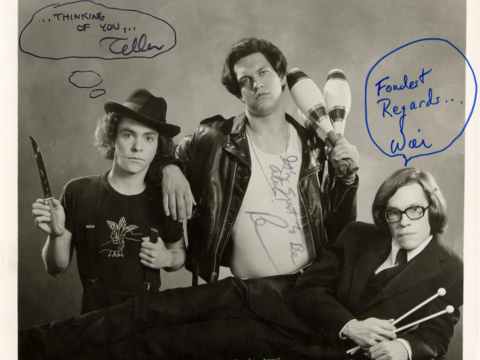
The result was The Asparagus Valley Cultural Society, named in recognition to the name of the Amherst region where they all met.
It was formed in mid-1970s, and, according to Teller, was headquartered in their home residences in Lambertville and Trenton, “on Olden Avenue, next to a kielbasa shop.”
A publicity photo of the group has a stamp that links the AVCS to 839 Beatty Street in Trenton.
Despite the group’s wryly banal sounding name, Teller says they worked seriously to develop a show that they premiered in Princeton.
Teller says he helped with designs for a rock group presentation at Theatre Intime on the Princeton University campus and worked out an arrangement to use the theater for AVCS’s premiere.
He adds that they borrowed money from his parents, Philadelphia-based artists, and Penn’s former prison guard father supported folks. Michael Moschen “was the backstage guy.”
Teller says AVCS’s premiere “wasn’t terrible. It had a lot of funny ideas, but it had terrible transitions. The audience would sit in the dark for 90 seconds. The show had a good deal of potential.”
It was followed by something completely different and a league of its own: “The Asparagus Leap for Life.”
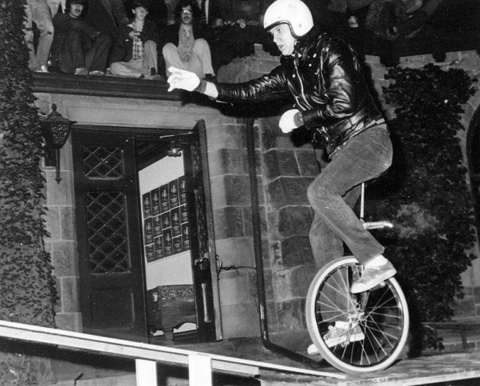
As Trillin reports, “In the hope of attracting some press attention, Penn, who had been put in charge of publicity, concocted an appropriately grandiose stunt that was a parody of the spectacular jumps then bringing a lot of notoriety to Evel Knievel, the daredevil motorcyclist. Penn’s stunt was called Asparagus Penn’s Unicycle Jump for Life and was described as an attempt to jump over five Volkswagen Rabbits on a rocket-propelled unicycle.”
The article adds that Penn admits to having “a lot of phony figures on what would happen when the rockets kicked in when the unicycle hit thirty-five miles an hour.”
According to an eye witness’s written account there seemed to be thousands of mostly Princeton students there “expecting something quite different than what would ultimately transpire.”
Then, on-the-scene report notes, “There was a very strong hint based on the structure of the ramp that this might not be completely legit. The wooden ramp spanned the entire length of the VW Rabbits — it wasn’t like those Evel Knievel ramps that curved upwards, ended, and then resumed on the other side.
“Adding to the tension, Penn was late, and when he did arrive, he played the role of an arrogant daredevil, emerging from a stretch-limo donning a black leather jacket and sunglasses. Waiting on the ‘landing’ side of the ramp was an ambulance, and on the ‘launch’ side, there was a partition preventing a clear view of the preparations.
“It appeared they were having some trouble igniting the ‘rockets’ attached to the one-wheeled device behind the facade. The crowd grew restless. When Penn emerged, there was smoke and fire, but he was pedaling up the ramp, the six-and-a-half-foot, leather-clad attention-seeker wobbling pathetically. It is indeed a difficult feat to ride a unicycle up a narrow incline, and Penn was more the showman than the diligent unicyclist.
“The rockets were flares, and the crowd booed vigorously. Penn fell, he appeared to exaggerate it further. So, as to end the debacle, he picked up his unicycle, flares still spewing sparks, and ran to the ambulance where it was extinguished. He quickly jumped into the vehicle, feigning some injury, which drove off.”
As Teller says, “After all the press, the public took it seriously and an audience came to see it. When they saw it was a joke, they started chanting, ‘Bull shit! Bull shit! Bull shit!’ It was catastrophic and everything went wrong; We were trying to find out how far we could go with deadpan humor and found out.”
Undeterred, the performers who committed themselves to making their music-magic-juggling-fire eating-theater Asparagus show a success.
And when the trio found an opportunity to bring AVCS to a Renaissance festival in Minnesota, Teller faced a choice. He could stay at Lawrence High School, where he had job security, or he could go on the road and live the risk that was at the heart of AVCS.
The solution was a sabbatical.
After the festival the trio was back in the region working various crowds, including those in Headhouse Square in Philadelphia, to support a successful and well received run at one of the Philadelphia’s Walnut Street Theater’s studio venues.
As the notice for their 1977 opening announced:
“Mr. Teller will swallow 100 separate sewing needles, and six feet of thread, and, by series of mildly loathsome muscular contractions, will bring up all the needles threaded, a duplication of Houdini’s famous feat.
“Mr. Chrisemer will lead the ensemble in virtuoso performances of J.S. Bach, Khachaturian, and anon on nose flute, xylophone, accordion, and electric bass guitar, mercifully not all at once.
“Mr. Jillette will tell stupid jokes in a manner little short of offensive, partially redeemed by his skill in such carnival feats as knife-juggling and fire-eating.”
As Philadelphia Inquirer theater critic William Collins noted about seeing the production, “There was something extremely unsettling psychologically about the combination of people. That’s what stopped me in my tracks. It had a kind of Pinteresque subtext” — or sense of danger and human unpredictability that was beyond spectacle.
He later wrote that Penn & Teller created “entertainment unlike any other on the face of the Earth.”
AVCS also appeared on the “Mike Douglas Show,” a nationally syndicated show from Philadelphia, and the radio interview show “Fresh Air with Terry Gross,” a nationally broadcast NPR program also from Philadelphia.
Then AVCS caught the attention of a California producer who brought the act to San Francisco, where it broke attendance records at the Phoenix Theater.
When the show wound down in 1981, Chrisemer decided to return to the East Coast and currently lives in the Trenton region (and did not respond to an invitation to be interviewed).
Penn and Teller then began experimenting with a new production, “Mrs. Lonsberry’s Evening of Horror.”
The New Yorker article quotes Teller as calling Mrs. Lonsberry “a difficult, excessively cerebral show” and reports that “that is the best thing anybody has said about the show. “
Although Penn, an admirer of the noted magician/skeptic James Randi, initially dismissed magic as gimmicky and an attempt to fool audiences with alleged powers, Teller sold him on the idea that it was an “intellectual art form.” The two then hunkered down to create a show that presented and exposed magic with street performing smarts, wit, and a sense of danger.
Trillin, evoking the duo’s cultural heroes, says it was “as if Lenny Bruce (Penn) and Edgar Allan Poe (Teller) had formed a vaudeville act and one of them could juggle.”
“You work at it,” says Teller about the mindset that led the “country mouse and city mouse” personas to become the self-announced “bad boys of magic,” whose calculated stage risks mixed the visceral and intellectual to engage audiences “who don’t like magic shows.”
And there was and continues to be a good deal of such audience members.
Despite several early and bumpy years in the entertainment wilderness, Penn & Teller have seen sold-out runs on Broadway, boast the longest running headline act in Las Vegas history, have appeared in and produced films, and host the hit television show “Penn & Teller: Fool Us!” — a magic competition show in its 10th season.
They also starred in a popular television show where they examined political ideas, paranormal belief, and faddish pseudoscientific claims. The show’s ironic title was “Bullshit!”
According to one report about the show’s name and use of profanity, Penn says if he called someone a scam-artist or a con-man, he would be liable to get sued but “if he called them a bullshitter or an asshole, the chance of a lawsuit was greatly reduced, and of course it all made for great TV.”
The two can also claim that the term was used on them without any harm to their success.
Sharing some thoughts on the magic of their ongoing success, Teller says “We have coffee together . We sit in a coffeeshop and we get ideas. Sometimes they’re strong and require 20 new pieces. Magic isn’t easy to write. For a song [you need] a good and clever idea, but for magic you have to make it a reality.”
Teller shows the difficulty in an article he wrote for Smithsonian Magazine: “You will be fooled by a trick if it involves more time, money, and practice than you (or any other sane onlooker) would be willing to invest. ”
He also noted that “Magic is an art, as capable of beauty as music, painting, or poetry. But the core of every trick is a cold, cognitive experiment in perception: Does the trick fool the audience?”
Yet, there is also the art of human understanding of both himself, his partner, and their obligation.
As Teller says during an National Public Radio interview, “The idea that you can respect someone without wanting to sit by a fire and snuggle with them is maybe not a very popular idea in show business, but it is a very true one. And what turns out to be more important in a long-term relationship is that you can do your job,.”
He then cites the following analogy: two guys who own a dry-cleaning shop, who show up and do their jobs.
“There are lots of times when Penn does not like me, lots of times when I do not like him. And that’s what you want in a partner, an artistic partner.”
In addition to making Penn & Teller synonymous with wit and magic, their respect has also made them one of the only continuous comedy teams working today.
“When I grew up , individual comedians were not that popular,” says Teller, 75. “People’s relationships changed in our culture. Comedians complain about their relationships. Two contrasting people and who stick together and work together are rare.”
And while Penn & Teller are unified by their suits, their physical attributes, personalities, and stage presences are an exercise in opposites attracting — that is especially highlighted by the married Penn’s boisterousness and the single Teller’s taciturnity.
Teller says he went silent somewhere in early 1970s. The reason was that he got tired of magicians pattering while they performed.
“Magic is artful lying, much like storytelling,” he says, “You are doing the most evil thing, lying to people, but with their consent. Lying without speaking was more interesting, to let the audience lie to itself. I did it and it felt right.
“And when you’re not speaking, it creates intimacy. That felt good to me, and I seemed to have a knack for it, and that was good way to deal with a rowdy crowd, if someone tries to heckle me, they burn out more quickly,” he says.
Regarding their State Theater presentation, Teller says they haven’t completely planned the schedule, but he does mention a new pizza trick and “Whack a Teller.” That is where Teller gets wrapped up, capped with tin foil, and then replicated. Penn then asks the audience help decide which Teller should be smacked with a sledgehammer.
Thinking about his time in the Trenton-Princeton area as well as the duo’s long-term performance in Atlantic City, where they also filmed “Penn & Teller Get Killed,” Teller says, “I really have a great fondness for (New Jersey) and grew to appreciate the straightforwardness. New Jersey people are New York people without the pretentiousness.”
He also recalls something about the Trenton area: The bread pudding and tapioca at Cass’s Diner on Route 1.
Thinking over the phone, he says, “I should have asked. ‘How do you make bread pudding?’”
Perhaps it was made of magic.
Penn and Teller, State Theater of New Jersey, 15 Livingston Avenue, New Brunswick. Saturday, September 23, 8 p.m. $59 to $99. 732-247-7200 or www.stnj.org.