While the start of a new year is typically a time when people look ahead to the future, in Princeton it is a time for history enthusiasts to look to the past.
Friday, January 3, marks 248 years since the pivotal Battle of Princeton, the final in a series of three Colonial victories in the span of 10 days that turned the tides of the Revolutionary War in favor of the nascent United States.
The Princeton Battlefield Society will be celebrating the occasion with its annual reenactment taking place Sunday, January 5, beginning at 9:45 a.m. at Princeton Battlefield State Park on Mercer Road.
The event features narration starting with General George Washington’s Christmas Day crossing of the Delaware River and subsequent victories in the Battles of Trenton and Assunpink Creek, followed by the overnight march to Princeton via back roads ahead of the Battle of Princeton. The battle reenactment shows the movements of British and American troops and includes cannon and musket fire. A wreath-laying ceremony follows the reenactment. Reenactors and historians will be on hand to answer questions, and the historic Thomas Clarke House will be open for tours. Register online for free tickets at www.pbs1777.org.
The annual homage to Princeton history is just one celebration amidst a spate of improvements to the historic site. Beginning in November, 2024, new, immersive historical markers that bring the pivotal Revolutionary War battle to life were added to the park in a joint effort between the N.J. Department of Environmental Protection, the American Battlefield Trust, and the Princeton Battlefield Society. The enhancements are aimed at providing a richer, more engaging experience for the upcoming 250th anniversary of the American Revolution.
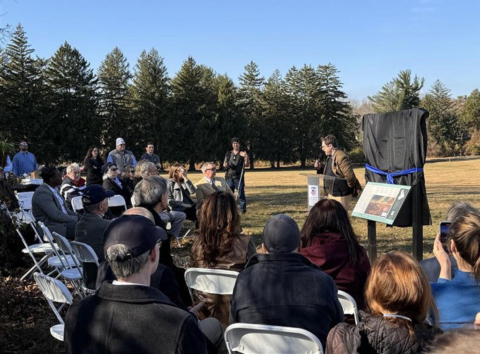
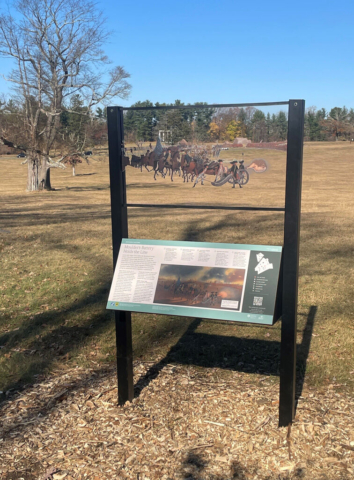
An unveiling ceremony in November featured the debut of an innovative “battle window” marker, a unique display that overlays elements from historical artwork onto the modern landscape. The feature is designed to help visitors visualize key moments from the Battle of Princeton, where General George Washington famously turned the tide of the Revolution.
“We want all Americans to visit the Princeton Battlefield,” said David N. Duncan, president of the American Battlefield Trust. “Through audacity and personal leadership, George Washington saved the American Revolution on this battlefield.
“Washington, riding a white steed, heroically led his men in a dramatic counterattack that broke the British lines, wasn’t lifted from a Hollywood script. It really happened, right here.”
The new signage is part of a larger effort to upgrade the park’s visitor experience ahead of the 250th anniversary celebrations.
Mark Texel, NJDEP’s administrator for historic sites, emphasized that these updates are crucial for helping people connect with the significance of the battle.
“On January 3, 1777, the cause of American independence hung in the balance at Princeton, and that pivotal moment in history deserves to be captured through the very best in 21st century interpretive techniques,” said Texel. “This new signage will immediately enhance the experience of visitors and excite the community for the work still in progress.”
The updated markers include 10 traditional information panels, each with historical content, and the “battle window,” which uses an acrylic overlay to recreate scenes from the well-known James Peale painting of the battle. Additional features, including a second “battle window” from the British perspective and a bronze map table showing the battlefield’s topography, will also be installed. The panels also include QR codes that link to additional content related to the subject of the panel.
To support ongoing research and restoration, archaeologists recently conducted a targeted investigation, uncovering artifacts such as musket balls and case shot that confirm troop positions. The investigation also revealed a medallion from the 1745 Jacobite Rebellion, adding a layer of historical intrigue. A LiDAR (Light Detection and Ranging) scan of the battlefield was also completed to aid in the research.
These updates are part of a broader $1.3 million project approved by the state to restore and enhance the park. Planned improvements include a new park entrance, a visitor orientation circle, and the restoration of historic tree and fence lines. The goal is to make the site more accessible while preserving its historical integrity.
The American Battlefield Trust, which has spearheaded much of the preservation work at Princeton, previously acquired 15 acres of Maxwell’s Field, where Washington’s counterattack occurred.
From a grassroots organization started by historians nearly 40 years ago, the American Battlefield Trust has grown into one of the most successful historic land preservation and education organizations in the United States.
The Trust has protected nearly 60,000 acres associated with the Revolutionary War, War of 1812, and Civil War, representing 160 sites in 25 states from Massachusetts to New Mexico. Its 350,000 members and supporters believe in the power of place and the continued relevance of our shared history to modern American society.
Learn more at battlefields.org.