Parents looking for fun, educational, and affordable places to take their kids without a major investment can consider themselves covered.
I dipped into the archives to compile the following list of free and nearby destinations that may just be the ticket as spring arrives, COVID restrictions leave, and gas prices rise.
So, get your calendar out and take advantage of the following free and easy offerings:
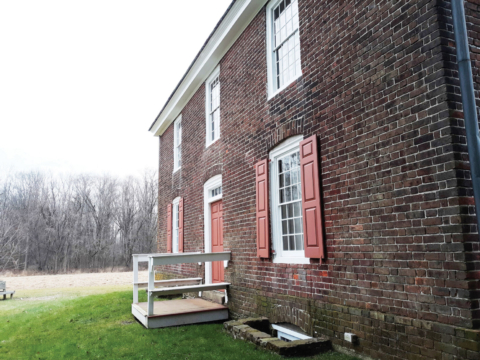
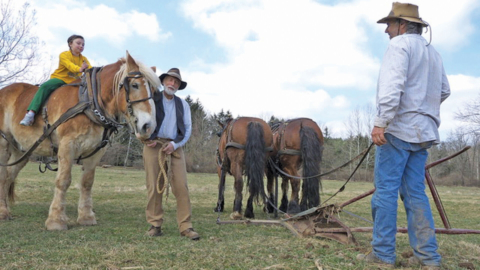
Howell Living History Farm, located in Hopewell (but with a Lambertville address) is a great kid-friendly place to visit. Part of the Mercer County Park System, the farm has been producing crops and livestock since the 1730s and involves visitors in traditional practices, such as corn cracking, blacksmithing, maple syrup and ice harvesting, and so on. It was one of our regular stops and provided some memorable experiences — such as a horse-drawn wagon ride across a snowy field.
The official address is 70 Wooden’s Lane, Lambertville. Park near the visitor center and walk up to the barn and farmhouse through pastures and crop fields. A working kitchen sometimes offers visitors hot beverages and snacks. www.howellfarm.org.
The New Jersey State Museum, 205 West State Street, Trenton, has collections spanning state history, science, and artwork by state and nationally known artists.
One of its major attractions is the important collection of New Jersey Native American artifacts, located in several rooms on its lower level. Interpretive signage will tell you that a good number of the objects come from the nearby Abbott Farm National Landmark site in Hamilton (another place to visit when it gets warm).
On the upper floors the fine arts gallery focuses on American and New Jersey art. Look there for American sculptor Daniel Chester French’s miniature version of his Lincoln Memorial in Washington, D.C., and famed American artist Thomas Eakins’ sculptural reliefs of Washington crossing the Delaware.
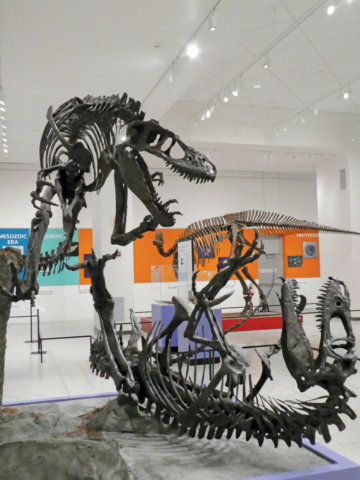
Fossil and dinosaur exhibitions are also on view in the Science Hall. And don’t forget, there’s the planetarium — the largest in New Jersey — and its shows where the big stars are the constellations of the season.
Free weekend parking is available in a parking lot next to and behind the building. Hours are 9 a.m. to 4:45 p.m. www.nj.gov/state/museum/index.html
Located at New Jersey State Police Headquarters in West Trenton, the New Jersey State Police Museum and Learning Center occupies two attached buildings, an 8,000-square-foot exhibition space built in 1992 and the 4,000-square-foot log cabin that served as the original NJSP headquarters.
A one-of-a-kind place, the museum has exhibits that chronicle the history of the state police and organized crime, a participatory crime scene, and a collection of confiscated weapons. But one of its main attractions is its “Crime of the Century” exhibition on the 1932 kidnapping of the son of aviation hero Charles Lindbergh and writer Anne Morrow.
The New Jersey State Police Museum & Learning Center, New Jersey State Police Headquarters, River Road (Route 175), West Trenton. Open Monday through Friday, 10 a.m. to 4 p.m. 609-882-2000, ext. 6401 or www.njsp.org/about/museum.shtml.
The National Guard Militia Museum of New Jersey, located on the grounds of the New Jersey National Guard Armory on Eggerts Crossing Road in Lawrence, uses military weapons, uniforms, photographs, documents, and interpretative texts to chronicle the state’s militia and National Guard history from the early Dutch and Swedish settlements through the present day.
It also claims to possess one of the largest collections of New Jersey-related Civil War research material in the country, including copies of diaries, letters, newspaper clippings, memoirs, regimental histories, and articles, and pays attention to the diversity of the New Jersey citizen soldier and his or her experience.
National Guard and Militia Museum of New Jersey, 151 Eggerts Crossing Road, Lawrenceville. Tuesdays, Fridays, and Saturdays, 10 a.m. to 3 p.m. 609-530-6802 or www.njmilitiamuseum.org.
History
Washington Crossing State Park in Titusville offers several visiting opportunities. The first stop is the Visitors Center Museum and the Swan Collection of Revolutionary War artifacts. Nearby is the Johnson Ferry House. An authentic Colonial-era farmhouse that Washington’s officers used during the famous Christmas Night crossing in 1776, it is now a Colonial-era museum.
Admission to Washington Crossing State Park is free September through the end of May — that is between Labor and Memorial days. And there is no admission for the Visitors Center or the Johnson House.
Washington Crossing Historic Park across the Delaware River in Pennsylvania features a visitors center that provides exhibits and education programs. It also features a replica of Emanuel Leutze’s famous painting of George Washington crossing the Delaware River. It also allows visitors to walk around a small village-like area with historic buildings
The two parks are connected by the easily walkable Washington Crossing Bridge over the Delaware River — providing a commanding overlook of one of the most important areas in American history.
For more information on the parks, visit the following links: www.state.nj.us/dep/parksandforests/parks/washcros.html and www.state.nj.us/dep/parksandforests/parks/washcros.html.
The Clarke House, Princeton Battlefield State Park, 500 Mercer Road, was built in 1772 in what became a Revolutionary War battlefield and was the sanctuary for the wounded Continental Army General Hugh Mercer, who died there. Today it serves as a museum that features Revolutionary War exhibits and artifacts. Visitors can also hike the battlefield and visit the colonnade memorial created by Thomas U. Walter, architect of the United States Capitol Building. Free. www.state.nj.us/dep/parksandforests/parks/princeton.html.
Rockingham, the 1760 farmhouse where George Washington resided from August to November, 1783, helps visitors gain a better understanding of life in the Colonial period. Each room is filled with 18th-century furnishings and artifacts. The site served as General Washington’s final Revolutionary War headquarters and allowed him to visit Nassau Hall in Princeton, which served as the nation’s capital.
It is here that Washington received England’s agreement to end the war and liberate the colonies as well as wrote his Farewell Orders to the Armies of the United States. Admission to the historic house, located on Laurel Road (Route 603) in Kingston, is by guided tour only, set for Saturdays at 10 and 11 a.m. and 1, 2, and 3 p.m. Call in a reservation at 609-683-7132. www.rockingham.net.
The Brearley House in the Princessville section of Lawrence and off Princeton Pike is a Georgian brick house typical of other 18th-century colonists’ homes. Its 1761 date noted in glazed bricks was “the practice in York, England, from whence John Brearley had arrived 66 years earlier, to identify a house with the date of its construction on the gable that faced the road,” according to background information written by the house’s occupants, the Lawrenceville Historical Society.
It was built for James Brearley, the thrice-married farmer who lived into his 90s. For the next century or so it was occupied by various family members and then a succession of people in the 20th century — with one using portions of the house to renovate a similar house elsewhere.
The house was rescued by Lawrence township, which secured the building from developers in 1978, renovated with support from the New Jersey Historic Trust, and is now run by the Lawrence Historical Society.
Brearley House, 100 Meadow Road. Tours the third Sunday of every month, from 2 to 4 p.m., and the first Saturday of the month, March to October, from 10 a.m. to noon. www.thelhs.org/1761-brearley-house
At the rear entrance of the house there is a path that offers entry to the Lawrence Hopewell Trail. Head towards the woods and you come to a sign that welcomes you to the Brearley-Great Meadows Trail, a one-third mile path that leads to the Delaware and Raritan Canal State Park, whose trail is part of the National Recreation Trail System.
Built in the 1830s, it is a 70-mile engineering marvel running from Bordentown to the Raritan River in New Brunswick (with a feeder canal starting near Stockton and running south to Trenton) that fuels the region.
Benjamin Temple House in Ewing was built circa 1750 and takes its name from an early area settler, prosperous farmer, and friend and brother-in-law to area Declaration of Independence signer John Hart.
The Temple family maintained and modified the Georgian-style house for 150 years. Records show that the house was eventually sold in 1903 to Patrick Ryan, whose family operated a dairy there for the next half century. The house was also moved in the 1970s. Originally on Route 31 or the old Hopewell-Trenton Road, it was in the path of the construction of Interstate 95 and was to be razed. The building was saved by the Ewing Township Historical Preservation Society (ETHPS) and Ewing Township and moved to its current Federal City Road location.
According to the ETHPS, which maintains and operates the building, the “front entrance opens into the oldest portion of the house with four rooms (two rooms on the first floor and two rooms on the second floor) leading off the side hall and the staircase. This oldest section of the house is distinguished by the original paneled fireplace surrounds, dentil crown molding and corner cupboard.”
The house now operates as a museum and cultural events center.
Benjamin Temple House, 27 Federal City Road. www.ethps.org
Summerseat is the 1765 Georgian mansion on the quiet back streets of Legion and Hillcrest avenues in Morrisville, Pennsylvania. As tour guides will tell you, “Few homes in America have been owned by, or occupied by such important actors of the 18th century as Summerseat.”
Want proof? General George Washington used the building as his headquarters in the winter of 1776, and it was where he formulated the strategy to secure or destroy all the boats and water crafts along the Delaware River and plan to attack the Hessian garrison in Trenton.
In addition to other events during the war, the home was later owned by two individuals who signed both the Declaration of Independence and the United States Constitution: Robert Morris, who helped finance the Revolution and who gives the town its current name, and George Clymer, who gave the mansion its summer-friendly name when he took possession in 1806. He remained here until he died in 1813 and was buried in Trenton.
The property was acquired and renovated by the all-volunteer Historic Morrisville Society, which provides free tours on the first Saturday of each month, 10 a.m. to 1 p.m.
Summerseat, Legion and Hillcrest avenues, Morrisville, Pennsylvania. www.historicsummerseat.com
John Abbott II House is the Hamilton home that Merchant John Abbott and his farmer son, also John, built in 1730. Its role in the American Revolution involves money.
Reports note that as the British were advancing on Trenton in 1776, state treasurer Samuel Tucker secured 1,500 British pounds of public money and 1,000 more pounds of assets, packed them in a trunk, and took them to the Abbott House for safekeeping. The alleged result was a British raid on the property and a search that failed to find the lock hidden in the bottom portion of barrels.
John Abbott II House, 2200 Kuser Road. Saturdays and Sundays from noon to 5 p.m. (last tour starts at 4:15), March through December. Closed Easter Sunday and Thanksgiving weekend. Free. 609-585-1686.
The Watson House is located in Roebling Park in Hamilton. Situated on a bluff overlooking the marshlands between Trenton and Bordentown, the stone house was built by Quaker Isaac Watson in 1708, making it the oldest house in the region.
As historical reports have it, Watson came to America from Farnsfield, Nottinghamshire, England, in 1684. His father brought his family to escape religious persecution and after a short time in Philadelphia arranged to purchase the property in what was then called West Jersey.
It was Isaac who built the stone house where he lived with his wife, Johanna Foulke, and their nine children. The stones were moved by flat boats from the “falls” of the Delaware (now the stony section of the river near the state house).
The Watson House is owned by Mercer County and has been leased to New Jersey Daughters of the American Revolution since 1964, when the organization took on the building’s restoration as part of the New Jersey tercentenary celebration. It now serves as NJDAR’s state headquarters and is listed in the New Jersey and National Registers of Historic Sites.
Now restored, the house’s lead-glass windows, kitchen hearth, and furnishings let visitors quietly escape today’s high-tech world and get a glimpse of the past. And there’s a bonus: The site is located in the National Historic Landmarks Program’s Abbott Farm Historic District — an area where Native Americans lived and worked for more than 8,000 years and where several important 20th-century archaeology excavations were launched.
It is also across the way from the Tulpehaking Nature Center. Located in a renovated ranch-style home, it hosts ongoing exhibitions and events.
According to TNC materials, Tulpehaking is a Lenape Indian word meaning “Land of the Turtle.” It is a name used for an area near the marsh and the turtle was a totem for one of the Lenape clans. During warmer days, sometimes even in winter, there are plenty of turtles to see.
Isaac Watson House, 151 Westcott Avenue. Open Sundays, September 9, October 14, and November 11, 1 to 4 p.m. The grounds and the Abbott Farm Historic District are always open. Free. www.njdar.org/watson.html
For more information or to book a program at the TNC: www.abbottmarshlands.org/nature-center
Nature Walks
Roebling Park, in addition to the above entry, has another entrance on Sewell Avenue where it connects visitors to history of a more recent vintage — evidenced by the magical presence of a grand beaux arts-styled stairway leading from the brush on the bluff to the parking lot. That’s where the former White City amusement park was built in 1907 to provide visitors with flume rides, boating trips on the lake, and summer concerts.
The house on top of the bluff was where the trolley dropped off customers who would purchase their tickets and descend the stairs.
Abandoned by 1930, traces of the park remain in a small display with images showing women in long white dresses and men in suits walking near flume rides and boats. It also remains in the ruins appearing in the woods — most noticeable in the late fall and winter.
So where’s the Roebling connection? The Broad Street Civic Association, with assistance from the Roebling family, gradually acquired more than 300 acres of the land, including White City Park. When the BSCA sold the lands to the county for $1, the county named the park John A. Roebling Memorial Park. The sale also specified that the land would be a wildlife refuge designated for passive recreation.
Open all year, Roebling Park generally provides a getaway from the everyday and is generally safe despite occasional encounters with individuals marching to a different drummer and even building structures across waterways. But the combination of deep history and observing wildlife is a winning one.
The Lambertville Canal and Wing Dam walk starts in Lambertville, heads south from the city along a strip of land along the canal, slowly leaves civilization behind, and offers one of the most spectacular views of the Delaware River.
The entrance is hidden is right off Bridge Street by a small bridge over the canal. Of course, being Lambertville, parking may be a problem, but there is a parking area behind the Lambertville Inn that connects to the towpath along the canal — where a vital train line that connected towns along the Delaware River once ran.
Some of the sites seen include the remains of a lock that let barges move between the canal and the Delaware River.
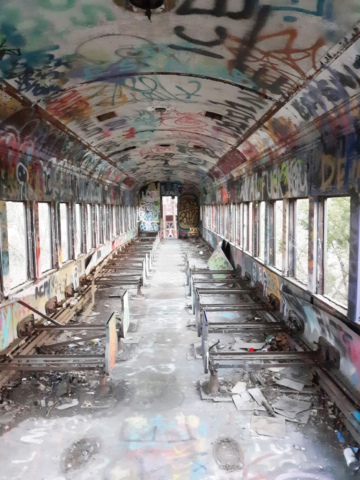
Also of interest are the abandoned passenger train cars, remains of the unsuccessful late-20th-century effort to restart train passage. While a few cars have been incorporated into the Lambertville Inn as restaurant spaces, two other decaying ones silently greet passersby along the walk — with one serving as the canvas for graffiti artists. Although that car’s entrance is chained to discourage visitors, it is easy to take a peek inside and imagine the ghosts of the many passengers who depended on the car to carry them through life.
Further up are the unglamorous but necessary Lambertville Sewage Buildings and a weir where the canal water roars through and leaves behind branches and logs.
After passing a series of old but functioning buildings that back onto the canal (and open to Route 29), the path becomes tree-lined, quiet, and less traveled, affording an opportunity to relax and slow down the pace.
Then about a half mile across from a bench on the right is a path leading down a bluff toward the river. Fraught with gnarled tree roots and rocks, it invites only the intrepid to enjoy its reward: the wing dam.
Built in the early 1800s to feed the canal and power Lambertville paper mills, it is now regulated by the Delaware River Basin Commission based in Trenton.
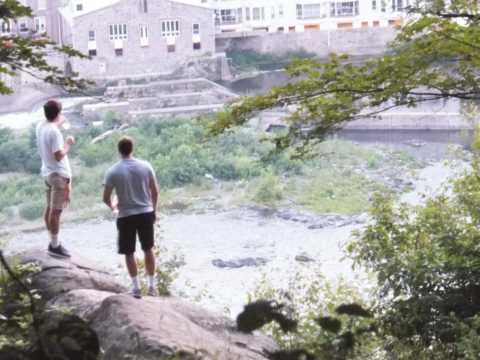
A combination of stone and concrete, the dam extends from both sides of the river in a chevron formation with an opening to let the water race through. Although often submerged after high waters resulting from heavy storms, the dam is usually slightly above the water line and provides visitors with the opportunity to walk close to the surface and into the center of the river.
There you can stand — or sit — with water running under foot and hear only the musical sound of the moving water. Look south and gaze at the white-capped water rushing over rocks and around small islands, then notice the river arching to the left and Bowman Tower on top of its mountain to the right.
Turn around and gaze at the silent traffic glittering in the sun as it travels across the Lambertville-New Hope Bridge and the 19th and early 20th century buildings of both towns seemingly out of a vintage Bucks County painting.
The experience — especially in the summer — is like walking into a postcard and then realizing the beauty and history under your feet.
Goat Hill Overlook outside Lambertville is a small New Jersey state park where easy and short hikes lead to a spectacular view of the Delaware River. Make that two views. One is an easy and family-friendly walk that leads to an open area with picnic tables. The other leads to an extended rock formation and is for the more sure-footed and adventurous. Nevertheless both provide commanding views of the Delaware River, the towns of Lambertville and New Hope, and the bridge that connects them.
To get to Goat Hill Overlook, take Route 29 to just south of Lambertville and take Valley Road, and then turn left on Goat Hill Road; follow up about a mile and then on the left turn on Washington Road. Follow it to the parking lot.
Incidentally, the Washington name comes from the belief that General George Washington had visited the area at least twice: once in the early days of the Revolutionary War to gather information and plan attacks and later when he and General Marquis de Lafayette made a visit to the stone promontory.
Open daily from morning to dusk.
Baldpate Mountain Park along Route 29 in Hopewell Township was formerly known as Kuser Mountain. Owned and operated by Mercer County, the park has more than 12 miles of trails. Some are short loops at the top of the mount. Others are steep and include climbs up rocky hills.
In addition to the beautiful overlook of the Delaware River, on a clear day, visitors willing to search will be able to locate the gold dome of the state capitol in Trenton as well as the tips of Philadelphia’s skyscrapers. Picnic areas and restrooms are available.
Baldpate Mountain, open from dawn to dusk, is located off Route 29 North. Turn on Fiddlers Creek Road and look for the entrance on the left.
The Lumberville-Raven Rock Pedestrian Bridge, 13 miles north of Lambertville, has the distinction of being the only pedestrian-only bridge on the Delaware River.
But that wasn’t by design. The original vehicle wood bridge was constructed by the Lumberville Delaware River Bridge Company in 1856. It operated until 1903, when a portion was destroyed by a flood. A steel truss replacement was installed the following year, and the bridge continued to operate until 1944 when its timber portions were deemed unsafe.
The current 689-foot bridge started its life when the DRJTBC hired the Trenton-based John A. Roebling Company to design a pedestrian suspension bridge in 1947. Built on the original piers, the bridge is part of a heritage of Roebling bridge-building that includes the Brooklyn Bridge and the 1847 Delaware Aqueduct, the nation’s oldest suspension bridge connecting New York State and Pennsylvania.
The easiest access to the Lumberville-Raven Rock Bridge — which in 1993 underwent major rehabilitation — is by visiting Raven Rock, part of New Jersey’s Bull’s Island State Park. Once there, simply park and follow the road towards the bridge. Then there’s the leisurely and quiet stroll over the water that leads to two dining venues. The first is the historic Black Bass Hotel, where adults looking for a romantic getaway may be able to spend time in the glass-walled riverside restaurant or with outdoor dining. The other is the quaint Lumberville General Store, where families can find snacks and beverages.
By the way, the name Lumberville connects to the town’s sawmill past. Raven Rock’s nomenclature is less clear and has been linked to a possible Leni Lenape name.
Parks on both sides of the river provide opportunities for picnics, hiking, fishing, and even boat launching.
For more information on Bulls Island State Park, visit www.state.nj.us/dep/parksandforests/parks/bull.html.
For A Few Dollars
While all of the above are free, don’t forget that for a small fee one can visit some of the most historic places in the region.
The Old Barracks, located at 101 Barrack Street, Trenton, was built in 1758 during the French and Indian War and housed the Hessian troops during the Battle of Trenton. One of the only such buildings of its kind, it has tours, a museum, and living history events. It’s open Mondays through Saturdays, 10 a.m. to 5 p.m., with tickets $8 adults, $6 students, and free for children five and under. Parking in lots, with meters on street, or at the State Museum parking lot for free — requiring a walk down West State Street, past the State House, historic Petty’s Run and the New Jersey World War II Memorial. www.barracks.org.
Morven, the Princeton home of Declaration of Independence signer Richard Stockton (1730-1781), has its roots in the 1750s when in 1758 he rebuilt an earlier home consumed by fire. It was his wife, poet and patriot Annis Boudinot Stockton, who dubbed the mansion Morven — Gaelic for “big peak or mountain” and connected to the Romantic epics of Scottish poet James Macpherson.
The house was also part of the action of the Battle of Princeton when the British ransacked it after Stockton and his family had to flee — with the signer being captured and imprisoned.
Now a National Historic Landmark, Morven has undergone a series of additions and renovations reflecting the character of its occupants who are the subjects of a permanent exhibition that highlights the original family, including slaves and servants, subsequent owners, and its years as the official home for New Jersey governors.
Morven Museum & Garden, 55 Stockton Street, Princeton. Wednesday through Sunday, 10 a.m. to 4 p.m. $8 to $10. 609-924-8144 or www.morven.org