The new Edelman Fossil Park and Museums in Mantua, Gloucester County, is an hour trip to the very distant past — 66 million years ago to be exact.
Billed as a “one of a kind” center, the Edelman’s promotional materials promise “full-scale dinosaurs, live animal encounters, an interactive fossil scavenger hunt, immersive museum experience, free-roaming virtual reality, and a unique fossil-digging experience.”
Visitors can start checking off that list as soon as they arrive at the 123-acre campus, where the most prominent attraction is the 44,000-square-foot museum building.
The contemporary wood and concrete structure features a suite of exhibition spaces, two theater or presenting venues, a virtual reality chamber, fossil collection and live animal areas, café, and a gift shop.
Yet, two other nearby outdoor areas also attract attention.
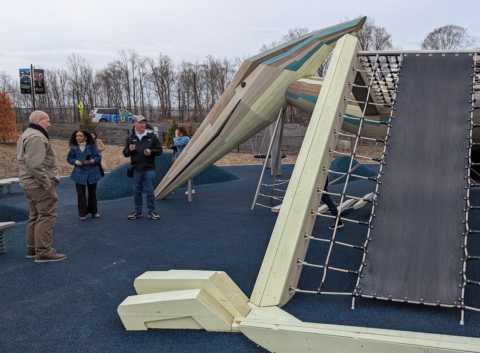
One is the playfully alliterative Pterosaur Pterrace, where youngsters can climb aboard an abstract Pterosaur (a variety of prehistoric flying reptile) and excavate an equally abstract 30-foot Allosaurus (a smaller version of a Tyrannosaurus).
The other attraction is the four-acre quarry and dig area where visitors of all ages are invited to try their hands at finding fossils — and take them home.
Together the three sections weave together an overarching design to use the present to explore the lost world of New Jersey’s dinosaur past.
The intent is slyly reinforced by Ennead Architects’ and KSS Architects’ decision to construct the building in a manner that suggests a camera obscura — a device that allows an image to be projected through glass into a chamber.
Visitors start their adventure by passing through a foyer flanked by a gift shop and café before checking-in with electronic ticket vendors that provide tickets or “keys” that visitors use for interactive displays.
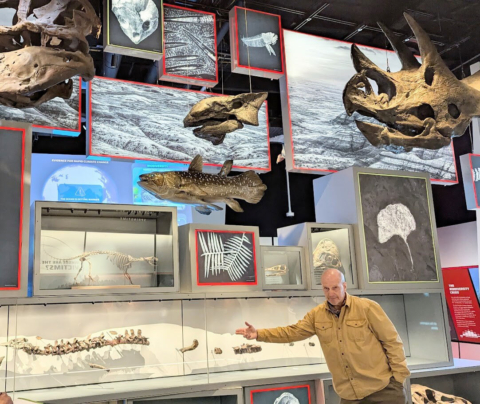
After fast steps through a glass and wood hallway with replicas of prehistoric skeletons dangling overhead, it’s time to enter “The Cretaceous World” exhibition.
Named after the period that started around 145.5 million years ago, when dinosaurs started ruling the world for the next 79 million years, the space focuses mainly on the species living in New Jersey at the end of their era, approximately 66 million years ago.
Here visitors encounter the first in a series of life-size dinosaurs and other prehistoric creatures in forest habitats designed by Kansas City-based artist Gary Staab.
The former art and biology student at Hastings College and intern at the Smithsonian and British Museum of Natural History is known as both the creator of lifelike works found in more than 50 museums worldwide and as the five-time recipient of the Vertebrate Paleontology Award for Excellence in Paleontological Art.
Appropriately, Staab’s star attractions include towering facsimiles of New Jersey dinosaurs discovered in the region.
That includes the Dryptosaurus and Hadrosaurs.
The former is a member of the meat-eating Tyrannosaur family that was discovered in Mantua in 1866.
The other, a land-dwelling herbivore whose bones found in 1858 in Haddonfield, NJ, made history as the world’s first of dinosaur skeleton — a distinction that made it the official dinosaur of the State of New Jersey.
Artful lighting, aural sounds, and authoritative signage enhance the viewing experience for older audiences, while knee-high dioramas and crawl-through passageways provide tots with discovery opportunities.
After a number of stationary and interactive stops designed to promote wonder, visitors soon encounter the climactic moment of the era with the Chicxulub impactor asteroid slamming into the Earth near the Yucatán peninsula in Mexico.
In just hours changes shook the world, and earthquakes, firestorms, and tsunamis turned the thriving world of dinosaurs into the bones of history.
Also affected was a once 10-mile-wide ribbon of coastal land that stretched from Asbury Park through Maryland, including the site where the fossil park and museum now stand.
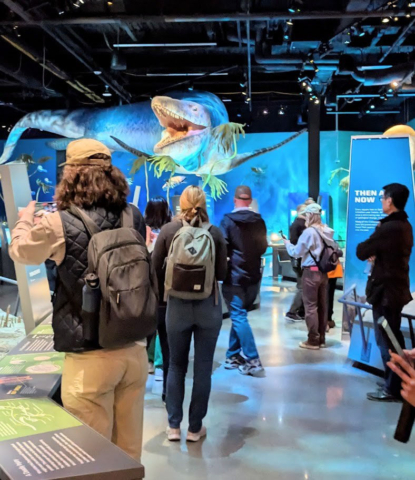
Accordingly, visitors encounter an undersea environment featuring the overhead recreation of the monstrous sea reptile Mosasaurs, whose skeletal remains were discovered nearby.
That the once firm spot was turned into an undersea jungle is demonstrated by another display showing a prehistoric fish ripping into the floating carcass of one of the unfortunate dinosaurs caught in the catastrophe.
Along with an accompanying film depicting how the unsuspecting dinosaurs were suddenly subjected to a painful demise, visitors suddenly experience an unanticipated realization regarding the precariousness of existence.
That is reinforced by the next display exploring to the Five Extinctions — aka the five epochs of the mass extinction of various species occurring over 440 million years.
Bringing the exhibition to the present, visitors then arrive at a section that examines the current dangers related to the health of planet Earth and the hopeful choices before them.
Here, interactive panels are used to a create a dialogue about climate causes and remedies and recommendations that can be digitally forwarded to home computers or phones.
Digital technology is also employed in the virtual reality chamber, where visitors use eye and ear devices to find their way through the thematic landscape — and interact with dinosaurs.
Since the museum uses timed tickets, visitors are then guided outdoors to the hands-on dig component that gives meaning to the title “fossil park.”
To get there, museum attendees leave the museum and go to the quarry area, a field of marl with mounds of loose earth rich with fossilized clams, sea creatures, and shark teeth.
For those not interested in fossil finding, there is a café that offers thematically named pastries, packaged snacks, soft beverages, and coffee. There is also a gift shop with lots of park and dino themed souvenirs.
The behind-the-scenes guide for the exhibitions and the museum is the park’s founding director, Kenneth Lacovara.
The founder and past dean of the School of Earth & Environment at Rowan University, Lacovara gained fame for his discovery of the massive new dinosaur species, the 65-ton Dreadnoughtus in Patagonia.
He is also known for his award-winning book “Why Dinosaurs Matter,” his Discover Magazine articles, and a TED talk that has attracted over five million viewers, and he is a recipient of the Explorers Club Medal.
A New Jersey native who grew up near in Linwood and graduate from Midland Regional High School, near Ocean City, in 1979, Lacovara says, as he walks to the quarry, “My father was a carpenter and my mother was a stay-at-home wife. I got interested in dinosaurs as a second grader, and when a guest showed fossils at a cub scout meeting, I declared that I’d be a paleontologist.”
Since no one from his family had an academic background, Lacovara says he didn’t actually know how to achieve his goal and took some detours.
The main one was music. The former rock band drummer decided to study music at Glassboro State College and eventually became the house drummer at the Golden Nugget Café in Atlantic City.
But after an encounter with noted American astronomer and science writer Carl Sagan’s book, “Cosmos,” Lacovara says “I knew I needed to find a way back to school” and returned to Glassboro to study geology. That was followed by further studies and degrees from the universities of Maryland and Delaware.
And that delay in his studies? It worked to his advantage when he found he had the opportunity to go on an expedition to locate the legendary Lost Dinosaurs of Egypt and then to Patagonia, where he became part of the history that he was studying.
Returning to Rowan University as a professor, Lacovara focused his attention on the region’s rich fossil deposits.
One noted site was the marl and fossil-rich grounds of the Inversand Company, where the museum now stands.
The company’s owner, Churchill Hungerford, had history of allowing paleontologists from the New Jersey State Museum in Trenton and Academy of Natural Sciences in Philadelphia to recover fossils from the site and add to their collections.
When the company closed in 2007, Lacovara and Rowan University moved to acquire the site for research and study.
Eventually, the idea of a museum and education center emerged.
As board member and Rowan alumna Jean Edelman says during a board meeting, “Dr. Lacovara gave a presentation (about the idea of a fossil park and museum). I got excited and said this is a project we want to support.”
The “we” includes her husband, New York Times Best Selling author and Rowan alumnus, Ric Edelman.
The couple are the founders of Edelman Financial Services. According to press materials, the wealth management company serves more than 1.3 million households and manages more than $270 billion in assets.
The Edelmans’ $25 million gift enabled the project to move forward in a partnership with Rowan University and secure additional support, including a $75 million Gloucester County Improvement Authority bond.
With an interest in promoting science education and learning in the United States, Ric Edleman said at a museum opening, “We are the global economic leader, (but) the rest of the world is catching up. We need to do a lot of work and support STEM learning. There is no better way to get kids inspired than putting them in the dirt. In a big picture, this site plays an important role in that. We want to engage in projects in things that make a difference. If we didn’t get involved, it may not happen.”
Looking at the museum and its position to attract attention to southern New Jersey, Ric Edleman says “This has far exceeded our expectations. (Lacovara) has produced a world class experience.”
For his part, Lacovara is pleased by the support and the opening of the museum and center.
Yet, when asked about something that he hadn’t anticipated, he smiles and says, “I expected Gary Staab’s sculptures to be good. But they go way beyond my expectations. Sometimes, I just go and hang out with them.”
Edelman Fossil Park and Museum, 66 Million Mosasaur Way, Mantua. Open daily 10 a.m. to 5 p.m. Timed Admission, 13 years and older, $29; ages 3 to 12, $24; under 3, free. 856-284-3466 or www.efm.org.