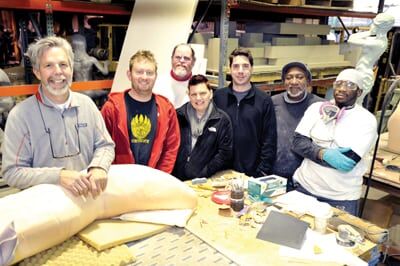
At first glance the Digital Atelier — housed on the Grounds For Sculpture campus in Hamilton — looks anything but monumental.
Located in the larger Johnson Atelier building, the worn cinder block side entry suggests an unadorned distribution center. The bank of computers arranged in a circle that greets the visitor does little to diminish the industrial feel.
But there is more than meets the eye. The Digital Atelier is on the frontline of contemporary sculpture and a leader in cutting-edge technology and art. Its services that move a project from inspiration to installation include laser scanning, computer numeric control (CNC) milling, and coating technologies that cater to artists, architects, museums, and the entertainment industry. It is also attracting global attention.
If that seems like too much hype, talk to founder and now owner Jon Lash and he will list clients that include — in addition to Johnson Atelier and Grounds For Sculpture founder Seward Johnson — Columbia Pictures and internationally known sculptor Jeff Koons, who recently contracted the atelier to build a 16 foot tall Lady Gaga for the unveiling of her new album.
Then there is the Tao Group, owner of world-class restaurants, and its recent big order for a new space in New York City: 20 giant replicas of a stone Buddha based in California, replicas of antique ceiling tiles, and relief work. The due date: right away. “We sent people to California. We made the (statues) look like stone and did the tiles and reliefs, but it was 18 to 19 hours a day to make it happen,” says Lash.
Forget the hammer and chisel, the new sculptor’s tool is the digital muscle that rushes through the computer work stations and has a tremendous amount of memory, can multi-process, and knows how to work with numerous software suites. “We probably have five different suites each containing five different softwares. We stay with PC-based 3-D software. They are all industrial (software): engineering, car manufacturing, maritime. They’re really for building large-scale or complicated things, like jet engines. We find a way to make it work for us,” says Lash.
The work uses high-definition laser heads that read a model or an original art work, record its data, and then guide the machine. Sculptures are milled — or shaped — with a five-axis-control CNC machine that uses readings recorded by the laser and programming orders.
To get an idea of how a work would be created, a project is devised. Lash is given a two-inch socket bolt and asked what it would take to create a 20-foot-tall pop art sculpture.
He picks the bolt up, feels its threads, looks at the hexagonal head, and says it would simple to scan the model and record the information into a data bank. But that’s just the start.
It’s his series of questions that lead to the realization of the sculpture. Lash asks if the work is being created for an interior or an outdoor site. If the latter, he wants to know where to determine costs related to codes, transportation, and installation. “We also recommend engineers. Of course it depends where it goes. I need to find someone who could sign off and say that it would be safe in 120-mile-per-hour winds,” says Lash.
When the discussion moves to materials, Lash says, “The one material we have been using most is urethane, urethane foam. It could be a six-pound to a 90-pound density. The higher (weight) we can paint. The lower density can be used as a pattern for the foundry for metal casting,” he says.
Say the artist wanted the bolt to be made in stone. Lash explains that “granite would be hard and difficult. Indiana limestone would be easier.” Yet that would have to be sent out.
The Johnson Atelier — which still maintains existing Grounds For Sculpture art and works with artists to create new pieces — formerly housed both the Digital Atelier and a Digital Stone Project.
The stone division was also sold in 2012 to artist Koons, who relocated the operation — now called Antiquity Stone — to Morrisville, Pennsylvania, for private use.
Since stone is rigid, costly, and less forgiving of mistakes, Lash recommends that artists interested in stone experiment first with low-weight urethane prototypes to test artistic vision and troubleshoot problems related to transportation and stability. Koons is an example of artist who uses this approach.
Once the basic questions are answered, Lash says that he can usually have the design, production plan, and budget worked out in an hour. Then the art of the deal begins, “If I ask you your budget and you say, ‘$10,000,’ I would just smile. But if you have $200,000 I would start talking and say that it was a $300,000 project, but ask if you could place it out of the States” (to avoid higher labor costs).
Even for the artist with a vision larger than a bank account, there is still a potential. Lash may advise the use of a different material or suggest that the way to realize a grander project is through smaller steps, such as selling a number of miniatures and using profits to create the larger piece. “If there’s a budget and project, there’s usually a way we could do it,” he says. A glance around the atelier workshops shows a lot of “doing” with works-in-progress by influential (and New Jersey-raised) artist Kiki Smith and Korean sculptor and installation artist Do Ho Suh.
Lash says that his atelier can create reductions of large works or enlarge smaller works, as in the case Seward Johnson’s life-sized sculptural replication of Manet’s famous painting of the reclining and unapologetic nude “Olympia.” A miniature version — less than one foot long — was manufactured to explore placement and transportation, and a 25-foot-long sculpture had been proposed to be placed on the rear of a flatbed truck and transported through a town to stir up attention. That idea has yet to be enacted.
Other projects, Lash says, are twice as large as the room that he is standing in. Others are the actual rooms themselves, as in the case of the Mayan chamber. “We did some work with the Peabody at Harvard and the University of Pennsylvania on a show on the Mayans and (replicated) some of tombs under the ground. I was asked to go to the jungles with $200,000 worth of equipment. The challenge was to recreate space underground and never seen. We knew we would get the surface. Mapping the surface is something that we can do.”
To finish the project, Lash says, he worked with the Johnson Atelier to match paint to the hues in the original tomb to the best of everyone’s ability. “It was very cool,” he says.
It is also something that he never imagined when he helped launch the Digital Atelier in 1998. “I was director of special projects at Johnson Atelier, and at that time I had been there 20 years. I came as an apprentice and worked my way up in all the different departments. I had a track record. I had my own vision that the way things were being made needed to be changed. They were too expensive and too slow to produce. We were missing something that was out there. There were people who had visions on how to mechanize it.”
Knowing there was software reading CPC (counter-pressure casting) machines being used by industries to improve casting, “I went to the Johnson Atelier board of directors to see what we needed in software and hardware to see how sculpture could be (digitally) made or manufactured,” Lash says. “The board did not like this idea, but Seward Johnson thought it was fantastic and said, ‘We’re a nonprofit, and I see a vision more than the money. But I want to see a business plan to see how you can pay us back in five years.’ And I wrote my own business plan.”
While originally a for-profit subsidiary of the non-profit sculpture foundation, the business that now generates revenue of one or two million dollars annually and depends on a staff of eight or nine — and sometimes interns from art and engineering schools — is independently owned. “I purchased the company outright a year ago. Our relationship (with the Johnson Atelier) is friendship. There’s no arrangement. I lease from them. I ask them to participate in our jobs. I go to them for bids.”
The company uses machines that have five axes — five programmed blades that shave materials. “When you get to five it becomes very complicated,” says Lash. When asked how it compares to a three dimensional printing — which builds physical objects with applied fluid materials — Lash says that products created through the smaller commercially available dot matrix 3-D printers are not as refined as the techniques used by the Digital Atelier to produce museum-quality works.
The examination of two art works in progress illustrates the point. A commercial 3-D miniature of Johnson’s “Olympia” statute is “pixilated” — or rough to the touch and eye. A fabric study created with more advanced technology for Jeff Koons is smooth and life-like.
Lash adds that 3-D printers are advancing and that the technology “is going to go crazy in the next 10 years. You’re going to be printing body parts. They’re printing food in Europe: hamburgers. Ten years from now today’s $10,000 printer may be printing (a high end) product. But not right now. But that’s where we’re heading.”
While Lash is a key part of this New Jersey link to high tech sculpture, he set out to create art the old way and from another part of the nation.
Lash, who now lives in Yardley, PA, with his sculptor wife, Dona Warner, was born in New York City but raised in Palo Alto, California, where his father — a General Electric vice president of sales — was transferred. It was in the public schools there that he discovered an aptitude for art. “In second grade I won some art award and it seemed pretty easy,” he says.
After graduating from Gunn High School he attended Sanford University, majored in art and religion, and toyed with the idea of entering a Catholic seminary. Still spiritual today, he says he is non-denominational.
His early career involved construction management in Florida, providing him with the project managements skills that he would later use in both his work and art. “I started out as a figurative artist and went totally abstract using color and space. I kept building things that had space around figures.”
In the 1970s he decided to focus on sculpture and moved to New York City. Although he had several solo shows, he says he eventually stopped creating sculpture after a bad experience with a gallery owner. He also became ill. “My wife asked me to stop,” he says. However, he continued working in art after arriving at the Johnson Atelier for an 18-month apprenticeship that turned into decades of work and innovation.
Lash says that while there are other enterprises using digital technology to sculpt or “print” products, those companies have a narrow focus or do not produce the “high end” or “museum-quality” products that his company does. One is Koons’ Antique Stone, which has several things in common with the Digital Atelier, including Lash’s wife. She served as director of the Johnson Atelier for 25 years and now serves as Koons’ office manager.
Lash says that what gives the Digital Atelier its edge are experience, background, and the ability to see things as an artist. “Our background is great, plus the diversity of the materials. We work in all types of plastic, woods, acrylics, plasters — we’re not limited. We accept any job. A very nice thing is that if we can’t do it I know who can. I can usually help people.”
The long experience also translates into cost efficiency and clients. “We are very competitive in our pricing because we’ve been doing it for some time. We don’t do a whole lot of advertising. We are definitely a world of mouth business,” Lash says.
That word extends around the world, including areas known for stone cutting and sculpture. “I just met with people from Italy. The European Union is setting up a school outside Carrara to teach digital carving. I can build files here and send them to Italy. We’re also working with artists in China and South Korea. I’m trying to bring manufacturing to the United States.”
Artists at the International Sculpture Center, a nonprofit located at the Johnson Atelier with the goal of advancing sculpture, are also interested. “They have asked me to speak on three separate panels to be based on this technology. It draws a huge crowd. They read about it and they don’t understand, but feel that they have to make the move.”
Lash says that as an emerging art form there is no standard or schools where young artists can learn digital sculpting, but some institutions “are jumping on the bandwagon.” While older established institutes such as the Massachusetts Institute of Technology and Stevens Institute have art programs, Lash feels that they are already too structured to accommodate innovations. “What you need are smaller schools, including the vocational and technical schools. I just met with the [La Plume, Pennsylvania-based] Keystone College board of directors. One professor invited me up to talk to their academic group. I told them that they need to develop a new program, usually between art, architecture, and engineering. The same software that you can use for sculpture you can use for architecture and engineering.”
As Lash told his college-age son, who attends the school of visual arts in Tucson, Arizona, “Learn 3-D software. The jobs will be there.”
Though technology is replacing tradition and the gap between artists and material increases, Lash says that the atelier requires artists to be fully engaged in the process. “It is not just the machine doing everything; we bring the artist in to make it personal. The whole process is a step. It’s a tool. We do 80 percent of the work. But we expect the artist to be there at the beginning and the end to do the other 20. Someone has to tell the machine what to do.”
Lash sums up the idea with a statement from a teacher: “Everyone has to have a foundation. Learn to paint and draw first. Then use a computer. It’s just a tool. If you don’t have the foundation, you’re not complete.”
Thinking how the speed of digital innovation will affect art making and his business, Lash says “The pieces are getting much more complex. The files are getting outrageously large. The real challenge is trying to stay ahead of the curve.”
Nevertheless as shown by the international and national interest in its activities, the Digital Atelier (along with Antiquity Stone) is a world leader in artistic innovation.
When influential 20th century New Jersey artist Robert Smithson contemplated North Jersey’s industrial relics as monuments, he asked, “Has Passaic replaced Rome as the Eternal City?”
Maybe. But with the Digital Atelier, a corner of central New Jersey is replacing Florence and Paris as sculpture centers.
Digital Atelier, 60 Sculptors Way, Hamilton. Jon Lash, founder. 609-890-6666. www.digitalatelier.net.