Libraries are safe places that connect to the world of ideas and human memory and are always on the front lines of combatting censorship.
Yet they are often the physical representations of past values and designs — if one just takes the time to check them out.
So, let’s take a quick tour of some of the region’s vintage libraries.
First stop, the Trenton Free Public Library on Academy Street in Trenton. It’s the oldest organized library in New Jersey and the embodiment of a particular American movement.
Founded in 1750 as the subscription-styled Trenton Library Company, it allegedly started with 50 books purchased by Benjamin Franklin.
Yet the person who turned that first page in Trenton’s history was Dr. Thomas Cadwalader, who served as the town’s first chief Burgess and contributed 500 pounds.
The collection was housed in rented spaces or subscribers’ homes until the British arrived in 1776 and destroyed the building that housed the collection.
The library was back and running by 1781 and by 1797 had 240 items in its collection.
By 1804 the library collection was at 700 volumes and still growing without a permanent home.
That need was addressed in 1900, when the organization became the free public library, and Ferdinand W. Roebling served as its first board president.
The library board purchased the property that had housed the street’s namesake, the Trenton Academy, since 1782, and hired architect Spencer Roberts.
Roberts (1873-1958) was a Philadelphia-based architect who had attended Spring Garden Institute and worked for prominent architect Frank Miles Day.
In addition to designing the Trenton Public Library Building, Roberts also designed the Trenton Municipal Building, an “English Village” in Philadelphia, and served as an illustrator for architecture magazines.
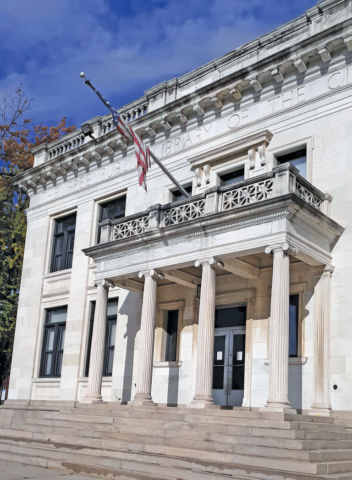
The Trenton library building is an example of the popular Beaux-Arts design popular during the period that has also been dubbed the American Renaissance.
As “Public Art in New Jersey” author Thomas C. Folk notes, the style, “which dominated much of American artistic and intellectual life from the 1870s to the 1920s, existed as both a reality and a mental construct. Not specifically a style or a movement in the commonly accepted art historical sense of those terms, the American Renaissance was more a mood, or a spirit, or a state of mind.”
In addition to encompassing “many diverse idioms of painting, architecture, and sculpture,” the style also “had a broad base of support with many politicians, financiers, businessmen, academics, and men and women of the American middle class. As an idea or mental concept, the American Renaissance held both nationalistic and cosmopolitan ideals and looked to the past and the future.”
The stone façade of the original building — as opposed to its late 20th century annex — shows a mixture of solidness, order, and elegance. The engraved names of European and American writers indicates the building’s purpose.
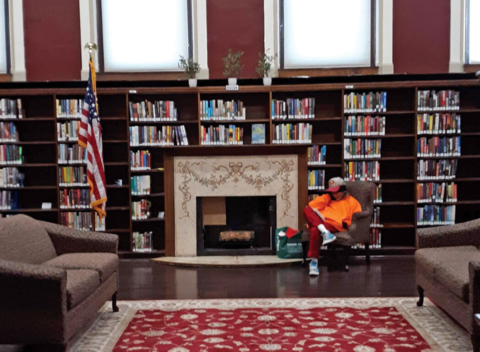
Its interior with stone staircases, large collection room with loft walks and a fireplace evokes old-world values and needs.
The building also hits another historic note for what it is not. As a library history reports, “Contrary to popular belief, the new library was not a Carnegie Library. Between 1883 and 1929, businessman Andrew Carnegie donated funds to construct over 2,500 libraries, but certain cities like Trenton and Newark felt that accepting this money would show that they were unable to provide for themselves.”
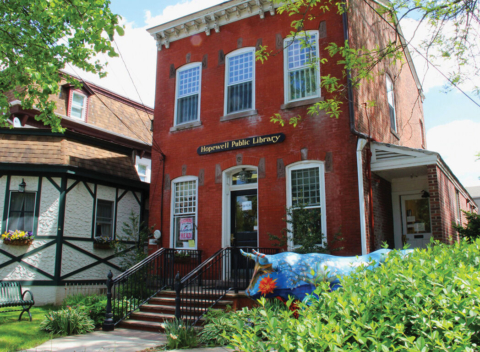
The Hopewell Public Library at 13 East Broad Street is housed in the red brick building that once upon a time had been the Hopewell National Bank.
While the current Hopewell library company was founded in 1914, there had been some sort of book or material lending system established as far back as 1802.
According to a history compiled by the Hopewell Library, that was when Pennington resident Archilles Wilson ran a library that provided books for Hopewell residents.
The report indicates that a Hopewell Library Company had an organized catalog in 1804 and that it was incorporated twice in 1806, first as the Hopewell Library Company, then as the Hopewell Columbian Library Company a week later. The name change was to indicate the library’s location in the Columbian section of the township, now Hopewell Borough.
While it is unclear what happened to that company, it is clear that other efforts continued to supply residents with books and information. That included the Mrs. M. A. Carter, Library and Fancy Goods company, operating in 1887 on the corner of East Broad Street and Seminary Avenue, and circulating and traveling libraries organized by the Grange.
Today’s Hopewell Public Library was established by members of the socially minded Roundabout Club and opened in a former harness shop on West Broad Street. A few years later it moved to the Fireman’s Hall. A public referendum turned it into a municipal and publicly funded library.
According its own documents, “The library was extraordinarily popular: As of October 1916, with a Borough population of 1,200, the library had 680 active patrons and owned more than 1,300 books, and had circulated 10,127 books over the past year. The library quickly outgrew its new space and moved to 28 East Broad Street in 1924 and shared this new space with the Hopewell Museum.”
In 1964 the library moved across the street to the former National Bank building.
Opened in 1890, it is a simple, solid, yet homey two-floor structure — nothing like the American Renaissance-inspired banks that look like Greek temples.
Here one gets the old-fashioned type of library experience of being greeted by librarians at a desk in front of a wall lined with volumes that chronicle the community.
Although there are sections that show that it was a bank — it has a vault, for example — the building’s small rooms make visiting the library feel like taking a step back in time.
The Lambertville Free Public Library also feels homey because it is an actual home that belonged to the Lilly family.
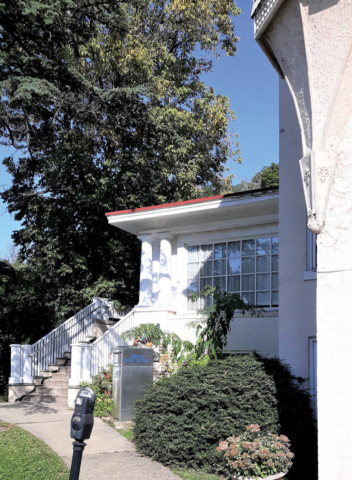
The house at 3 Lilly Street was built between 1812 and 1830 on property that Dr. John Lilly purchased from the son of Revolutionary War patriot George Coryell. The building was occupied by the politically and financially connected family through 1880.
According to a brief history compiled by the library, “Over the years, the Lilly Mansion lost its pond and stables and most of its land, which had extended from the newly established Bridge Street east to the cliff and south to Swan Creek. In the 1930s, highway construction claimed most of the east side, and in 1946 the front lawn became the site of a service station; later, other subdivided lots to the south were sold. The increasingly neglected mansion served as the Moose Lodge, as apartments, and as the offices of the Hunterdon County Nutrition Project for the Elderly, until the City purchased the dilapidated building in 1980 and installed the library on the first floor in 1988.”
The library effort goes back to 1881, when 28 community members founded the Stryker Library Association, named after prominent businessman and entrepreneur Samuel Davis Stryker, whose will stipulated $1,000 for the community to establish a library.
The library first opened in 1882 in a room over Cochran’s Drug Store on Union Street before moving a year later to a room at the Masonic Hall on Bridge Street.
As the library reports, “The library’s collection of about 1,300 volumes contained classic literature as well as practical materials for farmers, such as Downing’s ‘Fruit and Fruit Trees,’ Randall’s ‘Sheep Husbandry,’ and Harris’ ‘Insects Injurious to Vegetation.’”
In the early 1950s, the library re-located to the second floor of City Hall on York Street. Some of those original holdings can be found in the library near a portrait of Stryker.
The New Jersey State Library in the capitol complex in Trenton has a long and fascinating history and a facility shaped by an important design movement.
The library began with a collection of documents used by legislators when New Jersey was an English colony and before Trenton became the state’s capital in 1790.
An actual library started in 1796 when the State of New Jersey assigned the house clerk with the responsibility of maintaining the documents, pamphlets, newspapers, and books used by both the senate and assembly.
As the collection grew, so did the effort to maintain it, and a fulltime librarian was appointed in 1822. By 1883 the library had more than 30,000 volumes and occupied the southern wing of the capitol building — designed originally by Philadelphia-based architect Jonathan Doane, whose colonial and federal design had American Renaissance-flavored modifications and expansions by John Notman (1845), Samuel Sloan (1871), and Lewis Broome, 1889.
The library moved in 1929 to a new art deco-influenced New Jersey State House Annex building, which also housed the State Museum.
The library got its own building when the State of New Jersey created the Capitol Complex during the post-war boom in late 1950s and early 1960s.
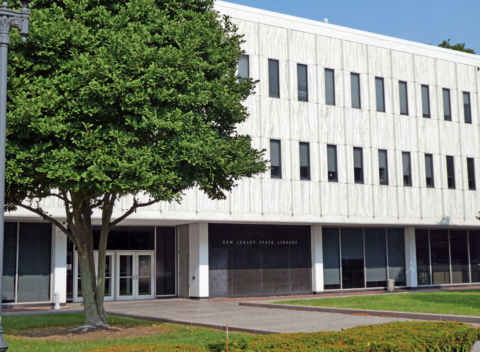
The building was designed by Frank Grad & Sons, a Newark-based company noted as one of the leaders in modernist government and corporate architecture.
The antithesis of American Renaissance or embellishments that connected to a particular nation or era, Grad’s approach was influenced by the international style’s emphasis on no-frills simplicity and clean lines — as demonstrated by the open spaces, windows, and sleek furniture.
While this modern style is no longer seen as modern, it — like all the buildings noted — offers both the opportunity to find a book as well as walk into history.