As much as the great recession and its still lingering effects, the specter of large suburban office complexes with increasing vacancies has been a dark cloud over the commercial real estate landscape.
But some rays of light have begun to shine through, most recently in Hopewell, where two real estate investment entities have purchased a substantial chunk of the Bank of America/Merrill Lynch campus at a premium over what the complex sold for less than a year before.
A Virginia-based firm, American Real Estate Partners, and an international commercial real estate investment company with offices in Chile and Miami, Independencia Asset Management, have purchased a three-building, 380,000-square-foot portion of the campus on Scotch Road for $90.82 million, or $239 per square foot.
The sellers, Fortress Investment Group, an investment management company headquartered in New York, along with Normandy Real Estate Partners, Sansome Pacific Properties, and Skyline Pacific Properties, purchased the entire complex in December, 2012, from Bank of America, Merrill Lynch’s parent, for $365 million (or $204 per square foot), according to CoStar, the real estate trade publication. This represents a $35 per square-foot increase in the price of the property.
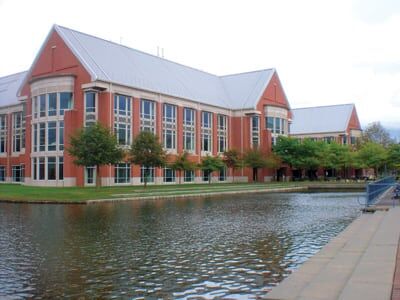
Located at 1100, 1150, and 1200 Merrill Lynch Drive, the three buildings constitute a portion of Bank of America/Merrill Lynch’s 1.8 million square foot, 12-building campus (see photo at right). The three buildings house corporate office space, a data center, and telecom facility for the campus. Also included in the purchase is a 761-space parking garage.
Built in 2000, the campus, adjacent to the new Capital Health Center on Scotch Road, features many corporate amenities. “The infrastructure commitment that Merrill Lynch made in this asset provides for the long term stability of the investment,” said Brian Katz, president of American Real Estate Partners.
“This is the finest corporate office park in the entire Princeton office market befitting a prestigious firm such as Merrill Lynch,” said Doug Fleit, CEO of American Real Estate Partners. “We are proud to be Merrill Lynch-Bank of America’s landlord at Hopewell and look forward to a very long-term relationship with them.”
Cushman & Wakefield financed the deal and represented the sellers. Mark Ehlinger, managing director of Cushman & Wakefield’s New York office, noted that Bank of America/Merrill Lynch has agreed to a 12-year lease on the property, but that the company has the option to terminate the lease on those three buildings in 2019. Other parts of the campus have shorter lease terms, and this may partially account for the higher price of the three buildings that were sold.
Economic forecasters have voiced concern in recent months about the changes in technology and demographic shifts that make the centralized office campus design less viable than it was just several decades ago.
James Hughes, dean of the Bloustein School of Planning at Rutgers, and a leading proponent of this view, notes that the Baby Boomer generation is now leaving the workforce and being replaced by their children, the Eco-Boomers, who have a different lifestyle and can utilize different technology.
“They look for a walkable existence, where housing, stores, and transportation to work is close by. There is a move back to the city from the suburbs. I see how this is affecting New Jersey.” Whereas baby boomers drove into the suburban office parks to avail themselves of networked computer systems, the eco-boomers are connected to the Internet and virtual networks through their laptops and smart phones. “Now everyone can do their jobs totally untethered,” Hughes says. “Companies are finding they don’t need office space for 100 percent of their workers, maybe half.”
But Cushman & Wakefield executives point out that the poor economy might be a better explanation of the recent decline in some suburban office campuses. David Byrne, vice chairman of Cushman & Wakefield, said the more modern large corporate office parks are still very appealing, especially to foreign investors, and especially if they are in the Princeton market, which he said has outperformed the state as a whole when it comes to commercial real estate.
“It’s a technology and pharmaceutical-driven market,” he said. “It has a very strong education base.”
Byrne said older corporate headquarters locations are a harder sell, but can be redeveloped. “The older campuses built in the 1960s, that are 1.5 to 2 million square feet, that aren’t divisible, are certainly going to have a difficult time,” he said.
Newer ones like Merrill Lynch, which was built in 2000, tend to be easier to repurpose if the original tenant leaves. The Merrill Lynch campus, for instance, has 12 buildings, each with its own parking. It could be divided up into space for 12 different companies, whereas the older campuses tend to have everything under one roof. “If you have the right assets, meaning quality and ability to accommodate demand, corporate campuses are very much in demand. This one was designed with that thought process,” Byrne said.
In its just-released third quarter economic analysis, Cushman & Wakefield noted encouraging signs in the commercial real estate markets throughout the state, and especially in the central New Jersey and Princeton markets, where overall vacancies fell by 1.3 percentage points to 17.7 percent. The lowest vacancy rate was in Mercer County, according to the Cushman statistics, with just 11.8 percent. Contributing to the region’s vacancy decline: The lease of the entire 500,000-square-foot former Continental Insurance company headquarters in Cranbury to Lam Cloud Computing for conversion into a data center.
The Princeton/Route 1 market in Mercer County contributed to an overall increase in asking rents — its average was $27.60 per square foot.
Jerry Fennelly, the Alexander Road-based commercial real estate broker, had similarly good news in his second quarter report. While pointing out that the recovery from the recession was progressing slowly, he noted such positive developments as the sale of Princeton Pike Corporate Center in Lawrenceville (800,000 square feet,) for $151 per square foot, as well as the sale of 7-9 Roszel Road, a 300,000 square foot office building, which sold for $293 per square foot.
“These sales demonstrate the trend that well located office buildings and/or high end office buildings are achieving values approaching pre-recessionary levels,” said Fennelly. The other building sale in the first half of 2013 was 600-619 Alexander Road, a Class B building, at a price of $102 per square foot.
Said Fennelly: “Class A, institutional quality real estate, with great highway locations, are achieving values that are approaching 90-95 percent of replacement value. Secondary product, Class B, is staying lower with opportunistic returns. This illustrates a movement of money into real estate. It seems there is an increase in companies buying buildings, using a combination of low interest rates and reduced risk of vacancy establishing the floor of values roughly 10 to 20 percent below highs of 2007.
“This establishment of pricing levels is setting up appreciation, and yes, there will be an increase in interest rates. This will help the lenders who need to increase the bottom line and aggressively open the lending window.”
#b#Another Major Move: Merck’s World HQ#/b#
The theory that even the big corporate campuses can still be put to use will get another major test. Cushman & Wakefield announced on October 7 that it has been retained for the sale of the 1 million-square-foot world headquarters corporate campus of Merck in Whitehouse Station. The sale is part of Merck’s announced plans to consolidate New Jersey operations.
The Cushman & Wakefield release notes that the three-story Class A office facility, completed in 1990, “contains 1 million square feet above two levels of covered parking for 1,600 spaces. Some of the property features include a five-story granite and glass lobby and an atrium that reflects the quality and superior finishes of the entire facility. Amenities include a 900-seat cafeteria and dining areas, elegant executive offices and conference rooms, a multi-level conference center featuring a 250-seat auditorium, a landscaped central courtyard, a fully equipped fitness center, and a 35,000-square-foot data center with raised floors. In addition, the building is set on a lush 500-acre campus that includes an on-site solar farm, a 25,000-square-foot childcare center, a basketball court, tennis courts, ball fields, and a helipad.”
Five major highways are located within five miles of the site: Route 22, Routes 202/206, I-78, and I-287.
How tough a sell will it be? Not impossible, says Cushman & Wakefield. “Every major corporate campus in New Jersey over the past three decades has either been repurposed to meet the needs of a growing corporation’s new headquarters or positioned for innovative reuse,” said Andrew Merin, a vice chairman of the firm.