The Trenton Historical Society’s annual Stop the Wrecking Ball gala is designed to raise funds and awareness of Trenton’s historic architecture by presenting the event in a culturally important venue.
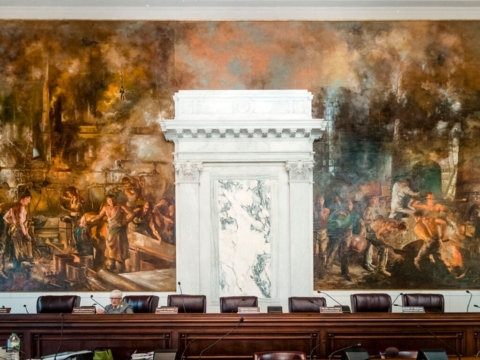
And while this year’s November 18 event will be held in one of Trenton’s most visible locations, Trenton City Hall, it will also put the spotlight on one of the city’s often out-of-sight cultural treasures, the Trenton City Council Chamber’s 1911 mural.
One reason for its lack of visibility is simple: The council chamber is mainly open during city council meetings. However, another, perhaps, is that the 45-foot-long by 22-foot-high mural isn’t recognized for what it is.
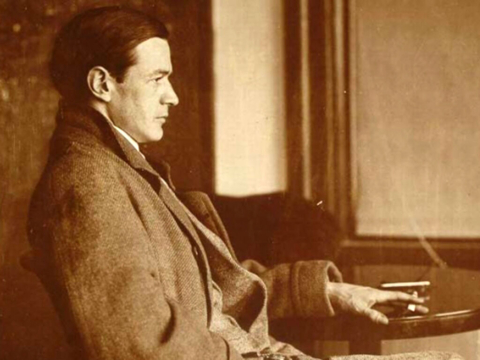
The work was painted by noted American artist Everett Shinn (1876-1953), a New Jersey native who originally made a name for himself in Philadelphia first as a newspaper artist and then as one if the “Ash Can” artists, a group of young artists dedicated to painting everyday life.
After the Ash Can — also known as “The Eight” — moved to New York, Shinn also became known as a society, stage design, and mural artist.
His works are part of the permanent collections of the Metropolitan Museum of Art, Whitney Museum of American Art, and the Phillips Memorial Gallery in Washington, D.C.
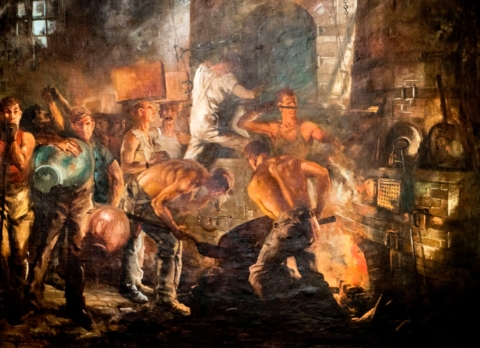
The city hall mural depicting workers in the bursting Trenton factories is something singular in Shinn’s output and records an era of Trenton history and a moment in art.
As Arts Magazine reporter Thomas Folk writes in 1981, “Everett Shinn’s mural of labor in Trenton’s City Hall represented a new tendency in mural painting. Shinn depicted interior scenes of the Roebling steel Mills and the Mattock Kilns of Trenton . Shinn’s Trenton mural breaks with the 19th century mural tradition of depicting historical and allegorical scenes. Shinn used actual workers from the Roebling Steel Mills to act as models.”
Folk makes his case by quoting “American Painting from the Armory Show to the Depression” writer Milton Brown’s comment that “Shinn’s Trenton murals are about the first instances of the use of such a contemporary subject painted in a realistic manner and as such they should have been a milestone in American art.”
The 1981 article also quotes from a 1911 New York Sun article noting that “Mr. Shinn has preferred reality to allegory, virility to daintiness that characterizes a great deal of the mural decoration in American municipal buildings — there are persons who would call them brutal. Shinn says that the steel workers don’t give the impression that they are carrying hummingbird’s eggs.”
Folks assesses correctly that at the time Trenton and other urban communities “were taking great pride in their cities. Measures were being taken to beautify and modernize their towns.”
In the capital city’s case, the City of Trenton building committee hired Philadelphia architect Spencer Roberts to design a new city hall in the prevalent style that freely borrowed from various European architectural movements, the American Renaissance.
That the same building committee would approve a daring and modern design may seem a mystery.
However, in the following document written by Shinn — and shared with us by the Delaware Art Museum’s collection of Shinn’s papers — the artist shows both a commitment to creating art of his time and an understanding of human psychology as he discusses preparing and showing the model of his work to the selection committee:
My preliminary efforts in the form of an eight-foot-long model that followed in detail the blue prints of the council chamber by Spencer Roberts, a young Philadelphia architect, of the then new City Hall at Trenton, New Jersey, brought to light the interests of two men who controlled the appropriations for its mural of modest proportions of forty-four feet by twenty-two feet.
The room was of gigantic dimensions. However, a superb dignity had been achieved through the many headaches of the architect with whom I worked closely, not as an advisory unit but as a grateful listener to proposed ideas for the mural that would embellish the wall, be informative to the visitor as well as permanently hold the traditional industrial power that stemmed from pre-revolutionary melting plants.
For days on end, I visited the incomplete council chamber and studied the light that entered from every window in order to key the color of the mural to meet its harshness or its support and still harmonize its surface to the necessary subjection of artificial light.
Before I began the model for the council chamber of the Trenton City Hall, I had piled up in my work shop nearly two hundred dollars worth of materials. Assisted by Hans Helm, an expert cabinet maker with whom I had worked in model construction for many years, we sorted and laid down the frame work. The aperture beyond the masking frame showed a space of eight feet to be filled with the cornice, ceiling, walls, and windows that showed on the architect’s blue prints. A most elaborate ceiling was first made that included countless handmade moldings. Two lines in half circular formation marked the little desks for the councilmen. They spread to the back wall where a central raised marble platform held the marble desk of the president. At the back was the space left entirely to me. The Mural. In size, in miniature, about 32 inches by 20 inches high.
Beyond the windows showed a cyclorama of the city of Trenton. I had painted the exterior from points within the council chamber. There was Senator Black’s stacking towers of potteries, their numbers on the chimneys. There was the canal showing a tug and barges at rest in the lock. Houses, saloons, and warehouses, made a background to the waterway where bulged the blackened roofs of the Roebling steel mills and wire works. An intricate lighting system permitted the exterior to be seen in moonlight blue or splashed with sun. The interior containing masked lights that gave a glow of light adequate for night sessions.
Hidden lights that would simulate actual lights were fissured in the ceiling and picked out my mural and its subject. After eliminating Washington’s Cross of the Delaware, a known historical fact, I had squeezed history down to the boasts of present day commerce. One half the mural consisted of Senator Black’s potteries, in colorful blends where half naked men moved like bees about a hive of towering bricks and fed honey of glazed pottery into the kilns. Potter and sweat, and coal, dust, iron wheelbarrows and clanking shovels, bowed backs and more clouds of dust rose until it met above a central divisional architectural feature set against the wall then dipped into sun cut steam and mist above the sweating men, busty at great machines that rolled through their spinning vitals, great lengths of white hot cable that writhed likes golden snakes in the deep shadows of the vast building to return and weave again among other rollers that thinned it to its required calipher proven thickness. This was the Roebling works.
The two men that were to approve of my proposed mural were Senator Black and J.C. Roebling. I showed it to them in miniature. The eye and mind of an adult when viewing a well-built model is warped and reverts to the thrills that have been formed in the nursery. All adults are children in the sight of any miniatures. They twist and wiggle and ejaculate exactly the same as they did in taking up a toy fire engine or a doll’s house and use instead of “ain’t it cute” … “Well, I’ll be God damned!”
Senator Black and Mr. Roebling literally entered the model. Actually head touching head, peering out through the little windows to their vast industries warped to toy size.
“Look at that … Will you, John … I own that row of houses. Look on this side … If there isn’t my new extension back of number one stack . … And there’s my number four and five stack. “
“Just you wait a minute… You’re looking at that roof I just had painted back of the engine house. … and say … I didn’t know that chimney was that high … Look, Senator, see that reddish brown building? There … off to the left … Stop looking at your own things for a minute. … You know I’ve never seen that building from the street before.”
“You’re not on the street … You’re somewhat elevated in the City Hall.”
“I’ll be damned if it isn’t marvelous.”
“What will you trade for those two warehouses of mine.”
“What can you offer, John?”
“I’ll trade that saloon and throw in two of the boarding houses.”
I had turned off the sunlight and flashed on the deep blue of night. There was silence between the two men when the light went up in the interior of the model that now for the first time revealed my mural. In its sight there was a continued pause. The slight grunts of perceptiveness followed by a childlike coaxing plea.
“Would you mind, young man, turning on that outside light again. I nearly closed a deal with the senator.”
I turned out the lights that left my mural in blackness and flashed again the sunlit panorama. While the two heads darted into the (model) council chamber, where again two distinguished business men played at toys … in a businesslike way.
In time they removed their heads and drew Mr. Roberts aside. There was a huddle and then whispering. They then left abruptly waving amiably to Mr. Roberts who came over to me and extended his hand.
“Shake, Everett, the job is yours.”
“What job?” I asked. “Am I to paint a full-sized panorama of Trenton? That’s all they saw.”
“Perhaps all they will ever see. The job and that’s what we wanted is yours and the price that I had hoped for.”
“They hardly saw my mural.”
“And possibly won’t see it after it’s up, but when they do come to this room, they will still have the windows, and what they have painted beyond those windows is more important to them than had Michelangelo covered the space that I expect you to fill.”
18th Annual Stop the Wrecking Ball Gala, Trenton Historical Society, City Hall, 319 East State Street, Trenton. Saturday, November 18, 6 to 9 p.m. Register. $100. 609-396-4478 or www.trentonhistory.org.
The mural is also on view before and during regular City Council meetings. Find times at www.trentonnj.org/476/Meetings.