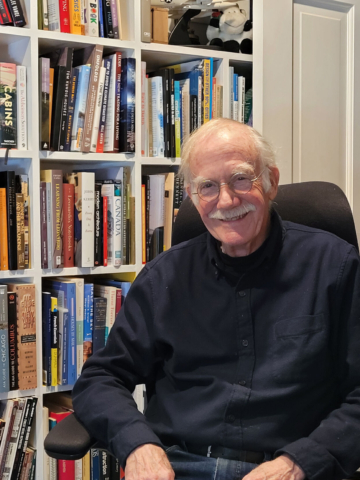
Some employees look forward to Monday mornings with dread or at least resignation. But partners and staff at Princeton-based KSS Architects could look forward to the workweek’s start with a happy curiosity.
Starting in the early 2000s they’d peer into their mailboxes (the physical kind, not virtual, as email was only starting to dominate office communications) and find memos neatly printed on 8-by-8-inch slips of paper (perfect squares being beloved by architects). The pages contained succinct thoughts — not just about building and design but on a range of professional, procedural, and creative topics.
These “Monday Morning Musings,” as they became known, were the creation of KSS co-founder Allan Kehrt.
From then until his retirement in early 2012, Kerht wrote some 500 or more of these missives: engaging, frequently cheerful, but unfailingly thoughtful. Now the best of them — and those most valuable to a wide readership — have been gathered into Kehrt’s newly published “Monday Morning Musings: Architecture, Architects and Life” (BookBaby, February 2022).
But it’s not just for architects or designers. Indeed, the phrase “and Life” might be the most descriptive words in its subtitle.
“The book was written to give advice, to give insights, and to be worthwhile for a wider readership,” Kehrt says.
“The life lessons I took out of the Monday Morning Musings enabled me to mentor people, communicate with clients, engage with engineers, and lead the team,” says Merilee Meacock, who joined KSS in 1990 and is now majority partner.
“We’re still learning from them 20 years later. Allan’s lessons are timeless in a way.”
Kehrt explains that he started creating the memos “because I really wanted to get my thoughts out to the staff, to make sure there was a connection between the people at the top of the firm and the staff. Every Sunday evening I’d write a piece just talking about what was on my mind.
“It was a firm that was starting to grow,” he further explains. “I think many times, especially in professional firms, the top gets lost from the bottom.”
Indeed, the growth of KSS Architects has continued. Starting with just a Princeton location and a handful of people, KSS now has a total roster of some 90 persons with additional offices in New York City and Philadelphia. “Allan’s life experiences provided the DNA of the company we became,” Meacock says.
In these Monday missives, Kehrt never talked down to the staff, dictated a philosophy, nor sternly enforced company policies. Nor in the new book does he blanket the reader with haughty pronouncements or self-congratulatory platitudes. These really were — and are — musings, born of the recognition of great issues but with an abiding curiosity about the overarching truths to be inferred from seemingly small topics.
And what are these issues and topics? Architecture and design, of course, and their crucial roles in human life. But there are mini-essays on neurobiology, Paris (parts 1 and 2), heuristics, starts, plans, mistakes, and love.
Love is something of which Kehrt has happy knowledge. He met future wife and life partner Michaele in Washington Square Park one day in the 1970s. Drawn to her, he asked permission to take her photo. Michaele agreed. Their conversation continued during a spontaneous stroll up to Central Park and back (a round trip of more than a hundred blocks). And it has continued with the same joyful stamina ever since.
“She’s amazing,” Kehrt marvels. “We’re going on 50 years.” They have three grown children: Emily “Sonner” Kehrt, a Berkley-based journalist who also did work for the U.S. 1’s parent company, Community News Service; Kathleen “Kat” Kehrt, a Denver-area teacher; and Matthew Kehrt, who works at Google.
Kehrt’s family was from the New York area. He was born in Queens. The family soon, in his words, “upstepped to New Hyde Park and then upstepped to Garden City.”
His father was not an engineer nor did he have a college degree. “But he was very technically adept,” Kehrt notes, working his way up on the facilities’ side of Bankers Trust Corporation to become responsible for the firm’s buildings and grounds, commuting by train into Manhattan while Kehrt’s mother kept their house.
Kehrt earned a B.A. in economics at Ohio Wesleyan. Then — of all things — he joined the U.S. Navy and became a pilot, flying A-4 Skyhawk fighter jets. “Vietnam was happening, and I was going to get drafted,” he explains.
After flight school, and by sheer serendipity, Kehrt was assigned to Hawaii. He was among those responsible for ensuring that Navy vessels (in his case, aircraft carriers) were properly outfitted and their crews fully trained before leaving for duty elsewhere in the Pacific.
But after five years as a Navy pilot, another plan took flight in his mind. In a life trajectory change more radical than the maneuvering of a fighter jet, Kehrt told wife Michaele that he wanted to earn an advanced degree in architecture. And his goal was to study at Virginia Tech.
“There was always something in the back of my head about architecture. One of my closest friends went to Pratt Institute and became an architect. I think maybe I was jealous,” he laughs, adding seriously, “but I was always interested in it.”
He continues: “I decided this in August or thereabouts.” Which should have been way too late to apply. But he did, successfully. “To some extent, I talked myself in. It turned out to be one of the best programs in the country, but I didn’t know that at the time.”
Fortunately, he had a skill to draw on — literally. Kehrt loved to draw and, although totally self-taught, was quite skilled at it.
He submitted two drawings of detail-filled historic public monuments, one in London and one in New York. “And I said, ‘Here, I can draw!’” In 1978, Allan graduated from Virginia Tech with a master’s of architecture. (Along the way he gave himself extracurricular study in hands-on architecture, building a small home for himself and Michaele on a plot of land there in Blacksburg, Virginia.)
At the time of Kehrt’s graduation from Virginia Tech, the Princeton-based firm of Geddes Brecher Qualls Cunningham, led by Robert L. Geddes (senior partner and then also dean of Princeton University’s School of Architecture), had been named Firm of the Year by the American Institute of Architects. Kehrt cold called and was able to obtain an interview.
Even more wonderfully, his interlocutor was Bob Geddes himself — who then offered Kehrt a job.
Kehrt acknowledges how much he learned from Geddes, not only about architecture and design but about the creation and management of a positive workspace. “He could get the best out of other people,” Kehrt says.
In 1983, Kehrt left the Geddes firm with co-worker Michael Shatken. With another architect, Rafael Sharon, they founded Kehrt Shatken and Sharon (KSS). Kehrt has previously described it as “a real out-of-the-back-bedroom operation” at first, with mostly residential projects and some retail work, including malls.
Geddes proved highly supportive of their venture, treating Kehrt and his partners more as colleagues than competitors. Sharon left to make a notable career change, earning an advanced degree in psychology and joining his wife’s busy psychotherapy practice. But other partners were brought in, and the firm grew.
KSS Architects soon enjoyed particular success designing college and university buildings, including the campus center at Richard Stockton College and main buildings at the Cornell Hotel School. Local government centers have also been a specialty, a notable example being the Princeton Municipal Building, for which Kehrt himself was the project architect. In 2001, he was named a Fellow of the American Institute of Architects.
But as KSS grew, so did the number of its partners. Kehrt and Shatken wisely developed a clear succession plan for their eventual retirements.
“We thought it through, “says Kehrt. “It was very clear what was going to happen.” The plan garnered praise for enabling a smooth transition without conflicts or even drama. (See “The Partners Split But the Firm Survives,” U.S. 1, January 31, 2012).
Kehrt has been busy in that retirement, the new book being a prime example. At the urging of Michaele and others, he gathered the best of his “Monday Morning Musings” with a mind to inform not only his architecture and design peers but a general readership whose horizons of interests might range from entrepreneurship to personal development.
In a musing about “Personality,” Kehrt notes that the most admired architectural designs “show the inventiveness and personalities of the artists who designed them. Think about (Finnish architect Alvar) Aalto’s brick experimentation in his house, (Frank Lloyd) Wright’s whimsical glass patterns, (Scotland’s Charles Rennie) Macintosh’s odd personal vocabulary, or (Frank) Gehry’s early use of cyclone fencing. Let’s loosen up and let ourselves show through.”
However, when asked about the phenomenon of “star-chitects” — internationally renowned architects who have been criticized for flamboyant buildings that overpower their surrounding cityscapes and whose designs can prove to have serious structural issues — Kehrt acknowledges that creative ego must be constrained by well-considered design values.
Such star architects, he says, “get themselves into a position where they can do anything they like, although it might not be appreciated by the general public. And they attract patrons who will accept and support anything they wish to do.”
This brings him again to a point he frequently makes in the book, which “could apply to any business: Considering what’s important, considering the greater implications.”
As Kerht notes in the selection titled “Confidence”: “We ask clients to spend vast sums of money on ideas that come out of our heads.” That is certainly true of any endeavor. Confidence is necessary but it must be realistic, grounded in one’s true skill.
In addition to timeless truths, the book finds Kehrt contemplating the crucial roles of design and engineering in humanity’s fraught future. In the entry “Waste” he observes, “All of nature produces useful products necessary for the continuation of life without pollution, except man … There is however, an inchoate environmental movement that looks at redesigning our industrial processes to model nature’s efficiency … It may be one of the most important changes in the way we have inhabited the planet since we began to make things.”
In addition to being a thinker, creator, and award-winning architect, Kehrt is very much a teacher. He has taught at his grad school alma mater, Virginia Tech, and as an adjunct faculty member at the New Jersey Institute of Technology’s College of Architecture and Design — developing additional skills that were combined to provide the foundation and structure for Monday Morning Musings.
“I enjoy helping people think things through,” he says. “Each one of these entries gives you a little something that’s useful.”
Monday Morning Musings by Allan Kerht, 216 pages, $39.99, BookBaby Press.
Monday Musing: Educated
The profession of architecture puts many demands on us as practitioners. We work in a complex world, and we use a complex methodology to get our work done. We deal with our clients using skills we have acquired over years of formal education, starting in kindergarten, continuing through college and perhaps graduate school. We slowly become educated. It takes a great deal of education to be successful in this profession. We eventually need to educate ourselves in more than architecture and all its associated design and technical information. We need to know finance, proper English usage spoken and written, we need finely honed communication skills, an understanding of mathematics and all sorts of other subjects, the arts, literature, and music. In short, we need to be educated, very well educated. It’s something you should continue to work on for the rest of your life.