Writer’s note: The following article is the subject of talk I prepared for the April 5 meeting of the Present Day Club in Princeton.
It follows several other newspaper columns on regional stained-glass that began with one in 2018 — also just before the Passover and Easter holidays. That story examined how a stained-glass movement began in the region in the early 20th century.
It and subsequent articles were followed by invitations to share my findings with various community organization and clubs.
And while it is difficult to research stained glass windows while writing and editing a weekly newspaper, I did and frequently added new information in to the presentations.
When the Present Day Club invited me to talk about regional stained glass, I had already begun to explore a topic I thought would interest a women’s group: women in stained glass.
I also wanted to share some on-the-scene reporting about a New Jersey phenomenon: Three nationally known stained-glass companies operate in New Jersey — including one that is recognized as the oldest continuous stained-glass company in the nation.
That they all involved women and contributed to creating glass for regional churches added to the relevancy of the presentation and this story. And here we are with another chapter of regional stained-glass history. Happy reading!
Hiemer & Company
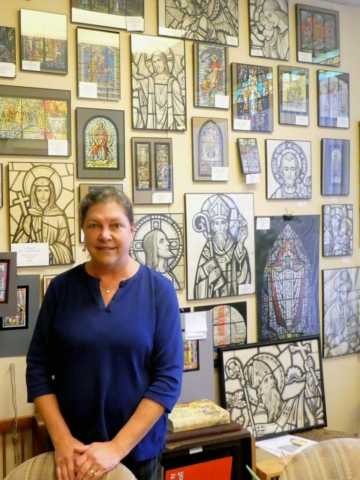
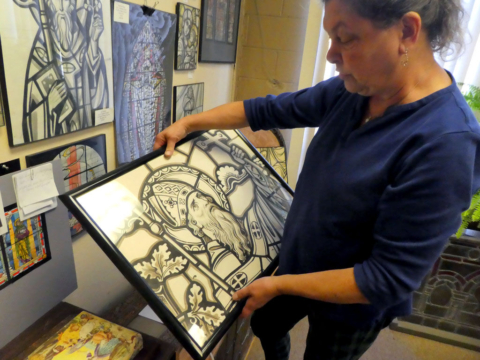
“There were a lot of women involved,” says stained glass artist Judith Hiemer, director of one of the three longtime New Jersey stained-glass companies.
“There were always female designers,” she adds while sitting in the council room of Hiemer & Company Stained Glass Studio in Clifton.
Formally established in 1931 by her fraternal grandfather, German-trained glass artist Edward Hiemer, the company has been a family business that has also included her father and great-grandfather, George Hiemer. He began his training in the late 19th century.
George and Edward Hiemer were also connected with the Von Gerichten Art Glass Studios operating in Munich and Columbus, Ohio, in the early 20th century.
While George worked with the company in Munich, Edward began a career as a company journeyman before coming to the Ohio division in 1925 and serving as its head designer.
When Von Gerichten folded during the Great Depression, Edward completed the company’s existing commissions by forming his own company. He also asked his father to come to the United States to work.
Edward soon moved the studios to New Jersey to take advantage of its central location between major urban areas and transportation hubs.
Following Edward was his son, Gerhard, now 90, and then his daughter Judith, who, after helping in the studio and the shop her mother ran, took over the company in 1992.
Since its incorporation, Hiemer has produced glass for more than 1,100 churches across the United States — including roughly 70 in New Jersey and 22 in the Greater Mercer region.
Speaking about her choice to take over the business, Hiemer says she originally thought of becoming an archaeologist.
Then she realized she would end up doing the same things that she saw the studio artists doing: historical research, art study, and travel.
When she learned that her father was interested in retiring and that none of her three sisters were interested, she made the move.
“It gave me challenges to express a lot of different aspects of my personality, and it gave me a paycheck. And it offered the potential of being my own boss,” she says.
“I saw a real opportunity for a woman to be involved. There were a lot more blockages then than there are today. That was what I saw when I grew up.
“I was also qualified for the job. I trained here with my dad. He sent me to business school because my dad was tired of artists who don’t know how much things cost. And I took applicable (art) courses at Parsons (School of Design) and learned from artists about symbolism.”
But most of all, she understands the art form. “It is a fabulous medium. There are so many facets. It has so many different requirements. And some of those challenges required make it interesting and attractive.”
The family business looms large in the small showcase areas where designs and religious objects fill the walls and cabinets.
Then there are the rows of tall files brimming with thousands of documents that are some of the only records tracing the company’s artistry with the art works in hundreds of churches around the nation.
The reason is that churches often don’t allow the company to mark their work with a logo because they say it’s too commercial.
However, those same churches have discarded or misplaced their records and have trouble figuring out whom to call to assess or repair the glass.
Hiemer says it is unusual for her company to be called into a church and asked to identify the work.
Sometimes it is easy; she simply knows before she gets there that Hiemer did it.
But sometimes it isn’t and is perhaps impossible: There were a number of East Coast glass companies no longer in business that used the same “holy card” images, glass companies, and bordering designs.
To test her record keeping, I mention the stained glass at St. Paul’s Church in Princeton.
Hiemer gives a knowing smile. Then, as she removes a file and places its open contents on the conference room table, says, “The architect got involved with St. Paul. He had a red carpet down the center of the church. He didn’t want competing colors of glass. That’s why we have the blue and gray glass. That’s how we got known as the blue glass company.”
Currently, Hiemer’s projects include a mixture of fitting new glass into new construction and repairs and replacements.
“I am seeing a shift back to tradition,” she says about churches moving from modernistic abstraction to figures. “With this one project we’re doing in Florida, we’re removing glass made in the ’80s. We’re replacing it with ‘Renner’” — referring to the company’s late Munch-trained designer, Jacob Renner, who was also a designer for Von Gerichten in Ohio. Renner’s works can be found in numerous churches around the nation (including the church my family attended).
While her five-member team needs to find ways to adjust the modern the ebb and flow of the economy and state and federal regulations, such as the EPA regulations that have caused some glass companies to close or to move, they basically adhere to a practice that began in the Middle Ages.
One concern is new stained-glass artists. Hiemer says that many art schools see stained glass making as a craft and won’t incorporate it into their curriculum.
However, when you ask Hiemer how she knows one of her designer’s work, she says, “A lot of it is in the general principles of art: balance and color.
“With us there also are some things that you have to be aware of in construction. And how colors work together. There are certain things that just don’t work. There are little nuances in the materials we use. You have to understand the medium.”
After all, she says she’s “painting with light.”
The Lamb Studio
The long workshop studio with a store front situated in a row of similar buildings does little to announce to any passersby that it is a place of both beauty and history.
The beauty is that of the glass that imbues colors in buildings around the nation.
As for history, owner David Bleckman says that it is the oldest continuously operating stained glass company in the United States, owned by two multi-generational families.
It is so historic that its archives are in the Library of Congress.
It’s a quiet late afternoon and Bleckman gives a tour of his facilities — basically a few long, thin rooms with workspaces and storage areas.
His small staff are busy at tables cleaning or renovating period glass found in some of the wealthier areas of New Jersey.
Bleckman provides a brief overview of the enterprise. English brothers Joseph and Richard Lamb found the company in 1857.
It remained a family operation until 1970, when no family heir wanted to continue the company, and one of the company artists/craftsmen, Donald Samick, purchased the company.
He led it until 2021, when his wife, Donna Bleckman Samick, died. Her son, and Samick’s stepson, David Bleckman, already in a successful finance-related career, decided to purchase the company with his wife, Kathryn.
The company operated out of New York City until it moved to Tenafly, New Jersey, in 1934, and had moved several more times between New Jersey and New York until it returned to New Jersey in the late 1990s. It has been at its current Midland Park location since 2012.
While its archives have been in the Congressional Library since 2003, Bleckman has an old file that has some information.
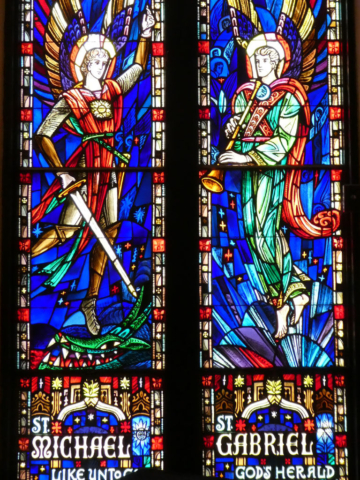
Since my previous research communication with the Lamb Studios had noted that the company had created some of the glass for St. Michael’s Episcopal Church in Trenton, I was interested in finding out if Bleckman could provide the name of the artist.
When I gave him a general idea of when the glass had been made, he didn’t hesitate and mentioned artist Ella Condie Lamb.
An accomplished artist who had gained a reputation on her own, Condie Lamb had become the studio’s art director sometime after her marriage to company’s heir, Charles Rollinson Lamb, in 1888. She remained was active with the studio until her death in 1936.
Condie Lamb was born in New York in 1862. Her already demonstrated ability in art was strengthened through her studies at the National Academy of Design, the Art Students League of New York, and Europe. Important New York artist and teacher William Merritt Chase was one of her champions.
In the early 20th century book, “Women of Art,” writer Geneva Armstrong assesses Condie Lamb as “a rapid thinker and producer in her art, which has been along the line of mural decoration and designs for church windows, et cetera, in which she has been very successful. The secret of such work is not different from other successful work — it is preparation, a thorough training. It was the method of the early masters. Nearly all the youths who were art-struck in the Renaissance period began as apprentices ‘bound out,’ as they expressed it, for a term of years, till the actual workmanship and knowledge of the scriptures had been acquired. We were reminded of the power and plentitude of such preparation when Mrs. Lamb said that she had eight years of constant study, for she feels that the vital point for a woman, no less than for a man, is a thorough training for her trade.”
Armstrong says Condie Lamb “is a member of the Society of Mural Painters; of the Washington Art Club; of the National Arts Club; she was awarded the Dodge Prize, 1889, at the National Academy of Design, New York; honorable mention at the Columbian Exposition of 1893; at the Atlanta Exposition, 1895; and at the Pan-American Exposition in 1901. To the above citations should be added numerous portraits from her studio, and a large number of murals and interesting windows here and there throughout the states.”
Her influence is such that important 20th century stained glass designer Charles J. Connick has a note in his book, “Adventures in Color and Light,” that he had admired Condie Lamb’s work and applied to work for the company (but was not accepted for some unclear reason).
Interestingly, after Condie Lamb died, another woman became one of the company’s main designers, her daughter, Katherine Lamb Tait.
As noted in a report prepared by the Corning Museum of Glass, Tait, born 1895, had “commented that ‘being brought up in that atmosphere, I wanted to be an artist, of course, because my mother was a painter.’ She would also realize that her father’s knowledge and designs had a strong influence on her as an artist, making him the ‘best teacher.’ After graduating from the Friends Seminary in New York City, Tait continued her education at the Art Students League of New York. She also studied design at Columbia University, the National Academy of Design, Cooper Union, and abroad in France and England, and taught design for multiple years.
“Tait’s first commercial work as an artist was in the advertising department of the Fleishman (Bread) Company in New York. After a few years, Tait grew tired of drawing ‘children eating bread.’ Katharine left the company and traveled to France, where she fell in love with the stained-glass windows she saw. In 1921, Tait joined her family’s company as a designer for glass windows and mosaics. Her early work for the Studio reflected the influence of the Gothic architecture she saw in France, as well as the work of William Morris, Edward Burne-Jones, and the art nouveau movement.”
Although Katharine Lamb married businessman Trevor S. Tait in 1925 and started a family that included four children, she continued to design at home for the Lamb Studio and returned to more regular work in 1937.
Recognizing Tait’s accomplishments as Lamb’s head designer for more than two decades, writers for the Corning Museum say her “windows are located all around the United States, from Holy Trinity Lutheran Church in New York City to 24 windows at The All Saints Episcopal Church in Birmingham, Alabama. In her lifetime, Katharine completed over 1,000 commissions.”
The Corning report also spotlights a difficult time for American women when it focuses on “a moment that stands out in the company’s history, when Tait’s work won them a prestigious commission from Marine Corps Base Camp Lejeune.
“However, the studio felt the need to hide the fact that a woman designed their windows. Katharine’s brother Karl said, ‘You’re the only one that can do it, and I won’t tell them that you’re a girl or a woman.’ She was proud that her sketches won them the commission, and even commented that the pieces had to ‘have two signatures on it by some high mucky-muck in the Marine Corps.’ The mucky-muck, General R. H. Barrow, praised her work in multiple letters found in the Library’s collection, calling the work ‘beautiful,’ ‘meaningful,’ and an ‘inspiration for generations.’ The work took her two years to complete, including the initial designs and the full-scale cartoons.”
She was the last member of the Lamb family to work at the company and remained head designer until 1979. She died in Cresskill, New Jersey, in 1981.
Rambusch
Situated in an industrial strip in Jersey City, Rambusch Studio calls itself “the sole survivor of the many Manhattan arts and crafts firms producing stained glass in the early 1900s.”
Also continuously operated by a family, it was incorporated in 1898 by Danish painter/decorator Frode Christian Valdimar Rambusch.
Born 1859, he was the son of a Lutheran minister in Jutland. He trained at the Royal Academy in Copenhagen, apprenticed with a master designer, drafted for noted Danish architect C.V. Nielsen, and then worked as a journeyman.
When he got engaged to a friend’s sister in 1888, he allegedly flipped a coin to see where he would go to build a career: Imperial Russia or the U.S.A.
He came to New York City, found work with the Arnold and Locke Company in Brooklyn, and then worked for other companies creating interiors for such projects as the Cincinnati German Opera Company and St. Michael’s Monastery in Jersey City.
He began his own company and won a commission for St. Ann’s Church in Brooklyn where Frode met — and began a working relationship with — Monsignor John Farley, later Cardinal Farley.
Soon, the elder Rambusch was working on projects in New York City, Rochester, Buffalo, Erie, Philadelphia, Washington, as well as Florida and the Midwest.
Traditional Building Magazine says that the elder Rambusch’s “style of decorating was drawn from his adaptation of the Book of Kells scrolls adding later Viking elements and employing devices developed during the ‘Art Nouveau’ period. He was influenced by Byzantine Church Art (and) each project was uniquely designed according to the architecture of that particular church.”
Company documents report that between 1908 and 1918, Rambusch broadened its spectrum of services to include art metal and lighting fixtures, the latter in direct response to the introduction of electric illumination. And by the 1930s, the company had established its own stained glass studio.
Frode’s two sons followed him into the firm, both working as apprentice painter-decorators in the summer. One, Viggo, received a master’s in art and architecture after his military service in Europe and worked as a painter-decorator in Copenhagen and London. Viggo’s twin sons — Edwin and Martin — fourth generation, received their masters respectively from Parsons School of Design in Illumination and from Columbia’s Graduate School of Architecture, Planning and Preservation. They now own and run the 124-year-old firm.
Major clients include film and vaudeville houses, Waldorf Astoria, lighting for the Empire State Building, and numerous churches in the New York City region.
The company had moved from downtown, to the Bronx, and then to Jersey City.
A Bloomberg company profile says Rambusch offers “LED lighting, engineered and custom lighting, liturgical design, stained glass, furnishings, and art work.”
During my recent visit, co-owner Martin Rambusch leads a tour of the company’s storage, work, and studio areas partitioned in a large, industrial space where warehouse vehicles are used to move materials from the various divisions.
Since my focus is on stained glass, we linger in the studio area where design spaces are located near the center of the room and glass storage frames surround them.
Martin lingers over a design they’re repairing for a church in North Arlington, New Jersey, and explains the images that include one of George Washington.
As we chat, he touches on the same points shared by the previously mentioned Traditional Building: “The painter-decorator skills and traditions died out under the pressure of the ‘modernist’ style in the 1960s and ’70s when ‘decoration’ was painted out-white. The skills of marbleizing, graining, gilding, glazing, stenciling, etc., were not appreciated. Today they again are practiced by scenic artists who work in the theatre and by restoration specialists.”
Rambusch also finds new stained-glass artists via a network, as in the case of Nikki Vogt, the female artist who created the glass for St. Gregory the Great in Hamilton.
As reported in the March, 2022, U.S. 1 article “Creating ‘The Creation’: Stained-glass art at St. Gregory the Great,” Vogt was a Virginia-based graphic art major whose aptitude for drawing was recognized by a representative of a nearby stained-glass company.
After she was hired, she was began fine turning her skills with expert training, including enrolling in the Atrium School of Stained Glass in New Hampshire. The program was founded and run by the late respected stained-glass artist and instructor Dick Mallard.
Martin Rambusch knew Mallard and called to ask if he could recommend someone to replace an artist. Mallard had become impressed by Vogt’s talents and mentioned her. Rambusch hired her and moved her and her husband to New York City, where she took on several jobs. That includes the wall-length abstract depiction of “The Creation” at St. Gregory the Great.
Vogt became anxious after September 11 and moved back to Maryland, where she had to give up her work because of a neurological problem.
While women come and go at Rambusch, including an Irish stained-glass artist who declined to be interviewed, two other women have an interesting Rambusch connection.
The first is the current owner’s mother, Catha Grace Rambusch, an architectural historian who maintains the company’s collections, was the director of the Catalog of Landscape Records in the United States, and whose collection of papers on architecture is part of the Smithsonian Institute’s collection.
The other was an independent artist who used the company’s artistry to help her own, noted Art Deco artist Hildreth Meière (1892-1961). Born and based in New York City — with extensive training there and in Europe — Meière designed approximately 100 secular and religious commissions, including designs for Radio City Music Hall, One Wall Street, Emanu-El, and St. Patrick’s Cathedral in New York.
According to the Hildreth Meière Association, the artist had a long-standing relationship with Rambusch. That was especially true with company designer William “Bud” Haley, who helped her select the glass for one of her most significant stained-glass works, the set of three windows at St. Bartholomew’s Church.
LeCompte
And finally, while no longer in existence, there is one 20th century stained-glass company that was co-founded by a female artist in New Jersey.
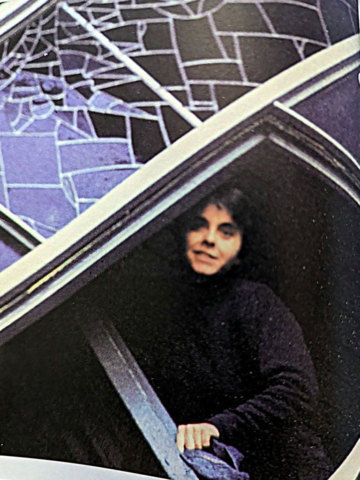
Irene LeCompte — nee Veronica Irene Matz — was born in New Jersey in 1926 and raised in Matawan.
The daughter of an electrician father graduated from Cooper Union in New York City in 1948 with a degree in architecture and worked as an architectural draftsman for the Perth Amboy firm of M. Murray Leibowitz, an Ecole des Beaux Arts trained architect and watercolorist.
Her World War II veteran brother introduced her to his combat friend, Rowan LeCompte, a serious stained glass artist who put his career on hold for wartime service.
The two were attracted to each other, married in 1950, and opened their first studio in 1951 in Matawan.
Between then and Irene’s death in 1971, they jointly created more than 120 windows.
A recent bio on Rowan LeCompte notes that “right from the beginning Rowan and Irene were juggling multiple commissions, including the College of Preachers and St. John’s Episcopal Church in Cohoes, New York.”
Their approach to create fresh images with bright glass and bold colors attracted attention, and the couple and their “modern” work appeared in Life magazine.
In the mid-1960s the couple was commissioned by Princeton University to create the glass for a poets section of the chapel. While their design features major European writers, such as Dante, Shakespeare, and Milton, the couple brings the canon into modern times with two interesting inclusions.
One is the image of the American-born author of the groundbreaking modern poem “The Waste Land,” T.S. Eliot.
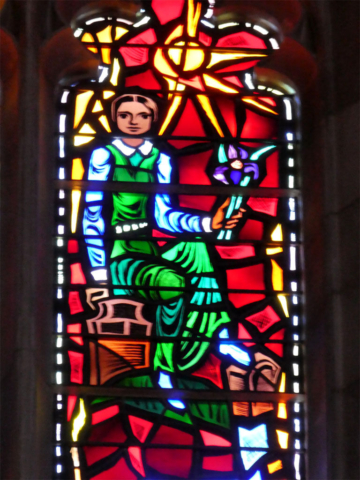
Yet it is the other that is perhaps more significant. It is the stained glass portrait of female American poet Emily Dickinson, created by New Jersey born, American stained-glass artist Irena Matz LeCompte.
In its own way, it commemorates New Jersey women making stained glass right before our eyes.