Did you know, the composer of “Old Nassau” was a pupil of Franz Liszt? That Princeton was the birthplace of one of the great stride pianists? That a colleague of Igor Stravinsky rests in St. Paul’s Parish Cemetery?
Every Halloween, I float the idea of writing about notable composers and musicians whose earthly remains rest in our area. Granted, it’s not the first angle most people consider when taking a “haunted tour.” But for those who find chills in trills, and feel tones in their bones, Princeton is an unsung location for composers who decompose.
On a recent weekend afternoon, I entered Princeton Cemetery with some print-outs from findagrave.com. Unfortunately, the plot numbers did not match the Princeton layout grid on the brochure available from a map box located just inside the cemetery entrance on Greenview Avenue. And it being a Sunday, the office was closed. The fact that photographs of the headstones were included on most — but not all — of the print-outs made the search a little easier, but it did require attention to background detail, a sharp eye, and plenty of persistence. It is, after all, a 19-acre cemetery. Hopefully, this article will make it easier for anyone curious to follow the “dead composer” tour.
Princeton Cemetery is owned and operated by Nassau Presbyterian Church. Founded in 1757, the cemetery is located near the center of town, at the corner of Witherspoon and Wiggins streets. Gates are open daily from dawn to dusk. The character of the community burial ground is inclusive and non-denominational. You know, death is the great leveler and all that. Still, you have to concede, some of the departed are more equal than others.
The graveyard is the final resting place of U.S. President Grover Cleveland, U.S. Vice President Aaron Burr, “Great Awakening” fire-and-brimstone minister Jonathan Edwards, Paris literary magnet Sylvia Beach (owner of the legendary bookstore Shakespeare and Company), best-selling novelist and short story writer John O’Hara, architect Michael Graves, mathematician Kurt Gödel, and Declaration of Independence signer John Witherspoon, among many other notables.
The cemetery is also home to a variety of trees, all especially distinctive at this time of year — beeches, cypresses, dogwoods, and, near the Princeton University “Presidents Plot,” an offspring of the late Mercer Oak of Princeton Battlefield.
On a pleasant afternoon, hours could be passed drifting from marker to monument. Some three centuries’ history is represented by its headstones, monuments, urns, and obelisks. I was there as much for album leaves as autumn leaves, so it was for composers’ graves I embarked.
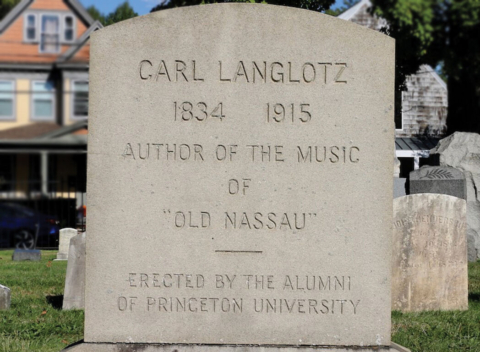
The headstone of Carl Langlotz was the easiest to locate, as his grave is positioned along the drive, wending east, not far from the cemetery entrance.
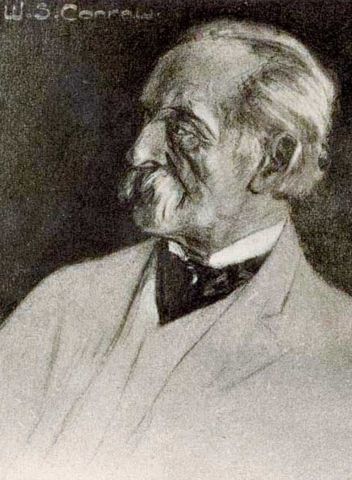
Langlotz, who played violin in the orchestra for the world premiere of Richard Wagner’s “Lohengrin,” is best known to generations of “Tigers” as the composer of “Old Nassau.” “Old Nassau” has been Princeton University’s alma mater since 1859. The original text was contributed by freshman Harlan Page Peck. Langlotz dashed off the melody one afternoon while smoking his pipe on the front porch at 160 Mercer Street. There is a plaque along the walk in front of his former residence to commemorate the achievement.
Langlotz himself was bemused by its success. “Its music was quickly and carelessly composed,” he said, “yet I suppose it will have a place among the songs that never die.”
Langlotz’s father was a court musician with connections to the Royal Family at Saxe-Meiningen (in present day Thuringia, Germany). He himself studied with Liszt in Weimar in 1851. At the age of 19, he emigrated to the United States.
Here he lived in Philadelphia, Trenton, and Princeton. He taught German at the university (and, for a time, fencing), while directing a choir on the side.
In historical records, “Carl” is frequently spelled with a “K,” but not so on his headstone. Nor in his obituary in the New York Times, which notes that he died at his home “after an illness of several months.”
“Old Nassau” is acknowledged right there on his grave marker. The headstone was “erected by the alumni of Princeton University,” no doubt in gratitude for his evergreen anthem.
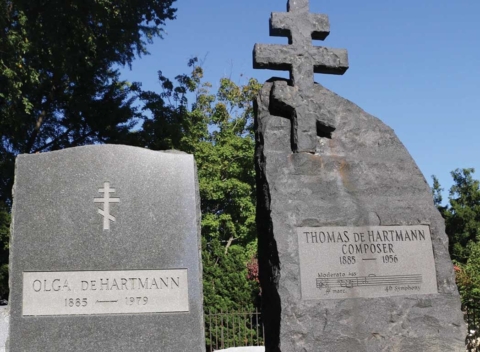
Locating the grave of Thomas de Hartmann was a bit trickier. Fortunately, it’s topped by a distinctive marker, a rough-hewn slab with a raised Russian Orthodox cross, which causes it to stand out from the surrounding headstones. I found it on the north side of the cemetery, past the office.
De Hartmann was born in Ukraine in 1885. He studied conducting with Wagner acolyte Felix Mottl in Munich, Germany, and composition with three of the greatest Russian composers of their time, Nikolai Rimsky-Korsakov, Anton Arensky, and Sergei Taneyev. His ballet, “La Fleurette rouge” (“The Red Flower”), was presented at the Imperial Opera.
He met the mystic-philosopher George Ivanovich Gurdjieff in 1916. The two left Russia following the Revolution, in the company of de Hartmann’s wife, Olga, who was a celebrated opera singer. They traveled first to Constantinople, then Berlin and Paris, then settled for a time in the south of France. In 1950, they arrived in the United States.
During his time in Munich, de Hartmann formed a friendship with the painter Wassily Kandinsky. Kandinsky encouraged him to look beyond traditional forms and to trust more in intuition. In the end, de Hartmann developed into something of a polystylist. His works incorporate world music, bitonality, jazz, and ultramodernism.
De Hartmann and Gurdjieff collaborated on a number of musical works, based on melodies Gurdjieff remembered from Sufi, Russian Orthodox, and Eastern folk sources. Gurdjieff communicated these by whistling them or picking them out with one finger at the piano.
On March 8, 1952, violinist Alexander Schneider performed de Hartmann’s Violin Sonata in Princeton, with the composer at the piano. He died of a sudden heart attack on March 28, 1956.
De Hartmann’s headstone bears a quotation from his Symphony No. 4. He is buried beside his wife. Olga shared his interest in the esoteric and spiritual. On the day of my visit, an inquisitive fox likewise weaved through the bars of the bordering iron fence.
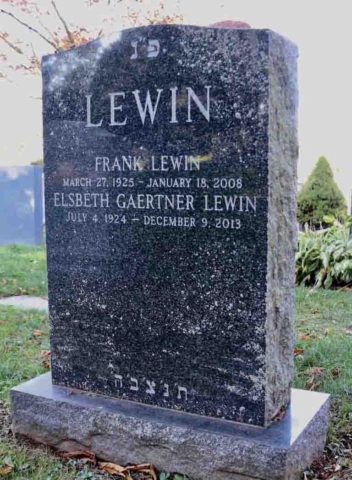
Continuing to wander, not too far to the west, beneath an arboreal canopy, I spotted the black granite headstone of Frank Lewin.
Lewin was born in Breslau, Germany (now Wroclaw, Poland) in 1925. His family fled the Nazis in 1939 and spent a year in Cuba before settling in the United States in 1940.
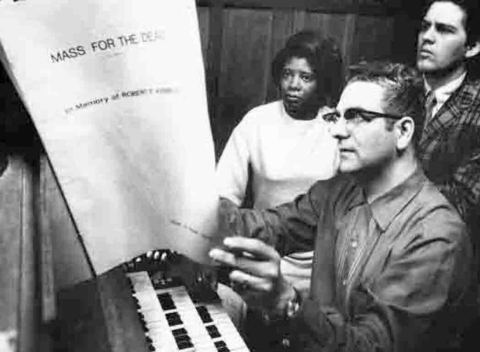
Lewin studied composition with, among others Roy Harris, Richard Donovan, and Paul Hindemith. He composed and arranged music for film and television, including dozens of episodes of “I Spy,” “Brenner,” “The Doctors and the Nurses,” and “The Defenders.” He also wrote incidental music for the theater, including plays of William Shakespeare and Tennessee Williams. In 1965 his cantata “Music for the White House” was performed at a state dinner hosted by President Lyndon B. Johnson. One of his operas, “Burning Bright,” was based on the novel by John Steinbeck.
Lewin was a professor at the Yale School of Music from 1971 to 1992, and at Columbia University School of the Arts from 1975 to 1989.
He made his home in Princeton, beginning in 1951. For the last decade of his life, he continued to work, though visually impaired, preparing a series of CDs for Albany Records. Rossen Milanov — then associate conductor of the Philadelphia Orchestra; now music director of the Princeton Symphony Orchestra — recorded a number of Lewin’s works with the New Symphony Orchestra of Milanov’s home town, Sofia (the largest city in Bulgaria).
Lewin died in 2008 at the age of 82.
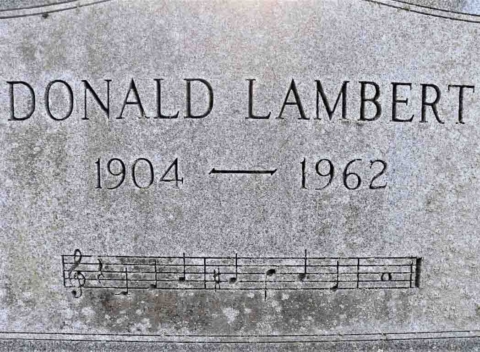
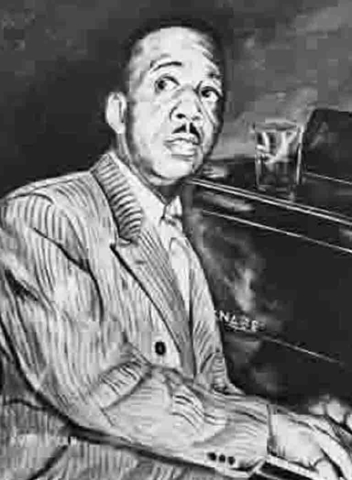
Heading south, on the far side of the cemetery is the headstone of Donald “The Lamb” Lambert. Lambert, who was born in Princeton in 1904, might seem something of an outlier. He is sometimes described as the last of the stride pianists. Stride is a style associated with the playing of Fats Waller and New Brunswick’s James P. Johnson. Lambert was a formidable opponent in “cutting contests” — musical duels between pianists. On one occasion, he went head-to-head with Art Tatum. On another, he outplayed Eubie Blake and Willie “The Lion” Smith.
While by no means a classical composer, Lambert did an awful lot of improvising on familiar classical themes by Richard Wagner, Edvard Grieg, Gaetano Donizetti, and others.
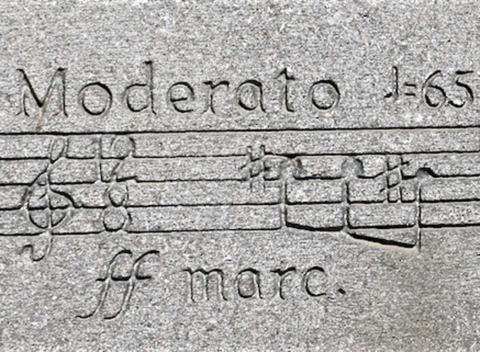
He would likely have achieved greater success had he not shunned New York City. Instead he contented himself with playing jazz clubs in north Jersey. He died in Newark of a massive stroke in 1962 at the age of 58. His headstone, paid for by some of his fellow musicians, displays a theme of his own composition.
By now in need of a boost, I took a quick break for a cup of coffee, before striking out for the grave of Arthur Lourié. This involved a side trip to St. Paul Parish Cemetery, located behind the Catholic church at 216 Nassau Street.
Several times during the day I was reminded of the climactic sequence in “The Good, the Bad and the Ugly,” when Eli Wallach’s Tuco makes a vertiginous dash through seemingly endless rows of tombstones, in search of Arch Stanton’s grave. The sun was low in the sky by the time I located Arthur Lourié’s marker.
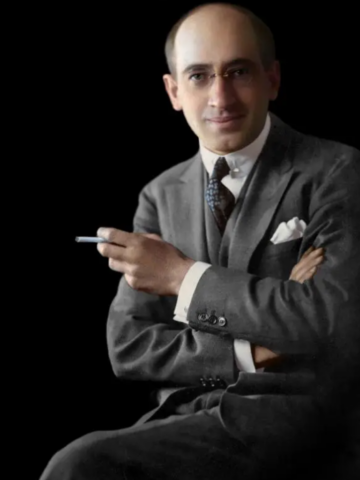
Lourié was a pupil of Alexander Glazunov (another student of Rimsky-Korsakov). He also enjoyed a close personal and professional relationship with Igor Stravinsky. He has been described as the first Russian Futurist composer. He was friendly with the poet Anna Akhmatova, some of whose verses he set to music.
Following the Revolution, he became disillusioned with Bolshevism and failed to return from an official visit to Berlin. He met Stravinsky in Paris and became an important early champion. He was a regular in the Stravinsky home and entrusted to make piano reductions of the master’s works. Unfortunately, a quarrel ended the friendship, but Lourié’s influence on Stravinsky’s style continued to be felt.
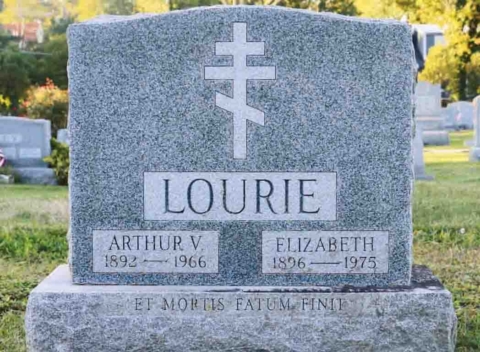
Lourié shares a headstone with his wife, Elizabeth. The marker is distinguished by another Russian Orthodox cross. Also of interest is an inscription on the top edge of the foundation, under Elizabeth’s name, indicating that she was “Born Countess Belewsky.” Seeing as she was the great-granddaughter of Tsar Alexander II, one can sympathize with how she might want to hang on to a piece of her former identity.
Of course, this is far from a comprehensive survey of area composer graves. George Antheil rests in Trenton and Alexander Gretchaninov in Jackson Township, New Jersey.
Any of these figures merit their own feature. They all lived extraordinarily interesting lives and, although not perhaps household names, they accomplished much in their individual spheres. With the internet at our disposal, it is easier than ever to call up newspaper articles, census records, and other documents, to put flesh on the bones of those whose music is known, if at all, from a comparatively small number of recordings, and whose names are recognized perhaps only by enthusiasts or as footnotes in broader histories.
I should add that guided tours of Princeton Cemetery are offered. And this time of year, “ghost tours” are very popular. Though it’s doubtful any of them will specialize in composers.
It’s a good time to find out who’s buried in your back yard.
Princeton Cemetery is located at Greenview and Humbert Street in Princeton. nassauchurch.org/about/princetoncemetery.
Upcoming events include the Princeton Cemetery Walking Tour, Friday, October 28 at noon, free. princetonhistory.org/events/princeton-cemetery-walking-tour-2.
And Princeton Ghost Tours (including a stop at Princeton Cemetery), through October 29, Friday and Saturday at 7 and 8 p.m., $35. princetontourcompany.com/tours/cemetery-ghost-tour.