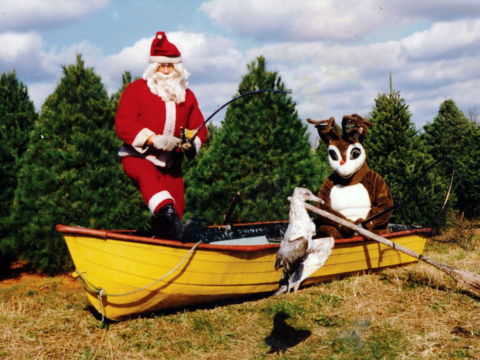
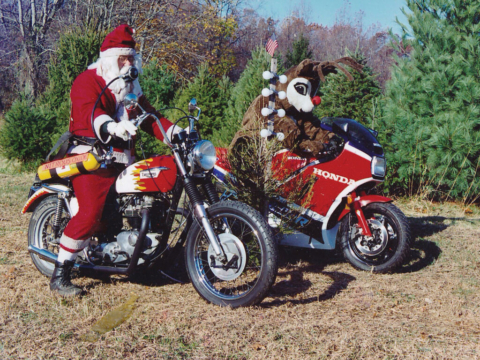
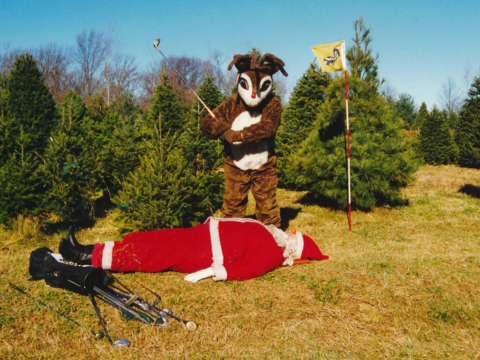
It was the “South Pole” return address that indicated that this holiday season envelope was going to make spirits bright.
For years the envelope’s arrival would cause my wife, son, and I to gather at the table to open it, get ready for a laugh, and remove a “Christmas Card” in the form of a 4 inch by 6 inch color photograph with a caption taped to its back.
The sender was my longtime friend John Chitester, whose DIY card sending started when personalized cards were not so prevalent as they are now.
That he was consistent with using the approach when digitized cards became increasing available suggests that he saw the simple photo, paper, and tape as his medium.
That he also was consistent with theme, characters, models, costumes, and locations suggested that each card was part of a thematic series added to the fun.
That the photos depicting Santa and Rudolph the Red-Nosed Reindeer — played by his mother and sister on the family farm outside Mt. Holly — in ridiculous situations were actually a type of art form became increasingly evident over the years.
It was a mixture of Dada and that quirky folk art farmers cook up while plowing or digging irrigation ditches or picking asparagus — just think of sheep farmers putting multi-colored lights on their herds and moving them into patterns.
Like many farmers I have met who grew up with farming, John had a college education — a journalism degree. After growing tired of covering municipal meetings, he decided to use the skill to bother local politicians and, after a long stay in the Peace Corps in Ecuador, run the family farm.
He also dipped into art on the side and exhibited his nature photos taken at the county library across the street from where he lived and published a small printing of a story and illustration.
Yet, the Christmas Cards that he returned to year after year for a few decades seem to be his true artistic statement.
Despite their simplistic format, the photos reflected his life on the farm, especially a keen sense of the seasons: he would look ahead to the coming winter holiday, have an idea by late summer, and then gather his crew and head to a location on the family farm.
He would then artistically limit his choices of subjects to mainly two characters and the available costumes and using whatever farm equipment, vehicles, or crazy things he collected were on hand. He even fashioned other characters out of cardboard or the vegetables he farmed, if needed.
Then, like a surrealist artist, he would position his subjects into absurd situations and photograph them with a matter-of-fact sense that heightened the absurdity.
The result for the viewer pulling them out of an envelope was a blink of disorientation followed by a laugh — both reflective of John’s hope that people would break their habits of seeing in a manner that reinforced their limited perception of the world, especially regarding agriculture and other cultures, and to get a jolt of laughter.
When his mother died two years ago and COVID took over the world, John’s Christmas Card planning was disrupted and further disrupted by his own health.
And despite my hope that he may get back to the camera to prepare for Christmas, John became increasingly ill and he — and his holiday art — died towards the end of summer of 2022 on his farm where he created a series of small images that can still produce the gift of a holiday laugh.
And what a gift that is.