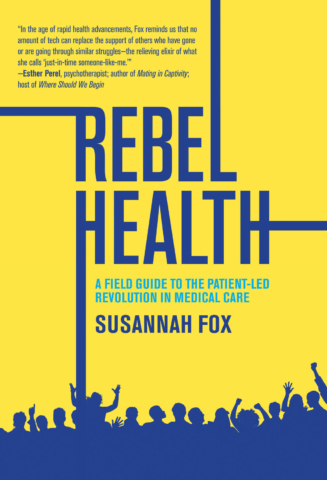
The Princeton Mercer Regional Chamber of Commerce’s “Monthly Membership Luncheon” for March features health and technology strategist Susannah Fox discussing her new book, “Rebel Health: A Field Guide to the Patient-Led Revolution in Medical Care,” on Thursday, March 7, from 11:30 a.m. to 1:30 p.m. at the Princeton Marriott at Forrestal, 100 College Road East, in Princeton.
To register or for more information, see the PMRC event calendar at business.princetonmercerchamber.org/chamber-events.
Fox will not only discuss the themes within “Rebel Health,” released under MIT Press in February and described on the publisher’s website as “an action-oriented and radically hopeful field guide to the underground, patient-led revolution for better health and health care,” but also share the “competitive advantage of working with patients, survivors, and caregivers.”
As the former chief technology officer for the U.S. Department of Health and Human Services during the Obama Administration from 2015 to 2027, Fox oversaw the HHS IDEA Lab — standing for Innovation, Design, Entrepreneurship and Action — developing initiatives like “Invent Health,” which was “focused on user-driven innovation for medical and assistive devices,” according to the biography on her website, susannahfox.com.
Fox previously served as editor of the media company U.S. News & World Report and helped launch its website. For 14 years, Fox was the associate director of the Pew Research Center’s “Internet & American Life Project,” where she headed the nonpartisan think tank organization’s health research and technology portfolio.
It was during this time at the Pew Research Center that Fox coined the term “peer-to-peer health care” in 2011 to refer to people in online communities providing advice, information, and emotional support about conditions or symptoms they are directly experiencing or observing, especially in the digital atmosphere, to “supplement” professional medical care.
This was a direct result of Fox’s research into “how information technology and social media affect the health care industry and the consumer health care experience, with a special focus on people living with chronic and rare conditions.” By forming these bonds, patients and caregivers not only gain access to much-needed emotional relief through camaraderie, but also expand their “peer network” when doctors or traditional treatment options are inadequate.
Before her government position, Fox was the entrepreneur-in-residence at the Robert Wood Johnson Foundation, the health-focused organization based in Plainsboro, where “she built project teams to bring patient and caregiver insights” into RWJF’s philanthropic work,” her biography continues.
For Fox, “Rebel Health” is the culmination of two decades spent in the field “tracking the expert networks of patients, survivors, and caregivers who have come of age between the cracks of the health care system.”
In the book’s press release, Fox explains that two distinct groups of people will benefit from reading “Rebel Health,” starting with “anyone who feels alone, forgotten, or lost in the shadows of suffering, whether they are navigating a new diagnosis or life with a chronic condition.” Through the resources provided, “patients, survivors, and caregivers will learn new skills and how to deploy them for themselves and their loved ones.”
The other, she writes, is “anyone working inside health care who is fed up with the status quo. If they are ready to create positive change — improve health outcomes, keep people safe, find effective treatments, or bring better products and services to the market — they need new allies and strategies. Rebels are standing by to help.”
“Health care needs to invite the rebels inside, to connect them with the resources they need to test and scale their ideas,” she adds, with the book serving as “a how-to guide” made “for anyone who wishes to join the health rebel alliance and become the hero of their own story.”
In addition to benefiting advocates, the “patient-led revolution” Fox describes also requires action from healthcare executives, with the author arguing that listening to and partnering with such groups can give these leaders a “competitive advantage” centered around connection.
Fox, who now lives in Washington, D.C., is a Princeton native who attended Princeton High School and graduated with a bachelor’s in anthropology from Wesleyan University in Middletown, Connecticut. Her father was a system engineer at the technology company IBM, then a programmer at Cylogix in retirement, while her mother, Barbara Fox, is a former senior editor at U.S. 1.
In “Rebel Health,” she notes that despite the rapid modernization of many industries through technology, those advances have not addressed systemic problems within the medical world. This leaves more responsibility to the individuals, who then turn to search engines to identify symptoms and share stories on social media platforms, adapting where the infrastructure fails.
“Patients are also teaching each other how to conduct research, to safely experiment, and to ask better questions. Expert networks of patients, survivors, and caregivers have grown up between the cracks of the health-care system. We need to tap into their wisdom, learn their ways, and give fuel to the rebel alliance that is building up our collective capacity for better health,” she writes in an excerpt from page eight.
As Fox explains in the Q&A section of the press release, her research identified four archetypes — seekers, networkers, solvers, and champions — derived from the differences in how “people whose needs are not being met by mainstream health care react to adversity.”
“Once I started looking for patterns, I was able to create categories of activities and motivations. I discerned three archetypes from the start: Seekers, who go on the hunt for answers; Networkers, who pool resources and learn in community; and Solvers, who attack problems and build tools. Champions, who fast-track innovations, emerged as an archetype as I got further into writing the book and recognized the importance of patient-led teams getting access to resources like funding, media attention, regulatory guidance, and materials,” she says, with these types prone to shifting to adapt to the scenario’s needs.
Whether an individual is making connections, raising awareness for a cause, or finding opportunities for innovation, as Fox continues on page 11, “Rebel Health” gives readers the tools to find these personas in everyday life and join forces for change.
Combining interviews, case studies, and research, the book covers tips for each of the four archetypes, as well as tactics, courage, visibility, resources, and more with a “prosocial, not anti-science” outlook. Fox cautions that misinformation is a major barrier to access and drives further inequity, so while the revolution is in motion, people on the frontline need support, not a barrage of falsities spreading the very darkness that peer-to-peer healthcare seeks to avail of.
“Online health communities are an information market opportunity, not something to disparage or dismiss. The desire to seek advice and collaborate on solutions is an unstoppable force. We need to channel it, not try to dam it up,” she writes on page 50.
But the “user-driven innovation” found in these spaces, Fox continues, demonstrates the transformative power of “community-led information resources” to engage patients and caregivers like never before — and may pave a new path in the medical field.
“Rebel Health: A Field Guide to the Patient-Led Revolution in Medical Care,” Susannah Fox, MIT Press, February 2024. $29.95 hardcover; eBook prices vary.