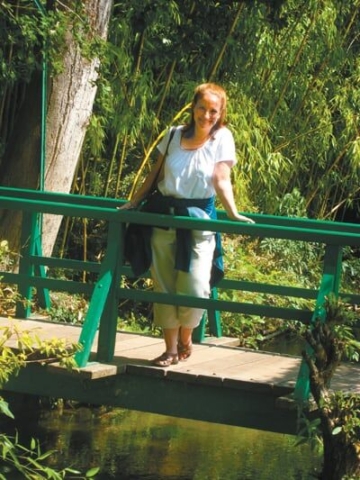
Playwright E.M. Lewis loves mysteries. From Dashiell Hammet all the way up to more modern writers like Sue Grafton, Lewis has always embraced a good mystery novel. Her new play “True Story,” receiving its world premiere at Passage Theater from Thursday, November 7, through Sunday, November 24, takes this love and places it squarely on stage.
“I started thinking that it would be fun and interesting to write a mystery,” says Lewis (whose first name is Ellen). “I rather like reading them, and thought it would be interesting to see if I could write a mystery for the stage. It does begin as a fairly straightforward mystery, but it got more complicated as it went along. I wasn’t sure where the play was trying to take me. It moved quickly into more personal territory, which some of my other plays have explored. The questions of grief and survival interwove themselves with the mystery, and I went where it took me.”
“True Story,” which opens Thursday, November 7 at Passage Theater in Trenton, focuses on grieving mystery writer Hal Walker, who is charged by his editor with ghostwriting the story of the century, a ripped-from-the-headlines tale of an acquitted murderer who everyone thinks is guilty. “He seems lost, he’s drinking too much, he’s not writing, and he’s fallen off the map a bit,” says Lewis. “And immediately he gets sucked into the story much more than is healthy for him. He becomes obsessed with whether or not this man is guilty, and if he is, what needs to happen to him.”
Lewis was inspired by the public outcry in response to court cases such as those of O.J. Simpson, Robert Blake, and Casey Anthony. “I was in L.A. for the Simpson trial and its repercussions. When the justice system doesn’t work the way it should work well, what then?” Lewis sought to construct a play that asks questions of overcoming grief alongside injustice. “This is a story of Hal not only becoming obsessed with a lack of justice, but how he comes to terms with his own grief over the loss of his wife.”
The child of elementary school teachers, Lewis grew up in rural Oregon, on a 15-acre farm that originally belonged to her great-grandparents. She majored in English at Willamette University in Oregon, and went on to the masters in professional writing program at the University of Southern California. “I didn’t know plays yet,” says Lewis. “But it was a multidisciplinary program where we could work on poetry, fiction, or whatever struck our interest. And once I discovered plays, it was plays all the time for me.”
Lewis became an active part of the Los Angeles theater community, working extensively as a playwright and receiving several productions of her plays. Her work has been produced across the country and around the world, in venues that include the prestigious Guthrie Theater in Minneapolis and the Edinburgh Fringe Festival in Scotland. Her play “Song of Extinction,” about a musically gifted high school student slipping into an otherworldly state of grief, has been especially popular, receiving a production at Hostos College in the Bronx last year and serving as the campus-wide “Book of the Semester.” Her play “Infinite Black Suitcase,” about a single day in the life of a town in rural Oregon opened last week at USC; both plays are published by Samuel French. Premiere Stages of Westfield recently commissioned a play from Lewis for its New Jersey history play program, Liberty Live.
Lewis came to Princeton as a recipient of Princeton University’s Hodder Fellowship, given to writers and non-literary artists of exceptional promise to pursue independent projects at Princeton University for a year-long tenure. It allowed Lewis to quit her outside-the-arts job in Los Angeles, where she provided technical support for the student information system for University of Southern California, including training and documentation.
Shortly after arriving in Princeton, friends introduced her to playwright Jim Christy, writer of Passage Theater’s award-winning “Love and Communication.” Christy, in turn, introduced Lewis to the Passage Play Lab, the company’s writing community for playwrights and incubator of new work. “I loved the Play Lab,” says Lewis. “For the three years I was in New Jersey, it became a home to me. I had this wonderful fellowship, but it didn’t come with a community; Passage became mine. David Lee White [Associate Artistic Director of Community Programming] has assembled a fabulous, really smart bunch of playwrights. I felt so supported and bolstered up while I was there, and I also received some great feedback from the neat minds involved.”
Participation in the Play Lab led to early development of “True Story,” culminating in a weekend workshop in winter, 2012, at Passage. “That was a great delving into the play, and what it was trying to be.” Next Flux Theater Ensemble in New York City presented a staged reading of the play, which showcased how some of the structural elements of the play were going to work. Further workshops at the Santa Barbara New Play Festival and Arkansas New Play Festival continued its development. “All these experiences were perfectly spaced to help me go deeper into how the play works. My director, Damon Bonetti, has been invaluable in guiding this play to its first full production.” Bonetti, an active theater artist in Philadelphia, makes his Passage mainstage debut with “True Story.”
Lewis is excited to see how audiences react to “True Story.” “The narrative begins to get complicated in this five-character play,” she says. “There’s a point where other characters try to take the story away from each other, like the classic story of ‘Rashomon.’ There’s a lot of ‘This is how it happened — wait, no — this is how it happened.’ It gets embattled, and that’s exciting to me in the writing. It’s going to be fun to see how audiences respond to the push and pull of it; it starts out as a mystery, but becomes more about how we deal with injustice in life, and how it’s perceived from different angles.”
Lewis reiterates the importance of Passage in getting the play to this point: “I feel loved and empowered here. The work of June Ballinger, Kacy O’Brien, and David Lee White made this all possible. I’ve worked at a lot of theaters, and this is a unique, wonderful program that really gives playwrights strength and an active voice in producing new work.”
Lewis has returned to Oregon to work and live, and is currently spending time on her family’s farm. In February, 2014, she will travel to Kansas for a residency at the William Inge House, where she will write and teach. In June, she will return to New York for the final phase of a year-long training program with the American Lyric Theater, where she is developing her skills as an opera librettist. “But I’ll always be a playwright!” she laughs.
“The team Passage has assembled for ‘True Story’ really is amazing,” says Lewis. “From the director to the designers, to the actors, each one is incredible. It’s been a nurturing and supportive journey to this point, and I’m just thrilled with the outcome.”
True Story, Passage Theater, Mill Hill Playhouse, 205 Front Street, Trenton. Thursday, November 7, through Sunday, November 24. Thursdays through Saturdays at 8 p.m., Sundays at 3 p.m. $30 to $35. 609-392-0766 or www.passagetheatre.org.