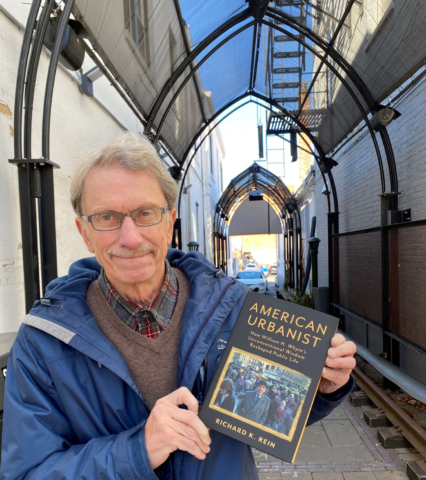
“American Urbanist: How William H. Whyte’s Unconventional Wisdom Reshaped Public Life” by Richard K. Rein is a new book that mainly looks at an individual who introduced a fresh way of looking at social organizations and examining urban projects.
Rein, as many area readers know, is also the founder of U.S. 1.
And as one of his colleagues, I’ll add that the book is also about the reshaping of a dedicated, if not compulsive, editor into a successful book author and serves as a lesson in writing.
But let’s start with Whyte — also known by the shortening of his middle name, Hollingsworth, as Holly Whyte.
As Rein notes early in the book, Whyte was the author of the 1956 best seller “The Organization Man,” a book “that defined a generation of men and women who committed themselves to the big corporations and other institutions where they expected to be employed for a lifetime.”
A product of Princeton University (where he studied English and wrote for the university newspaper), the U.S. Marine Corps (where he wrote for the Marine Corps Gazette), and Fortune magazine (where he wrote for a national audience), Whyte was a testament to the benefits of being part of a greater organization.
Yet through personal observations, including the crucial give and take between individual and organization during combat during World War II, and a streak of independence, Whyte began to understand how vital institutions could create cultures with a belief system that often squelched the equally vital input of individuals within that organization.
Whyte introduced the now common term “groupthink” to define the phenomenon, and, as Rein writes, used it to advise his readers “how to work with The Organization and how to — when necessary — resist it.”
Whyte’s book also honed his ability to examine and report on another cultural trend, the post-World War II population shift to the “little boxes” of houses in of look-a-like suburban developments and its impact on urban communities.
In doing so Whyte moved into what Rein says was his “true calling as an urban critic” — one who reviewed urban spaces through physical participation and observation of others.
“American Urbanist” is the first biography on Whyte and dutifully and expertly chronicles Whyte’s life from a small town in Pennsylvania to big city New York.
But it is also an overview of Whyte’s thoughts and practices organized by Rein into such chapters as: “Preservation Tactics in the Urban Landscape,” “The Art of Small Urban Spaces,” “From Small Places to the City: Rediscovering the Center,” “Applying Urban Principles in Suburban Places,” “Whyte in the 21st Century — the Urban Imperative.”
One, in particular, handily shows Whyte’s impact: “The Exploding Metropolis — Discovering Jane Jacobs.” The latter is the noted urban critic and author of the influential study of urban planning, “The Death and Life of Great American Cities.”
Like Whyte, Jacobs, once enthusiastic about the organizational approach to city planning, began to argue that professional planners needed to consider the experiences of the people living in the communities that were going to be impacted.
The idea is best reflected in Whyte’s notion that planners have plenty of ideas but residents have answers, “a radically revolutionary planning statement” at the time, says Rein.
The chapter’s “discovery” was actually Whyte’s gradual awareness of Jacobs through her short writings for Architectural Digest and participation in Harvard University’s Graduate School of Design’s 1956 conference on what Rein calls the “new science” of city planning.
Whyte called her a real genius and, despite the reality that she had not written any in-depth articles, engaged her to join him in exploring new approaches to city planning for Fortune magazine.
Those writings, along with essays by others, appeared the 1958 Whyte-edited book, “The Exploding Metropolis: A Study of the Assault on Urbanism and How Our Cities Can Resist it.”
Rein says the book touches on most major issues in urban planning still relevant today: suburban sprawl, the cost of urban renewal, unintended consequences of cars, missing middle housing, and the value of regional planning.
Whyte’s involvement of Jacobs continued by championing her work in an institutional environment that did not readily engage women and helping to secure funds to support Jacobs while she wrote her now famous book.
However, the chapter winds down with a fracture of ambiguous origin between Whyte and Jacobs that Rein suggests grew, in part, by Whyte’s penchant for romanticizing his own “heroic” efforts in engaging her and diminishing her by, in the words of a Jacobs biographer, depicting a “callow Jane Jacobs” to make a story more fun to tell.
Another fracture may be related to the way they practiced their attitudes towards reshaping urban planning.
While Jacobs became famous for publicly confronting developers such as Robert Moses, whose plans ripped through New York City neighborhoods, Whyte would meet them halfway and develop relationships with them, eventually working on the Plan for New York City 1969 and developing professional and personal relationships with the influential Rockefeller family.
So how does Rein connect to all of this?
Rein says his first exposure to Whyte came in 1965 when he attended Princeton University’s freshman class welcoming address, and the university president quoted the former Princeton student’s line from “The Organization Man”: “Every great advance has come about, and always will, because someone was frustrated by the status quo, because someone exercised the skepticism, the questioning, and the kind of curiosity which, to borrow a phrase, blows the lid off everything.”
While Rein unintentionally followed a path similar to Whyte by studying English, editing the student newspaper at Princeton, and writing for a major New York-based magazine, Time, he says he became more informed in Whyte’s ideas after he took a job for an environmental planning firm and read Whyte’s “The Last Landscape.”
When he turned to freelance writing, decided to stay in Princeton, and purchased his first home on Moran Avenue, he says he unconsciously began to incorporate Whyte’s ideas about productive community living into his own: being able to conduct daily business and creating a larger sense of yard space by installing a tall fence.
Then, as he was founding the newspaper that he would manage for more than three decades in 1984, a new corporate community began to appear seven miles from downtown Princeton and along the four-lane highway officially designated as US 1. Rein says he saw that “exciting work was going on in those offices. It was a community of its own, and it deserved its own community newspaper. I called the paper U.S. 1.”
And “over the years U.S. 1 covered many of the issues addressed by Whyte: Suburban sprawl; an unsuccessful battle to convert acres of parking lots at the busy Princeton Junction train station into a mixed-use transit village; New Brunswick’s successes and Trenton’s failures in efforts to revitalize their downtowns; and a squabble between the university and townspeople over moving the Princeton train station 460 feet further away from the center of town, among others.”
Rein and Whyte never met but they did connect. In the late 1980s, Whyte was involved in a series of reviews in the Princeton area. One at Princeton University was instigated by his friend, patron, and university alumni trustee and head of the grounds and building committee, Laurence Rockefeller, who asked for his opinion on a university plaza. The others included Palmer Square and “the sprawling new office developments of the Princeton-Route 1 corridor.”
For the book, Rein pulls from his years of covering the corridor’s development to provide an authoritative sketch of the early days of the Princeton Forrestal and the Carnegie centers and to describe how Whyte reviewed the social and community aspects of the corridor by making a foot journey that started in downtown Princeton.
Rein notes that during Whyte’s 1985 Route 1 corridor visits, U.S. 1 newspaper celebrated its first anniversary with Rein running an editorial that focused on the 10 essential truths about the corridor.
One, he says, was “the biggest problem with Route 1 is not that there are too many people out there, but rather that there are too few” and that the “paper went on to bemoan the lack of housing to complement the new developments and high vacancy rates of the newly built office space.”
Rein adds that Whyte cited the newspaper, calling it “sprightly,” and quoted the first truth in his book “City: Rediscovering the Center.”
While Whyte’s ideas may have been a quiet influence that shaped U.S. 1’s critical approach to planning around the region, Rein’s colleagues, including me, will attest that Whyte’s name and ideas grew louder and clearer when Rein began his exit as U.S. 1’s editor in 2017. He left in 2019.
Rein writes that a group of Princeton artists and designers began transforming the empty Dohm Alley on Nassau Street into the outdoor sculpture garden, art gallery, and performance space it is today.
“As I walked past the alley one day, I met one of the designers, Kevin Wilkes, an architect and general contractor. I remarked that taking an unusual space — as small as it was — and putting it to good use was exactly the kind of action that William H. Whyte had encouraged. I referred to Whyte fully expecting that I would then have to explain who he was. No need. ‘Holly Whyte,’ exclaimed Wilkes. ‘Holly Whyte’s my hero!’”
Rein called it an “aha moment” and time to learn more about Whyte.
He also had to learn to move a life of overseeing and editing every word of the paper he founded into a long-term, open-ended book-writing project that may or may not be successful.
And while that may have disrupted him for the short term, the reporter in Rein took over. Soon he was pounding the pavements of Whyte’s hometown, West Chester, PA, digging up his lackluster records at St. Andrew’s School in Delaware and Princeton University, reviewing military history and newspaper articles, reading his books, and communicating with scholars who knew Whyte’s work.
One was Miriam Fitzpatrick, University College Dublin assistant professor in the school of architecture, planning, and environmental policy. She also had been working on a biography of Whyte.
Rein says, “She had been researching Whyte going back to around 2009 or so and had been using his work in the classes she teaches. She did send me an academic paper she was working on, and I expressed my hope that both of our biographies would come out around the same time; one would gin up interest in the other.”
As Rein wound down his duties with U.S. 1 — even taking previously unheard-of lengthy vacations — Whyte’s name and ideas became more pronounced and helped inform Rein’s open discussions of the recently opened Lewis Center for the Arts in Princeton (Whyte wouldn’t like it) and Greater Trenton’s proposal to attract Amazon to the capital city (good idea to have the document for future planning but needed to go beyond planners).
Thinking those sources may have been the catalyst to get Rein thinking about Whyte, I double checked with him and received the following reply: “Dohm Alley absolutely was the catalyst. Until then I never had a single thought about writing a Whyte biography, and all that Trenton stuff and Lewis Center work came after the summer of 2017. But I absolutely was aware of Whyte’s writing, going all the way back to the early ’70s when I read and was very impressed by ‘The Last Landscape.’ I probably cited Whyte in a few of my columns over the years. But I never saw him as a subject of a biography.”
Mirroring Whyte’s use of an unadorned declarative sentence to introduce the book and focus the reader, Rein opens his work with the simple “This book is about William H. Whyte.” He then continues in a reader-friendly manner that disguises the extensive research and the hours of editing that such easy reading requires.
During a recent discussion at a café in Princeton, Rein says the book’s simple opening wasn’t so simple for the editors. “There was a brief negative reaction to the beginning sentence,” adding that his editor thought “it was a mistake” and that the approach sounded amateurish.
“But it had to be,” says Rein. “There was no other way. Almost every one of (Whyte’s) books started with a simple declarative sentence. Whyte talked about the value of declarative sentence,” something he had learned from his English teacher at St. Andrew’s who pushed his students to write with clear intent. “Like a (baseball) batter making a line in the dirt,” says Rein.
Rein then shares how he decided to cast himself in the story, rather than write an objective, third-person biography.
“Having edited more than several stories in which the person unnecessarily inserted themselves, I was very aware of the potential problems, but I decided that was the way to establish who I was. I was an interested layman, not an urban planning professional.
“I also thought it was how to show how I got interested in (Whyte) and to get the general reader into it and that he was an accessible guy. The other place I came in was when I discussed how Whyte took notice of U.S. 1 in the 1980s. It was one of the things that made us.”
Rein says he started the book without a publisher and sent inquiries as he progressed. He was turned down by several, including Princeton University Press.
Island Press came into the picture when Rein attended a talk by social and urban theorist Richard Florida in Philadelphia and an acquaintance mentioned the publisher during an informal gathering after the talk.
Already intrigued, he was more so when he discovered that one of the editors was related to one of his college classmates.
Unsure of how it would be received, Rein sent a proposal and sample chapters of a book that deals heavily with Whyte’s theories regarding organization to a company that specialized in environmental and urban design.
“Urban design comes in late in the book,” says Rein. “Jane Jacobs comes in around page 103. The first third of the book takes up Whyte’s organization. But I believed that ‘The Organization Man’ informs the other aspects of his work.”
Island Press editors agreed, and Rein says the relationship “turned out to be a good fit.”
While Rein began the book in 2017, the process that started with a cool pace heated up in September 2019. That’s when Island Press accepted the book, contracted him with an advance and royalty arrangement, and set the due date for December 2020.
“They put it in the timeline and set all the benchmarks for a 2022 release,” says Rein.
Rein stepped up the research at the start of 2020 and reviewed and took photographs of Whyte-related documents in the Rockefeller Archives, New York Historical Society’s collection of Time-Life magazine materials, and Princeton University’s Mudd Library.
The timing was fortuitous. In addition to the Mudd Library scheduled to be closed for renovations in early 2020, it and the above-mentioned centers were shuttered by the pandemic, forcing Rein to work with only the materials he had photographed.
Another “impediment,” he says was “my own ineptitude. Working at a newspaper, you work at one constant speed. I made the mistake of thinking there was so much time (to write the book). I felt that I could talk to someone, get to know them, and then get back with them (for an in-person interview).”
But when the pandemic took hold, he had to do everything by telephone or online while knowing, after years of experience writing for Time, People Magazine, and U.S. 1, that person-to-person interviews result in richer conversations.
Then there was the final copy. “The contract was for 80,000 words,” says Rein. “I thought they meant 80,000 to 100,000, so I turned in 110,000. They contacted me and said I had to cut” and employed the cold-eye editorial approach summed up in the expression “killing your darlings.”
“I’m glad that I did it,” Rein says regarding the creative journey. “I wanted to write a book. I had several false starts. But I always wanted to write a book. And when you are no longer doing the day job, having something you can always turn to is a good thing.”
Yet, it is deeper than that. Rein then mentions the “many strands” of thought that he encountered. “There was so much more there than urban planning.” That includes his own life and what he found out about the 1940s, 50s, and 60s.
A product of the 1950s and 60s, Rein says “I thought I knew about 1960s, I thought I knew the scene. As I dug into it more, it became more and more interesting. It opened my eyes to a view of (those times) that I had never had before.”
That includes a fresh look at his family and the two parents who graduated from North Syracuse High School.
“I grew up in the organization man’s world,” he says referencing his father, Dick, an IBM repair man — or customer engineer. “He put his nest egg in shares of IBM” and “would put on a white shirt and tie and sports coat to go out. He was very proud of the company and (through my writing the book) made me appreciate it.”
His mother, Marian, was a book reader, home keeper, and an entrepreneur who trained herself to be a part-time bookkeeper and provided day care at her house. She may also pass as the person that Whyte would say may have a better idea of what would work in her community than expert planners. Mentioned in the book’s dedication, Rein says she “believed that books enabled a high school graduate to stand toe to toe with a guy from a fancy college.”
The reference is mainly about Rein, whose Princeton career was instigated by a couple of Princeton grads on the young writer’s newspaper delivery route who decided the town needed another Tiger. However, it also connects with Whyte’s thoughts regarding the need to find the common ground between the experienced person on the hot street and the theoretically trained expert with a cool plan.
While Rein says he would have been happy to have the book come out and prompt some discussion about Whyte, organizational thinking, and urban planning, he adds the response “has exceeded expectations.”
As proof, just note the following: The New York Times review called it a “marvelous new biography.” The Wall Street Journal said “journalist Richard Rein tells the story of William H. Whyte’s particular genius and why it exercises an enduring influence on American life,” while also calling Rein a left-leaner. Publishers Weekly reported the book is “a welcome tribute to a visionary thinker.” And the American Conservative noted Rein “provides an excellent examination of (Whyte’s) work and advocacy, spanning everything from ideal stair rise configurations for public use to conservation easements to the amount of tree clearance along roads that is actually warranted for public safety (very little).”
Additionally, he will be presenting a talk for the Smart Growth Network in April and the City of Bordentown in May.
“The point being is that whole planning world is taking interest in Whyte and his work,” says Rein.
“Spend a few hours with William H. Whyte, and you may never look in the same way at the place where you live or the company where you work,” Rein declares in his preface and in interviews.
It’s a great and fitting declarative sentence that has inspired me to write one of my own: “Rich Rein has written an engaging and well researched book that does just that.”
American Urbanist: How William H. Whyte’s Unconventional Wisdom Reshaped Public Life, Richard K. Rein, 335 pages. Island Press. $35.