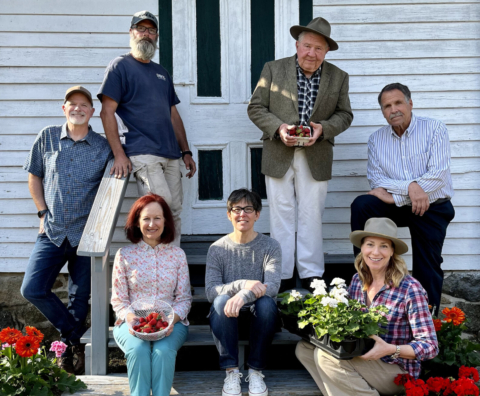
When the Woosamonsa school bell rings, the children will be ready … not for lessons in reading and arithmetic, but for a generous serving of strawberry shortcake.
We’re talking about the annual Woosamonsa Schoolhouse Strawberry Social, which takes place Sunday, June 4, 1 to 4 p.m. — rain or shine — at the schoolhouse on the corner of Woosamonsa and Poor Farm roads, Pennington.
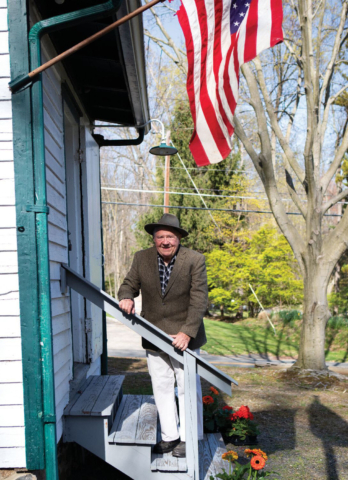
“The kids love it,” says Erwin Harbat, board chairman of the Woosamonsa Schoolhouse Association. Standing in the schoolyard by the flagpole where a large oak tree once stood, Harbat talks about the yearly celebration. Guests will be treated to strawberry shortcake, fiddle music, dancing puppets, a vintage car display, and an opportunity to learn about local history while mingling with friends.
Guests will also have the opportunity to tour the inside of the building, which houses several school artifacts and décor including a replica of the original clock, lamps, an American flag, and a portrait of President Abraham Lincoln, “our greatest president,” says Harbat. The event attracts families, history buffs, and new and old neighbors.
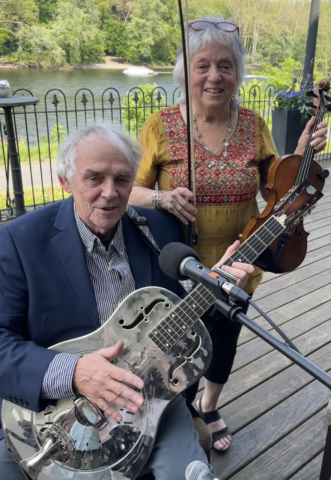
Music is a big attraction at the festival. The band, Fiddlesticks, which has performed at the social for the past 10 years, will perform regional and national music popular from the late 1800s to the early 1900s. New Hope resident, visual artist, and performer Nancy Shill will play the fiddle and will be joined by multi-instrumentalist Greg Meyers.
“I’m drawn to history, and I like being in old spaces,” says Shill, adding that she studies the origins of music to get a feeling for how people lived during their time period.
For Shill, having fun is an integral part of her performance at events like the strawberry social. For selected tunes, she invites an audience member to accompany the music. While she plays the fiddle, the guest performer taps the instrument strings with a stick, creating a rhythmic sound.
Shill also brings marionette-like puppets, which can dance to the music, with the help of a guest.
Shill says that around the time the school was active, there were lots of songs written for square dancing and songs that were cheerful and bouncy, like “Polly Wolly Doodle,” but the music also included songs with lyrics that speak of love, religion, and hard work.
Harbat, who is 87 years old, attests to the hard work that was part of everyday life for most people living in Hopewell during and after the school was in operation. He grew up on a family dairy farm, owned and worked by his parents, with the help of Harbat and his brother. The farm provided all the food they ate. “The only things they bought were sugar and coffee,” he said.
After graduating from high school, Harbat was accepted at Rutgers University, where he studied dairy farming and earned a master’s degree in agricultural biochemistry. Three months before Harbat would have earned his PhD, his father died, and he left school to help run the farm. Several years later, Harbat decided to give up dairy farming to pursue other interests. Today, the old farmland is now the home of Hopewell Valley Vineyards.
After leaving dairy farming, Harbat focused on business and community affairs. His curriculum vitae includes owning and running a grain merchandising business, consulting with the Hillier Group architectural firm, partnering with Harbat Farms Partnership, trusteeship with the Hopewell Valley Arts Council, and prominence in the real estate business.
Harbat joined the Woosamonsa Association at the invitation of his late friend Henry Burd, who served Hopewell as the town’s public works director for 30 years and was the former chairman of the association. Burd was able to share first-hand accounts of the school because his father was a student there when growing up.
The school was built between 1875 and 1876, but there is evidence that it replaced a school that had been built earlier. The school served 30 to 63 pupils a year. Students studied reading, writing, and arithmetic and graduated after the eighth grade. Older students helped teach the younger ones, and students who were advanced in a particular topic worked with those needing extra help in that area.
During the period the Woosamonsa school operated, there were 14 one-room schoolhouses in Hopewell Valley. “The idea was that every child should be within walking distance of a school,” said Harbat.
The Woosamonsa Schoolhouse provided education for 42 years until it closed as a formal school in 1918. A group of citizens who wanted to preserve the property formed the Woosamonsa Association with the mission to maintain the building and support its position as a significant part of Hopewell’s history. The school district transferred the property to the organization in 1922 for one dollar.
Since it closed, the school has served as a venue for various activities. Harbat smiles when he recalls Saturday night dances with live music. Other activities included Sunday school classes, yoga classes, art club meetings, a district polling place, several other community affairs — and, of course, the annual Strawberry Social, which begins with the ringing of the school bell.
The bell is a replica of the original but includes the clangor, cross piece, and saddle from the original. Harbat and Burd found the parts about 27 years ago when they were cleaning out the schoolhouse The word “Fredericktown” was inscribed on one of the parts, and later, after some detective work and good luck, they learned that a foundry in Fredericktown, Ohio, had made the bell. What’s more, the shop still existed.
Harbat and some neighbors traveled to the shop and had a new bell constructed with the original parts. They brought the bell back to Pennington, where it now crowns the schoolhouse.
While the school is rich with history, the building stands at the intersection of roads that have legends of their own. Accounts written about Woosamonsa and Poor Farm roads tell stories of Native American roots and a farm that supported poor and unemployed people from the 1800s through 1950.
According to the Hopewell Valley Friends of Open Space, the name Woosamonsa is derived from a word used by the Lenape Native Americans who inhabited the area. The earliest spelling of the Native American word, recorded in 1689, was “Wissomency” and is thought to mean “place of wrinkled trees.”
Historical accounts tell a story of a doctor who had befriended the Lenape people and included some of their healing methods in his practice. It has been suggested that the path which led to the doctor’s home had once been known as the Wissomency Road.
According to the Hopewell Valley Historical Society, the name “Poor Farm Road” harkens back to 1821. The public approved purchase of land where the poor could live, work in a garden, and sell produce and firewood. The farm became self-sustaining by 1838, remaining so through the end of the century. The use of the facility became less important in the early 1900s when various government programs began addressing the needs of the poor.
However, its use became prevalent again during the Great Depression in the 1930s. The society reports that up to 1950, “the farm hosted and fed as many as 100 drifters per year, who would stay for a day or two.” The farm was closed in 1951, but the name of the road where it stood still reflects its history.
“A lot has changed over the years,” says Harbat. Reflecting on the school and giving a nod to education before the internet, he says, “Lessons were taught using a chalkboard.” Not that Harbat is averse to change. If you ask him about the association, he is happy to direct you to the group’s updated website (see below). But when it comes to the school, he has no desire to make major changes. What matters to Harbat and the association is keeping the schoolhouse authentic to its historical roots.
Woosamonsa Schoolhouse Strawberry Social, corner of Woosamonsa and Poor Farm roads, Pennington. Sunday, June 4, 1 to 4 p.m., rain or shine. $10 per person; free for children 5 and under. Proceeds benefit the upkeep of the historic property. 314-324-8362 or www.woosamonsaschoolhouse.com.