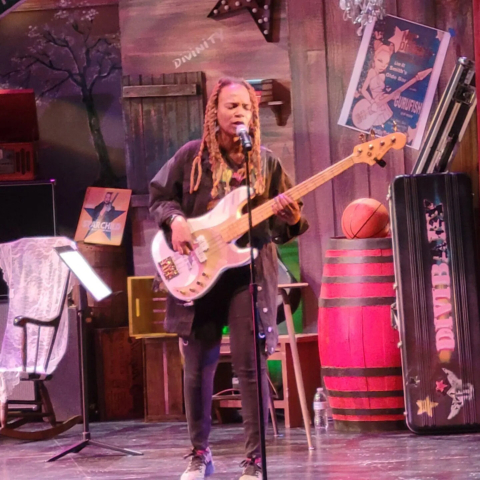
Reciting from scripts placed strategically on music stands with minimal movement or staging, Divinity Roxx tells an interesting, articulately written story, but she never quite manages to create a play or produce a work of theater.
“Starchild: The Ballad of Debbie Walker,” at New Brunswick’s Crossroads Theatre through Sunday, June 4, has some virtues. Roxx, as a performer and personality, is likeable. Her biography, since biography organized chronologically constitutes the substance of “Starchild,” covers a lot of territory. Her music reveals prodigious talent that is lyrically and rhythmically superior to most rapping or hip-hop.
With all of these aces, the one thing entirely missing is the slightest resemblance to a play. To give Roxx her due, she holds the audience with her story, but it comes across more as a lecture or, more precisely, a conversation, than a fleshed-out, fulfilling piece for the stage.
Since its opening in 2021, the New Brunswick Performing Arts Center, where Crossroads is housed, has provided a couple of life stories from which Roxx could learn how to combine biography and theater. George Street Playhouse just closed a charming, self-effacing piece by Steve Guttenberg. Crossroads offered a sterling example last year with Guy Davis’ “Sugarbelly and Other Tales My Father Told Me.”
These shows had depth and texture that is in Roxx’ writing but never registers as dramatic or compelling because “Starchild,” in general, is so static.
It isn’t a matter of energy or appeal. Roxx has plenty of both. It’s a case of, frankly, being lazy and not adequately highlighting the dramatic portions of the narration. Every sentence has equal emphasis, even those punctuated with jokes or tag line that might pay off if delivered in a more thoughtful, measured way.
Roxx is not helped much by director Daniel J. Watts, who lets her wander rather than giving her choreography and placement that would add some centering to her performance.
A case in point is the show’s opening. Roxx, speaking of her childhood as Debbie Walker, begins upstage and with her back to the audience. Already, from minute one, Watts has distanced his performer from her audience and made it more difficult for her to pull in an audience that is trying to hear what’s being said to a back wall instead of listening to someone framing her “once upon a time.”
The same thing happens when Roxx treats us to her entertaining music. Instead of placing her front and center, where the best give and take with the audience is possible, Watts has her at the back of the set, almost against that same wall Roxx addressed at lights up.
“Starchild: The Ballad of Debbie Walker” is a piece that has a chance of working if done with a serious attempt to act it rather than simply recite it.
Roxx wrote a lot, but she should have memorized her script rather than read from it. Especially because it comes across as read and not acted or felt.
Sadder yet, Roxx is a good writer. Her songs are worth hearing. Her script shows a way with words. Yet neither are enough to overcome the dry, level presentation.
“Starchild” is almost like an abandoned child. It looks as if it’s been thrown up on stage with no guidance or sense of building a script into the play. Even Chris Cumberbatch’s set lacks definition.
It’s busy. It contains some interesting elements, including posters from Roxx’ early performances and drawings of the first band of which she was a member.
The trouble is it doesn’t provide a sense of place. It is without stations at which Roxx can vary the audience’s view of her. In spite of projections by Lianne Arnold, no location in Roxx’ story seems concrete. You see a photo of the Decatur, Georgia, home in which she grew up. You see signs showing the address of that house and other locations, such as Atlanta and Berkeley, that are key to the Roxx’ story, but you never feel as if you’re there or that the environment being mentioned impinges more on Roxx’ life than as just more words.
The only time a setting works is when Roxx sits in a rocking chair, in for once a spotlight, and portrays her grandmother, a tough cookie who made a living collecting fees to pray for people.
Roxx sometimes uses voices to suggest the people in her life, but playing her grandmother is the only time her acting gives “Starchild” some variation from her narrator’s tone.
Should Roxx, Watts, or Crossroads think of moving “Starchild” to a different venue or on a road tour, they should look at that rocking chair sequence, notice its difference, and create more moments like it.
While I am severely critical of “Starchild” and believe it to be way underdone for prime time, I have to say I didn’t have a difficult time watching it, partially because I kept rooting for Roxx to put some of the moxie she obviously has, and shows in her music, into her overall performance.
Also, straightforward and without enough dramatic emphasis as it was, Roxx’ story is one of struggle, success, and, most important of all, acceptance of where she fit in the music industry. For years, she worked as a backup singer for Beyoncé and the Black Eyed Peas, touring the world as a member of their companies. Her own style, unique in its blend of rap and classic rock and its use of upbeat lyrics, never caught on, at least with producers and promoters. Yet Roxx persisted, continued to follow her dream, and rated her success as it suited her goals. This led recently to a Grammy nomination.
So, play or not, Roxx gives the audience something to listen to. If she really wants to take “Starchild” to its next level, she needs to apply the persistence that helped her establish a career in music and do the hard work, including the memorization involved with putting on a play and doing theater.
Musically, even when Watts places Roxx in deep centerfield, “Starchild” is excellent. Its best moments come when Roxx grabs one of her bass guitars, replicas of which now decorate Hard Rock Cafes, and shows her genuine creativity in the genre that, for now, suits her the most.
Even the music sequences rate one cavil. Roxx has two musicians, Wes Mingus and Granville Mullins, Jr., backing her in several numbers. Watts needs to bring these two on stage. They would fill the setting more and add to the breadth and depth of a production that sorely needs a boost in both.
“Starchild” is not a wash. But it’s also not a “watch.” It would be best if the Crossroads mounting were considered a sort of a test, a mostly failed one, that sent Roxx, and whomever she chooses to work with, back to making a real work of theater.
Starchild: The Ballad of Debbie Walker, Crossroads Theatre, New Brunswick Performing Arts Center, 11 Livingston Avenue, New Brunswick. Through Sunday, June 4, Thursday, 7 p.m.; Saturday and Sunday, 3 p.m. $45. 732-545-8100 or www.crossroadstheatrecompany.com.