It is like an airport control tower, this warm, glass-walled booth where one looks down at hundreds of people — including families — taking their seats and idly chattering before a journey. Except this journey is one of imagination and starts in the dark.
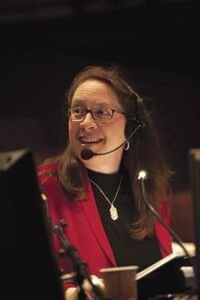
The “air traffic controller” enters the booth, sits at a table, and flicks on the desk lamp that illuminates her flight control book. The light glows on her face but little else as she slips on her headphones and mouthpiece set, and with a clear yet soothing voice speaks to the crew elsewhere in the theater. All communications on? Everyone set?
After a series of verbal technical checks in coded language — Q1, Q2, Q3, etc. — she takes a breath and utters a series of words that signal the crew to prepare for departure: “ready,” “places,” “dark,” and “music.”
As the house lights fade, so does the chatter. There is a pause — a suspension between darkness and silence, between daily cares and dreams. It is followed by music, soft rising light, and then an arrival in 1843 London.
The controller, McCarter Theater stage manager Cheryl Mintz, smiles at the sight and then focuses on her duty: to transport the 1,100 or so audience members, 40 actors, and 21 technicians through a dramatic experience — McCarter Theater’s annual “A Christmas Carol,” running from Friday, December 6, through Sunday, December 29.
While Mintz has charted this production for 19 years, it is only the performance or flight at hand that counts. “The McCarter production crew has had to listen to me call the show close to 500 times, and I have to go into the show with great energy and exuberance to get everyone through it again,” she says.
Some of the show’s flight skies are friendly, others are fraught with problems: “Tiny Tim’s crutch just broke,” reports a voice transmitted from backstage to the booth. Mintz follows — with a tone that is both warm with support yet expectant of results — by advising wardrobe of the problem, the location of the actor, and the amount of time to his next entrance. Yet there is no time to stop to worry, other cues for light, sounds, and entrances need to be given, and Mintz continues. A message sounds through her headphones and ends the worry, “crutch ready.” The flight continues.
Then there are times in the journey that need attention to more than just detail. One such moment comes when Scrooge — with the help of wires and backstage crew — flies over the stage. After the crew checks and double checks the preparations, including the lift harness that the actor slips on, and reports that all is ready, Mintz gives the flight cue. As the character ascends, the mood in the booth seems informed by a silent sustained musical note, one that wants to resolve to harmony and can only do so when the actor returns to his feet. When he does, Mintz’s whole body seems to exhale.
In both instances — and the numerous others encountered over two decades of running productions — Mintz concludes the exchange with perhaps the most appreciated words in theater, “thank you.” Far from being obsequious or patronizing, a stage manager’s use of the phrase is a practiced sign of respect for both craft and practitioners. It is also a bridge for the cooperation that helps Mintz perform one of the least understood yet most demanding jobs in theater, one that assures that the audience — as well as the theater’s artistic and technical staff — moves seamlessly from one world to another.
While actors are fairly defined (performing a written role on stage during rehearsals and performance dates), professional stage managers, according to the Actors’ Equity Association (the profession theater union), have duties that include coordinating a production during rehearsal and performance periods; maintaining the artistic intentions of the director after the opening of the show; scheduling understudy or brush-up rehearsals; maintaining order within the company; assembling and maintaining the prompt book (the accurate playing/stage business text), cue sheets, plots, and other necessary daily records; and maintaining records of attendance, illness, injury, changes in duties, and other work-related issues.
“It’s such a huge thing,” says Mintz when asked to define the position. “The production stage managers must understand the artistic mission of the theater that they’re working for and the artistic goals of the production’s director, and coordinate costumes, lights, and sound. They’re the organizational nucleus of the production and have to understand every department in the theater to get their job done.” She adds that her work is similar to creating “choreography in the cues,” and says, “If a show is poorly called, you know it.”
The word “call” is exact. Stage managers verbally signal the implementation of actions that produce the series of deliberate artistic choices that in turn form the surface and soul of a dramatic work. As noted in the Equity definition, they make such calls from a prompt book, a production’s equivalent of a legislative law publication or sacred text.
The prompt (a Latin word for “bringing forth”) book translates the lines of the play into an annotated document that “choreographs” the physical, visual, aural, and temporal choices specific to the production. To change metaphors, it is the score from which the stage manager conducts the piece. In it the scenes of dialogue and stage directions are marked by clear and consistent notations arranged with engineer-like precision. SQ is sound cue and LQ is light cue. LQ160 is the lighting configuration at a specific moment. The “calling” requires preparation, execution, and, in some cases, a follow up of an action (securing or removing a set piece or device).
While the score is created during the rehearsal weeks, the stage manager is both its generator and receiver. “The stage manager has to understand the actor’s process and create an atmosphere for the rehearsal hall so the director and actors can do their finest work, create a safe atmosphere,” says Mintz.
The stage manager (or SM) makes that happen by entering the process before the rehearsals begin, usually coming in a week prior to the cast’s first day reading. But in the case of a big production — such as McCarter’s largest show, “A Christmas Carol” — the SM begins several weeks ahead and prepares rehearsal space and dressing rooms, secures supplies, takes inventory, inspects equipment, coordinates with theater technical staff, creates contact sheets and preliminary rehearsal schedules, and develops a general understanding of everything from what time a train arrives to what pain relievers provide relief without hindering concentration. “On an easy week I am here 40 hours. Once we move into the theater hours go to 70. It is not unusual to have a 90-hour week,” she says.
Mintz says that her first stage management experience came in high school in Ocean Side, Long Island, where she was raised by a father who represented the upscale furniture maker Henkel Harris and a mother whom she calls the “Jewish Erma Bombeck” — she was a writer for the Jewish Post, local papers, and an administrator at the Ocean Side Jewish Center Hebrew School.
“As most students who are excited about theater in high school,” says Mintz, “I was an actor. But I was always the second or third lead. I was so worried that I wouldn’t get cast in ‘The Crucible,’ and the director said, ‘If you wanted to be stage manager I would have to decide before audition.’ And I chose it because I was afraid of not being cast. I loved being in the center of the collaboration and organizing the art.”
Mintz says she followed her interest by earning a bachelor’s degree from SUNY Stony Brook, received a three-semester scholarship to attend Loughborough University, England, and then, in 1986, attended the Yale School of Drama MFA program in stage management, a three-year interdisciplinary curriculum that includes academic and training courses as well as experience working with stage managers on both the academic and professional level.
It was at Yale that she says she learned how someone you work with at the age of 25 can “influence how your entire career is charted.” As part of her program of studies Mintz was assigned to work on a show with Broadway stage manager Susie Cordon. Mintz impressed and Cordon remembered. “When I graduated, one of my first jobs was being this woman’s production associate at Lincoln Center for an event called ‘Dancing for Life.’ It was the first major arts fundraiser of its kind to raise money for AIDS education and research.” The production’s artistic director was Jerome Robbins.
“That was when I was 25,” says Mintz, “Fast forward to when I was 29. First few years out of Yale, I was working Broadway shows. Then I was hired by New York City Opera, and I was there for five years. (Then) I got a call from Suzy Cordon from McCarter Theater, and she invited me to be a rehearsal stage manager for ‘Three Sisters.’ That was because the staff stage mangers were putting together ‘A Christmas Carol’ upstairs, which was huge. (Cordon) was in my (current) position for five years before I took it over.”
Mintz — who also stage managed high profile projects with Gian Carlo Menotti at the Spoleto Festival and South African playwright Athol Fugard on Broadway and at McCarter — says that she started her work at McCarter in 1991. Originally commuting from New York and then North Jersey, she moved to Princeton when she and her husband, New Jersey Manufacturers senior business analyst Harris Richter, had their son, Jake Richter, nine years ago. They now live on Franklin Avenue. “I always felt connected to the community and have my life here. There’s so much culture and diversity. I’m involved with the Jewish Center and have been a class mom at Littlebrook School every year that Jake has been there.”
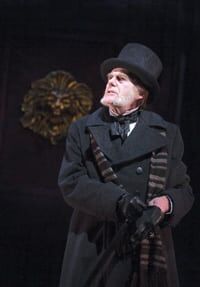
Of her time stage managing “A Christmas Carol,” Mintz says she is approaching a milestone, “I am going to hit my 500th performance with this year’s run. I guess I am the first.” However, others will also be celebrating too. That includes Broadway and McCarter veteran Graeme Malcolm, who on December 19 will give his 100th performance as Scrooge.
When asked about tricky situations that have occurred during the long-running holiday production, Mintz shares war stories. Some are amusing (being nine months pregnant and needing spotters to help her climb the ladder to the booth), some poignant (calling the show after receiving the news that her mother had died), and some serious: “Last year one of our leading actors had an emergency medical issues. I got a call asking what magical secret plan I had. We have no understudies. So I said call (director Michael Unger). He jumped in his car and came down, went to Princeton Medical Center to see the actor, and then went to a costume fitting. From 4:30 to 6 p.m. we put Michael into all his scenes, including a dance performance, and he was in for two performances, until we could rehearse a replacement. Michael was terrific.” Knocking on wood, she says, “I have never had to stop a show.”
Back in the booth, the actors and text have brought the audience and crew to that moment where Scrooge has seen the light and the show is ready to come in for a landing. Mintz follows the prompt and gives the final cue. The audience is again engulfed by silence and darkness, and then, as if part of a fairy tale, finds itself back home.
“Thank you, all,” Mintz says to the crew on her mouth piece as she looks out at the theater where audience members are returning from their journey and heading home for the holidays. And while nobody actually says the words, the hundreds of smiles silently say, “Thank you” to the voice that calls the shows.
A Christmas Carol, McCarter Theater, 90 University Place, Princeton, Thursdays and Fridays at 7:30 p.m., Saturdays at 2 and 7:30 p.m., and Sundays at 1 and 5:30 p.m. American Sign Language Interpreted and Audio Described Performance, Saturday, December 14, 2 p.m. Additional performances are Monday, December 23 at 7:30 p.m. and Tuesday, December 24 at noon and 4 p.m., with post holiday performances on Thursday, December 26, at 7:30 p.m., Friday, December 27, at 2 p.m. and 7:30 p.m., Saturday at 2 p.m. and 7:30 p.m., and Sunday, December 29, at 1 p.m. $20 to $80.50. For more information, call 609-258-2787 or visit www.mccarter.org.