Three recent small and limited run press offerings work together to accent the deep history and strong artistry in our region.
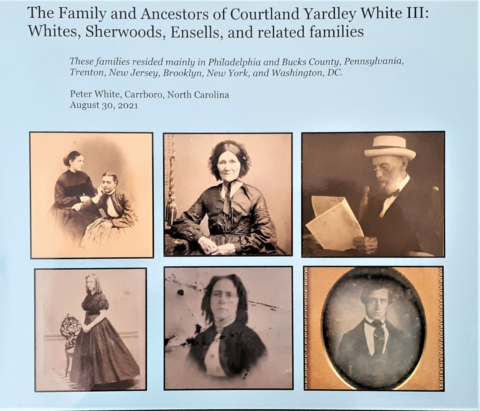
The first is “The Family and Ancestors of Courtland Yardley White III,” a history of a family connected with Trenton, New Jersey, and the topic of several well received articles that I wrote for U.S. 1 and its sister paper, the Trenton Downtowner.
The subject was the three Delaware River islands located within borders of the City of Trenton. One of those islands was originally called White’s Island and was property of the White family.
The above-mentioned book was written by Peter White, a descendent of the family that owned the island. Although he lives in North Carolina and works as a biology professor for the University of North Carolina at Chapel Hill, he was researching the island and attempting to connect with any of the family lineage that may still exist in the region.
While doing so, he came across my stories, contacted me, and we began sharing information that led to his publishing the book on his family, and three copious spiral bound volumes of documentation and support to accompany the book now available for viewing in the Trenton Free Public Library’s Trentoniana Collection.
To get a flavor of White’s research, the following brief excerpts from White’s book and support volumes provide a quick overview of the island and how my articles played a role in documenting the seemingly lost history of Trenton’s largest island:
White’s Island was known as Gould’s Island in the early to mid-1700s. By the mid- to late 1700s, Whites were living on the island and using it for farming and fishing. The fishing rights, especially for shad, seem to have been particularly valuable. By the late 1700s and early 1800s the island became known as White’s Island.
While Rotary Island is closer to Pennsylvania than New Jersey, a Supreme Court ruling of April 26, 1783, declared all the islands in the Delaware River to be part of New Jersey rather than Pennsylvania. White’s Island was part of Hunterdon County until that county was split into smaller counties. White’s Island became part of Mercer County as of 1837 or 1838.
Sometime in the late 1800s, after the Park Avenue Canoe Club purchased the island in 1889, it became known as “Park Island”, though the name “White’s Island” also persisted into the early 1900s, as shown in the chronology. It was officially renamed “Rotary Island” in 1929, a name it retains today. The Rotary Club ran a camp there for ill and disadvantaged children until the 1960s.The Rotary Club sold the island in 1966. It is now owned by the state of New Jersey and is part of Washington Crossing State Park as a conservation and recreation area.
I used four sources to find information about White’s Island: searches of newspapers.com for articles that refer to the island, searches of internet sites, essays written by Trenton writer Dan Aubrey, and collaboration with Frances Waite, a professional genealogist in Bucks County, PA, (now retired). Frances first documented her work on White family genealogy in a 1999 spiral bound book, “The White Families of Bucks County.” After getting a copy of her report, I hired her to look for additional records concerning the White Family and White’s Island. Frances conducted research looking for original records of wills, deeds, sales, administrative actions (e.g., fisheries bonds), and other primary sources.
Dan Aubrey, a writer with Community News in Trenton, got interested in the Delaware River islands that were jurisdictionally part of that city. I found two of his articles online and opened up a chain of emails with him. He then interviewed me and wrote a third article. (The articles contained) important research materials and accounts I have not seen elsewhere.
To read more about Peter White and Whites Island, see the online version of the January 8, 2020, story “A Winter’s Tale from the Trenton Islands,” on princetoninfo.com. White’s volumes are available to read at the Trenton Free Public Library, 120 Academy Street, Trenton. 609-392-7188 or www.trentonlib.org.
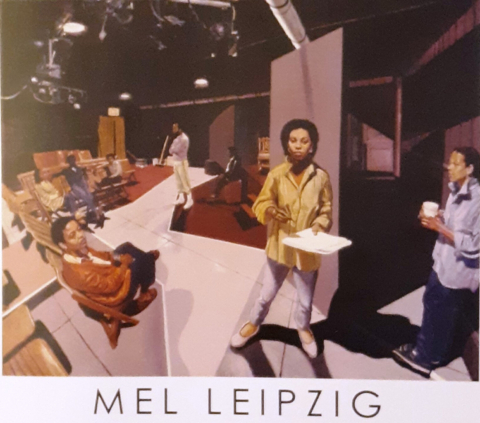
Next up, the catalog “Mel Leipzig ‘Painter of People,’” which complements the nationally known and regionally respected Trenton artist’s March 10 through April 2 exhibition at Gallery Henoch in New York City.
As New Jersey State Museum Executive Director and Curator of Fine Arts Margaret O’ Reilly observes in the catalog’s introduction:
The past two years have both reduced and expanded our ideas of community. Initially stuck at home, learning to navigate video meetings with family, friends, and colleagues, many reconsidered who was within their circle of contact, who made up their community.
Mel Leipzig (b. 1935) has been considering his community for over seven decades. His paintings are a memoir: portraits of himself, his family, friends, colleagues, and the life he has created in the Metropolitan region around his home in Trenton, NJ.
Leipzig set out to be a realist painter, with a particular passion for the figure. However, at the Cooper Union and Yale University in the 1950s, his commitment to realism and the figure was challenged by several professors including Morris Kantor, Nicholas Marsicano, and Josef Albers, who discouraged his vision, instead advocating for abstract expressionism and non-objective paining. After some struggle to come to terms with the advice he was receiving, Leipzig committed himself to the figure and realism.
Gifted with an innate ability for composition, he has always worked directly from life. Leipzig depicts the inhabitants of the broad and diverse community of which he is an integral part. Sitters from all walks of life — students, coaches, politicians, graffiti artists, retirees — are all treated alike, with dignity and respect for their humanity.
Leipzig has often stated that he is unable to paint someone he doesn’t like. This affection sometimes appears in tender portraits of personal moments. More often, hover, the figures seem at a remove from the viewer, as if the act of being painted has allowed for a moment of self-reflection. This remove may also be the manifestation of the painter’s immersion in the act of painting itself.
Early works include his family, documenting home life with his wife and children. As the children grew, their friends were often included in the paintings. Later, Leipzig painted his colleagues at Mercer County Community College. By 1995, Leipzig began to depict artists and arts professionals, clergy, architects, their companies, students at a local high school, and the families of his friends, all in their own homes or workplaces. Today, Leipzig works primarily from his home with elements from the models’ lives added to the compositions.
While the figure is Leipzig’s way into a painting, the grounding element around which the composition grows, his work also depicts the material culture of the past 70 years. The most quotidian elements of our modern lives — books, fabric, movie posters, the cabinets, furniture, clutter — are rendered in great detail, as Leipzig is interested in representing elements that provide clues into his subjects. And the environments themselves become characters in these narratives. Sometimes spaces are pushed or pulled, foreshortened or expanded to create the composition and mood the artist is seeking. At nearly age 87, he continues to push himself to reconsider the possibilities for space, by removing walls and bringing the outside in, abstracting environments into a near surreal state. His palette has also become brighter and bolder in the last decade, an outgrowth of a series of paintings of graffiti artist he produced in the 2010s. Taken with their brash use of color, Leipzig expanded the limited palette he had long employed, unlocking a new vibrancy in recent work.
Painted without irony but with deep reverence for each sitter, these works draw in the viewer because they see themselves reflected back. This memoir, this life’s work, is as true a vision of a time and place as any historian would seek to uncover. In painting people, Mel Leipzig reveals the richness that builds and sustains communities.
A full preview of the exhibition is available online.
Gallery Henoch, 555 West 25th Street, New York New York. 917-305-0003 or galleryhenoch.com.
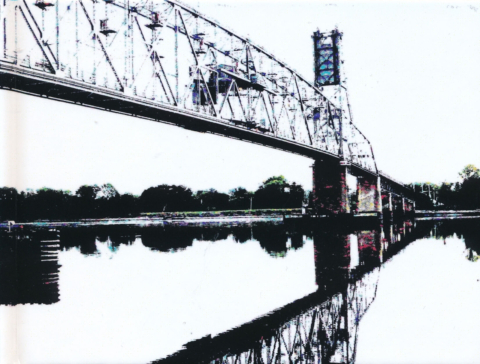
And finally, Trenton photographer C. a. Shofed recently created a book whose small run has generated interest from art collectors and fans.
A resident of Trenton’s Mill Hill District, Shofed — aka Craig Shofed — has gained a growing artistic reputation in and beyond Trenton. He is also known for his community arts engagements: hosting the Common Threads exhibitions, serving as the coordinator for the Trenton Downtown Association’s Broad Street Gallery, and as board member of Artworks Trenton.
While the Community News Service profiled Shofed in an October 31, 2017, article on a project he did with West Windsor artist Kathleen Hurley Liao, Hillsborough art collector Bruce Stowell wrote the following in the introduction of “The Art of C. a. Shofed, Volume I”:
I smile as I write these words about Craig’s images. I tend to consume images at a glance, then more closely. Be it on a wall, via a screen, or as a print in this book. My words are best when supported by a physical reaction. I feel it. In Craig’s images I sense an optimism. A portrayal of the world that is, even, if it is aging in place.
By Craig’s shaping of an image, he keeps our vision steady. I appreciate balanced forms. A dock on a bay, the Delaware River, the sunset surrounding a building’s final stand. Craig manages complexity with reflections on glass, on pebbles. Then adds color to the mix. He keeps everything in his images in balance. I’m not unsettled. Questions, maybe. Perplexed, maybe. But good.
The images are accessible. He brings everyday items into his pictures. Bees, boards, flowers, leaves, asphalt. And they are in sharp focus. We are familiar with his scenes, yet never saw them this way.
I ask myself, why do I keep coming back to Craig’s images? It’s because there is more detail to consume. Craig’s images are crisp, enhanced through metal or glass prints. Oh . . . then there is all the color, but I digress. You can place Craig’s prints on a wall and talk of them for a good while.
The Art of C. a. Shofed, Volume I,”26 pages, $45, signed. Visit the artist at amphorartworks.com.