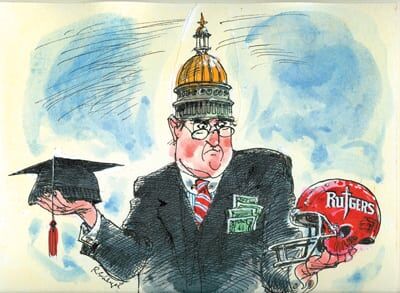
Editorial cartoonist Ralph Schlegel’s images may be loosely lined renderings of political figures against familiar state and government buildings, but — as the small exhibition that continues to August 30 at the Mercer County Library shows — they speak clearly about life over the past few decades in New Jersey and the United States.
More to the point, the images — a governor (in this case a very overweight one) breaks the scales of justice, a state house-crowned worker sweeps a bill under a carpet, politicians wrestle in mud, an empty cookie jar is labeled “pension pot,” and pork-barreling politicians herd a flock of hogs — scream of recurring political shenanigans and the constant need for a free press to keep an open eye.
“I am a product of my background and have a feeling of right and wrong as I see it. I approach things from that point of view, and I act on it,” says Schlegel, who over the past 30 years has teased, enlightened, or even enraged area readers by creating more than 1,500 editorial cartoons for the Times of Trenton. He retired two years ago.
While the majority of the 57 works on display in cases and on wall shelves at the library feature the likes of Chris Christie, Jim McGreevy, the two Tom Keans (as well as presidents Ronald Reagan and George Bush I and II), there are also illustrations for U.S. News and World Report (the cover), the New York Times, Business Week, Readers Digest, and more. It is a small sampling of a big output.
“I do pictures for advertising, editorial, and publishers,” says Schlegel of his work. “I was a freelancer and things worked out well. I am locally a political cartoonist; other places I’m an illustrator.”
Schlegel is fast to explain the difference between the two. “As an illustrator, you’re working with other people to put forth an idea by another person. If you are an editorial cartoonist, you’re on your own. If the client doesn’t like, they don’t buy it. I get an idea and submit it. They either take or they don’t,” he says.
The artist says that he gets his ideas mainly from the newspaper and quotes American humorist Will Rogers — who would follow his satirization of a politician with an innocent shrug and the quip, “All I know is what I read in the paper.” However, sometimes an idea would come up at a newspaper editorial meeting and Schlegel would be asked to visually explore it. “I would get a slug, something like ‘prejudice,’ and be asked to do something on first impressions and give it to (the editors) on Thursday. They would give me subjects, not ideas, and I winged it on my own.”
Schlegel says that there is a key to making an effective editorial. “You have to make a statement. And you have to be articulate. If (the artist) can’t get an idea across, it’s worthless. You have to have the graphic ability to make it work.”
As for subject matter, Schlegel says, “If you have a crooked politician, that’s far game.” So is “whatever you think the editor allows.”
While he says that there is no shortage of material for a political cartoonist and that “you can almost re-date something you wrote 30 years ago and rewrite it,” there are certain things that he looks for. “You have to have a caricature type of face and a good target, like Chris Christie or the late Frank Lautenberg. Either side of the political spectrum, they’re colorful people on and off the page.”
Calling himself a “left-leaning moderate,” Schlegel says, “I am not a hardcore ideologue in any way. I have an open mind.” No matter his thoughts, he has to work his own feelings out during the sketch period. “The ideas seem to come out of the pencil, believe it or not. It is almost stream of consciousness. If I don’t come up with a solution, I discard (the drawing). If I don’t believe what I am doing, I don’t do it.”
He says that there is another consideratio. “I can’t do anything if I’m too emotionally charged. I have to step back. What can I say? You have to keep perspective. It’s nice when you get a bit of humor into the (editorial), but sometimes you cannot be anything but serious.” An example is his civil rights images where the arm of an African-American reaches up along the arm of the State of Liberty.
About his drawing style, Schlegel says, “I like things to look sketchy. It may take a day or two, but I want it to look like I just sat down and did it.”
To help get that look, his approach is as direct as his idea. “I use pen and ink on water color paper. I dip the pen in the ink well and go. The pen varies depending on what I pick up. Sometime it has a different look, but I never was concerned about it as long as I stayed in my own style.”
He is, however, selective about his paper, one that enables him to keep that lively, fast sketched feeling. “I use an imported paper that has a very sympathetic surface. It’s not smooth. I like to use a paper that helps me out. It’s a water color paper that comes from France. It seems to work for me, but it’s rather expensive, 120 pound paper. Good size.”
Schlegel’s interest in illustration came from his father, who was a graphic artist for Paterson Parchment Paper. The company created decorative wrappers for major food companies. As indicated by the name, the company was in northern New Jersey, where Schlegel was born. When the company moved to Bristol, Pennsylvania, his family followed, and the young illustrator spent his formative years in Langhorne and Morrisville. He says that he and his sister and brothers all played around with art, and that when he was six years old he was appointed cartoonist for “The Schlegel Weekly,” a family newspaper put out by his parents and siblings. His early effort was an ongoing cartoon called “Ghoulie the Ghost.”
Though he says, “I’ve always thought in images” and gravitated towards drawing, he mixed pictures with language to convey a message. “(Thinking in images) has never hindered me in expressing myself,” he says.
After a two-year stint in the Army during the early 1950s and working a variety of jobs (including the U.S. Steel maintenance shop), the 22-year-old Schlegel decided that he needed a trade, took advantage of the GI bill, and attended the Philadelphia Museum School of Art (which became the Philadelphia College of Art and is now the University of the Arts). In those days the courses were more basic. “It was just drafting and painting and drawing and art education if you wanted it,” he says.
During that time he also came across an illustrator who helped set a standard that he tries to maintain: the early 20th-century German pen-and-ink satirist Henrich Kley. “He is as close to a patron saint as I have. He works directly. He’s a master, and I try to work like him. I don’t emulate him, but I like his style. (His illustrations) are really fresh.”
In the 1960s Schlegel landed a job as an artist in the Philadelphia Evening Bulletin’s promotion department. There he met Sharon Ribner, who after 47 years of marriage is known as Sharon Schlegel, the long-respected reporter and columnist for the Times of Trenton. They live in Yardley, not far from where the illustrator grew up, and have a grown daughter, Vickie.
It was in 1981 — when the Times of Trenton was the more plainly stated the Trenton Times — when Ralph Schlegel’s editorial career started with a cartoon dealing with the New Jersey State Police. “I don’t know what happened. All I know I was doing a couple a week and it sort of evolved.”
No matter how it developed, Schlegel added editorial cartoons to his freelance services and is happy that it happened. “I had a ball with it all. There may have been some down moments, but no one said there were editorial boundaries. I am happy with my career. I came along at the right time. I saw the best of it. I did the best I could. I was very proud. If I had to start today I guess I couldn’t because things are different. But I’m pleased with my career.”
He drew his last lines for a September 31, 2011, issue — the topic was the recall of Trenton Mayor Tony Mack — and then firmly put down his pen. “I am fully retired,” he says. “My eyes have shut me down, and I don’t see well anymore. I can’t see the kind of quality that I want to do. No way am I blind; I just don’t see well enough to draw.” Draw, that is, in a manner that is up to his standards.
While there will be no public program during the exhibition, which was developed through a conversation with Sharon Schlegel and Mercer County Library reference librarian Ann Kerr, the artist says that he intends to visit often and be on hand to talk to anyone who may be there.
He will also be wondering what to do with his collection of cartoons — pictures that say thousands upon thousands of words about a specific time and place.
Ralph Schlegel Cartoons and Illustrations, Mercer County Library, Lawrence Headquarters Branch Library, 2751 Brunswick Pike, Lawrenceville, through Friday, August 30. Free. 609-989-6920 or www. mcl.org.